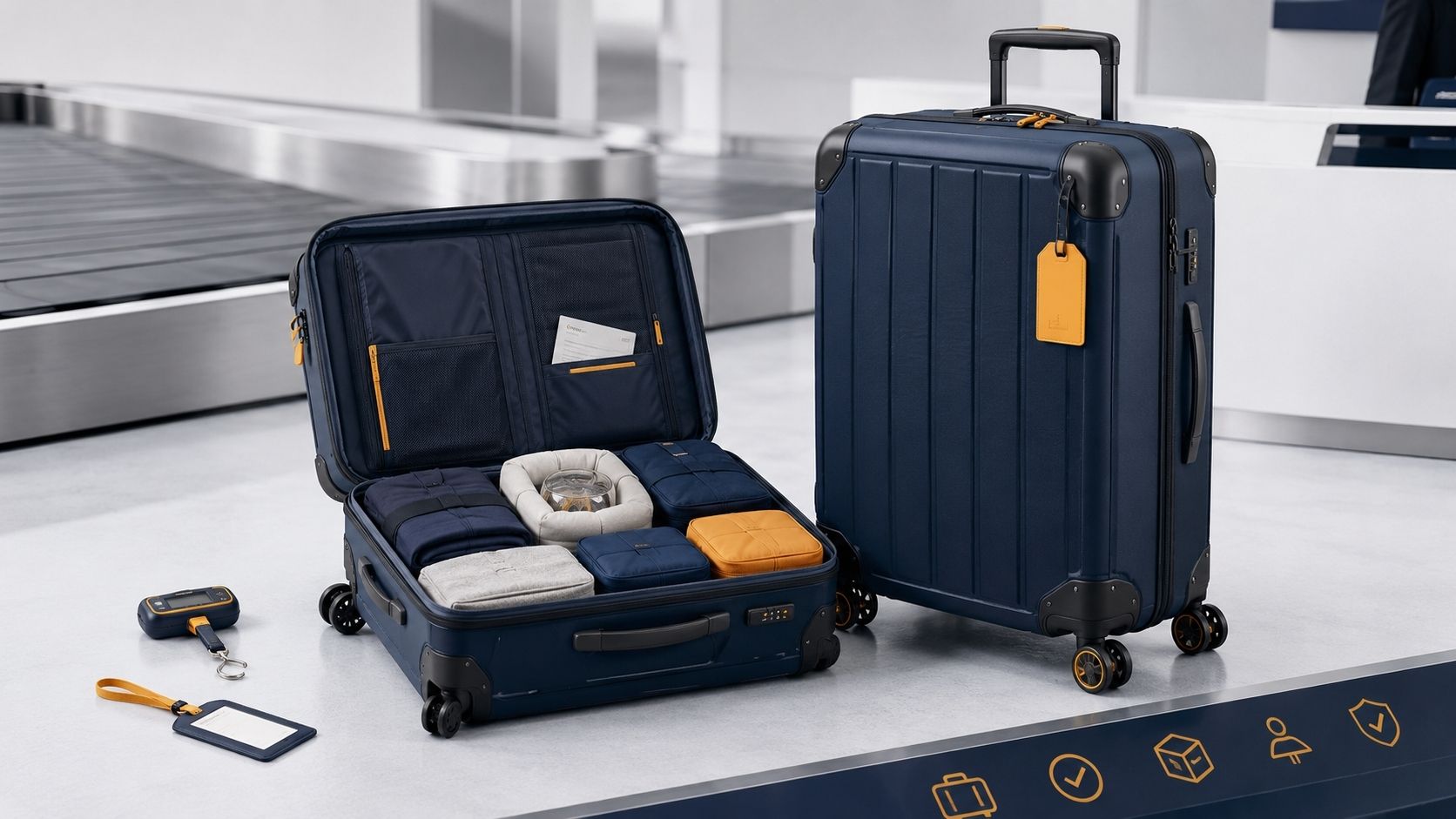
Which suitcases travel in the cargo hold?
Cargo suitcases travel in the cargo hold when they are checked before boarding and handled through the airline’s baggage system instead of staying in the passenger cabin. In this article, cargo suitcases means checked-baggage suitcases for aircraft cargo-hold placement, not freight cargo, shipping crates, or professional transport cases.
This article explains checked-baggage rule checks, cargo suitcase structures, packing stability, check-in mistakes, and the final readiness checklist before handing a suitcase to the airline.
Why do cargo suitcases matter for checked-baggage travel?
Cargo suitcases matter for checked-baggage travel because they face more handling, stacking, routing, and baggage-claim exposure than cabin suitcases. Travelers often pack them like cabin carry-ons, but checked bags move through conveyors, carts, loading equipment, aircraft holds, transfer systems, and baggage carousels.
Once checked, the suitcase is usually unavailable until baggage claim or transfer recovery. Checked luggage explains why cargo suitcases need more planning for weight, access, and handling exposure than cabin bags.
The safer solution is to plan for handling exposure, not only packing volume. Checked cargo-hold placement changes the priority from cabin access to stability, identification, and handling preparation.
How do airline checked-baggage rules affect cargo suitcases?
Airline checked-baggage rules affect cargo suitcases by setting the ticket allowance, full exterior size rule, packed weight limit, route conditions, special-item rules, and prohibited-item restrictions for checked travel.
Cargo suitcases are checked before boarding and travel in the aircraft cargo-hold system. Checked capacity allowances should be verified before assuming a larger cargo suitcase is included with the ticket.
Checked linear dimensions should be compared with the fully packed exterior, including wheels, handles, grips, bumpers, and expansion panels. Checked weight allowance matters because dense packing can make large cargo suitcases exceed the current airline rule.
| Rule Area | What to Check | Why It Matters |
|---|---|---|
| Checked allowance | Included bag, paid bag, or extra bag | Prevents ticket-rule surprises |
| Size rule | Full exterior measurement | Wheels and handles may count |
| Weight rule | Packed bag weight | Dense packing can exceed limits |
| Route/destination | International or domestic rules | Allowances may differ |
| Special items | Sports gear, instruments, tools | Separate rules may apply |
| Prohibited items | Batteries, liquids, valuables, restricted goods | Security and airline rules apply |
Which cargo suitcases structures handle cargo-hold exposure best?
Cargo suitcases structures handle cargo-hold exposure best when shell type, closure design, wheel protection, handle strength, corner reinforcement, and internal support match checked-bag handling risk.
Checked handling exposure makes wheels, handles, corners, zippers, latches, shell material, and packing stability important. Checked structural integrity depends on the shell, frame, wheel housings, handles, latches, zippers, corners, and internal load control.
When do hardside cargo suitcases help?
Hardside cargo suitcases help when travelers want a fixed shell that can resist light compression and maintain shape during checked handling. Rigid shells can still scratch, crack, dent, or transfer impact to poorly padded items.
When do softside cargo suitcases help?
Softside cargo suitcases help when travelers pack clothing-heavy loads or irregular soft items that benefit from slight fabric flexibility. Overfilled fabric panels can bulge, strain seams, and expose contents to more pressure.
When do trunk cargo suitcases help?
Trunk cargo suitcases help when travelers need deeper packing space for bulky gear, shoes, winter clothing, or structured packing cubes. Deep capacity can lead to overweight packing if the bag is not weighed.
When do latch-frame cargo suitcases help?
Latch-frame cargo suitcases help when travelers want to reduce zipper-track exposure and prefer a cleaner closure line. Latches and frames can still bend, jam, or fail under heavy impact and are not theft-proof.
When do reinforced wheels and handles matter?
Reinforced wheels and handles matter because wheels, handles, and corner zones often take heavy stress during checked handling. Heavier hardware may reduce available packing weight.
| Structure | Helps With | Watch Out For |
|---|---|---|
| Hardside shell | Fixed shape and compression resistance | Scratches, cracks, dents |
| Softside shell | Flexibility and clothing-heavy packing | Bulging and seam strain |
| Trunk format | Bulky gear and deep packing | Overweight risk |
| Latch frame | Reduced zipper-track exposure | Latch/frame damage |
| Reinforced corners | Impact-prone edges | Added weight |
| Protected wheels | Handling durability | Less internal space |
How should cargo suitcases be packed to improve stability and reduce internal damage risk?
Cargo suitcases should be packed to improve stability and reduce internal damage risk by keeping dense items low, filling empty spaces, centering fragile items, avoiding forced closures, and separating essentials.
Place dense items low and near the wheel base, then fill empty voids with soft items so contents do not shift heavily. Fragile items should sit in the center inside soft padding rather than near shell edges, wheels, or corners.
Forced zippers, stressed latches, and overfilled shell edges increase closure strain. Medication, travel documents, valuables, and permitted critical electronics should stay with the traveler according to airline and security rules.
| Packing Goal | Safer Packing Move | Benefit |
|---|---|---|
| Weight balance | Heavy items near wheel base | Less tipping |
| Interior support | Fill empty gaps | Less shifting |
| Fragile protection | Center and cushion items | Lower impact exposure |
| Closure safety | Avoid forced zipping | Less zipper strain |
| Leak control | Bag liquids separately | Cleaner containment |
| Delay preparation | Keep essentials separate | Better access |
What mistakes cause cargo suitcases to face check-in, delay, or damage risk?
Cargo suitcases face check-in, delay, or damage risk when they are overweight, mislabeled, poorly padded, overfilled, weakly identified, or tracked with unrealistic recovery expectations.
How do cargo suitcases create overweight risk?
Cargo suitcases create overweight risk when travelers fill large checked bags with dense items without weighing the packed suitcase. Weighing at home lowers the risk of last-minute repacking or overweight charges.
How do cargo suitcases create routing confusion?
Cargo suitcases create routing confusion when old barcode stickers, baggage tags, or routing labels stay on the suitcase. Removing old labels reduces the chance of confusion from outdated routing information.
How do cargo suitcases increase fragile-item risk?
Cargo suitcases increase fragile-item risk when fragile items sit near shell edges, wheel housings, or corner zones. Centering fragile items inside padded clothing layers improves internal protection.
How do cargo suitcases create zipper or latch strain?
Cargo suitcases create zipper or latch strain when they are overfilled until the closure must be forced shut. Reducing overflow creates less stress on zippers, seams, latches, and shell edges.
How do cargo suitcases create identification problems?
Cargo suitcases create identification problems when they have no external tag, internal contact card, or clear photo record. Current tags, an internal card, and photos make the suitcase easier to describe during a delay, claim, or recovery process.
How should trackers be used inside cargo suitcases?
Trackers should be used inside cargo suitcases only as visibility aids, not as guaranteed real-time recovery tools. Location clues may be useful, but recovery still depends on airline processes, device settings, battery rules, and network coverage.
| Problem | Likely Cause | Safer Fix |
|---|---|---|
| Overweight risk | Dense packing | Weigh packed bag |
| Routing confusion | Old barcode tags | Remove old labels |
| Fragile damage | Poor item placement | Center and pad items |
| Closure strain | Overpacking | Reduce load |
| Lost-bag difficulty | Weak identification | Add tags and photos |
| Tracker confusion | Overreliance on device | Treat as visibility aid |
Which final checklist helps cargo suitcases stay secure and ready for check-in?
A final checklist helps cargo suitcases stay secure and ready for check-in by verifying airline rules, packed size, packed weight, identification, essentials access, restricted items, stability, closures, locks, and tracker limits.
This checklist does not make cargo suitcases damage-proof, theft-proof, loss-proof, or recovery-proof. It helps reduce avoidable check-in, routing, closure, packing, and delayed-bag problems.
- Confirm your airline’s current checked-bag size, weight, and fee rules.
- Check whether your ticket includes checked baggage or requires a paid checked-bag allowance.
- Measure the fully packed suitcase, including wheels, handles, side grips, bumpers, and expansion panels.
- Weigh the packed suitcase before leaving for the airport.
- Remove old barcode stickers, baggage tags, and routing labels.
- Add current contact information to an exterior luggage tag.
- Place a second contact card inside the suitcase.
- Photograph the suitcase exterior and packed interior before check-in.
- Keep medication, essential documents, valuables, and permitted critical electronics with you.
- Follow airline and security rules for batteries, liquids, tools, and restricted items.
- Center fragile items and cushion them with soft clothing.
- Fill empty spaces so contents do not shift heavily.
- Avoid forcing zippers, latches, or shell edges closed.
- Secure loose straps so they do not catch during handling.
- Use a route-compatible luggage lock if allowed and appropriate.
- Use a compliant location tracker only as a visibility aid, not as a recovery guarantee.
What should you remember about cargo suitcases?
Cargo suitcases work best when checked-bag rules, cargo-hold placement, structure, packing stability, identification, and delayed-bag planning all match before check-in. They are checked-baggage suitcases, not freight cargo, and they need preparation for handling exposure.
Real readiness depends on current airline rules, packed dimensions, packed weight, structure, internal load control, tags, essentials access, lock rules, tracker limits, and careful check-in preparation.
Frequently Asked Questions About Cargo Suitcases
What are cargo suitcases?
Cargo suitcases are suitcases intended to be checked before boarding and transported in the aircraft cargo hold. In this article, the term does not mean commercial freight cargo, shipping crates, or professional transport cases.
Are cargo suitcases the same as checked luggage?
Cargo suitcases are a type of checked luggage when they are handed to the airline and placed in the cargo hold. Checked luggage can also include duffels, trunks, sports bags, or other airline-accepted checked items.
What type of cargo suitcase is best for checked travel?
The best cargo suitcase depends on the trip. Hardside suitcases help with fixed shape, softside suitcases help with flexible clothing loads, trunk suitcases help with bulky gear, and reinforced wheels or handles matter for checked handling exposure.
Do cargo suitcases prevent damage or theft?
No. Cargo suitcases can reduce some risks when packed and built well, but they do not prevent damage, theft, loss, or delay. Locks, trackers, structure, padding, and identification are risk-management tools, not guarantees.
Should I put a tracker inside cargo suitcases?
A tracker can be useful as a visibility aid if it follows airline and battery rules, but it does not guarantee recovery. Network coverage, device settings, airport handling, and airline processes still affect tracking usefulness.