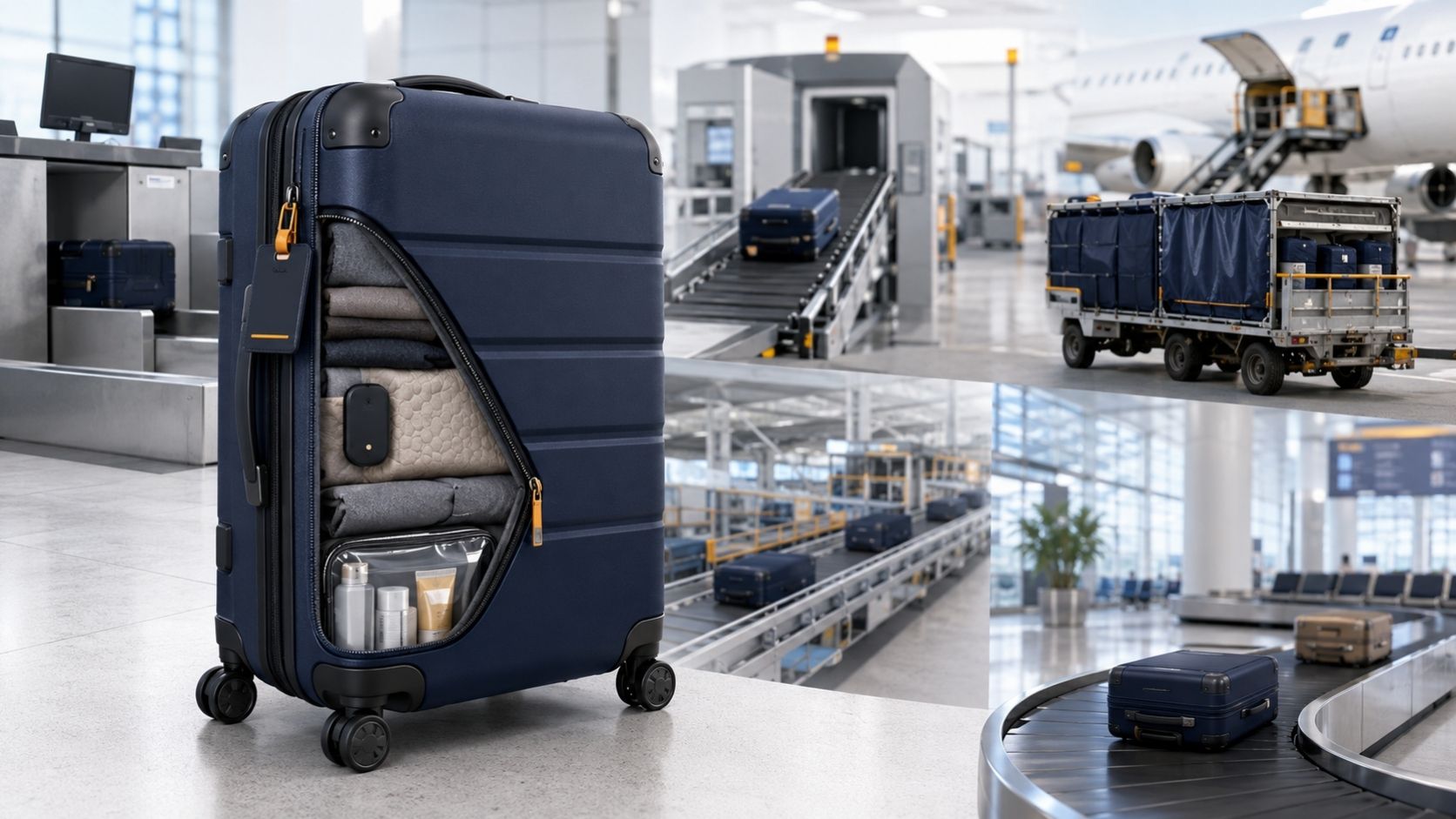
Where is checked luggage stored during transit?
Checked luggage storage during transit may include bag drop, conveyors, security screening, sorting areas, holding zones, transfer hubs, ramp staging, aircraft cargo compartments, unloading areas, and baggage claim.
This guide explains where checked luggage storage during transit can begin, how ground handling differs from aircraft cargo storage, which luggage features may help, how to pack for protection, which mistakes increase misrouting risk, and which final checklist to use before bag drop.
Why does checked luggage storage during transit matter for damage, delay, and loss risk?
Checked luggage storage during transit matters for damage, delay, and loss risk because checked bags may pass through several handling, movement, storage, and claim environments before returning to the traveler.
Travelers often imagine checked luggage going directly from bag drop to aircraft to carousel. In practice, the checked-bag journey usually includes conveyors, sortation areas, carts, aircraft loading, transfer zones, unloading, and baggage claim.
Checked luggage should be prepared for several handling and storage stages before it reaches baggage claim. Overpacking, weak closures, exposed wheels, loose straps, poor internal padding, and fragile contents can increase damage risk during those stages.
Tight connections, barcode problems, transfer issues, operational changes, or missed loading can increase delay or misrouting risk. Some bags may also face rain, heat, cold, or wet ground during staging or loading depending on airport setup and conditions.
The safer solution is to prepare checked luggage for movement, stacking, weather exposure, identification, and possible delay before the bag leaves your hands.
Where does checked luggage storage during transit usually begin after bag drop?
Checked luggage storage during transit usually begins after bag drop when the checked bag is tagged, weighed, accepted, and sent into the airline or airport baggage handling system.
The early journey can include the check-in counter, initial conveyor movement, scanning points, sorting areas, and early baggage storage. At a connecting airport, the same bag may enter transfer handling before it reaches another aircraft or staging area.
Checked handling exposure helps explain why checked bags need stronger closures, secure identification, and internal packing control. Old tags, loose straps, unclear identification, weak closures, and overfilled bags can make early handling less predictable.
| Transit Stage | What May Happen | Main Traveler-Controlled Risk |
|---|---|---|
| Bag drop | Bag is tagged and accepted | Wrong or old tags |
| Conveyor system | Bag moves through belts and scanners | Loose straps or weak handles |
| Sorting area | Bag is routed by tag and system | Barcode confusion |
| Holding area | Bag may wait before loading | Weather or handling exposure varies |
| Transfer hub | Bag may be rerouted between flights | Tight connection delay |
| Baggage claim | Bag reaches carousel or claim area | Identification confusion |
How does checked luggage storage during transit differ between ground handling and aircraft cargo areas?
Checked luggage storage during transit differs between ground handling and aircraft cargo areas because bags may move through conveyors, ramp staging, cargo compartments, transfer hubs, and baggage claim before the traveler sees them again.
Ground conveyors can involve belts, scanners, diverters, carts, and sorting equipment. The practical risk is snagging, tag confusion, weak handles, or delays when the bag cannot move cleanly through the system.
Checked cargo-hold placement depends on aircraft type, loading process, airline handling, and route conditions. Inside aircraft cargo areas, bags may be loaded in bulk or containers, stacked with other baggage, or shifted by movement during the trip.
Checked transit forces can come from movement, stacking, loading, unloading, and internal shifting. Transfer hubs and baggage claim add their own risks, including tight-connection delay, public pickup exposure, and bag confusion.
| Storage Environment | What It Involves | Risk to Prepare For |
|---|---|---|
| Conveyor system | Belts, scanners, diverters | Snagging or tag issues |
| Sorting area | Routing by barcode/tag | Misrouting or delay |
| Ramp staging | Carts, containers, waiting areas | Weather exposure |
| Aircraft cargo area | Bulk hold or containerized loading | Stacking and shifting |
| Transfer hub | Movement between flights | Tight-connection risk |
| Baggage claim | Carousel or claim pickup | Bag confusion or theft |
Which checked luggage features may help during checked luggage storage during transit?
Checked luggage features may help during checked luggage storage during transit when they support closure reliability, wheel protection, corner strength, light moisture resistance, and internal organization.
Checked structural integrity depends on shell condition, corners, wheels, handles, closures, and packing pressure. These features can reduce some weak points, but they cannot guarantee protection.
How can stronger shells help checked luggage storage during transit?
Stronger shells can help checked luggage storage during transit by resisting some light compression, scraping, and impact better than weak shells.
Stronger shells can still crack, dent, scratch, or transfer shock to contents, so fragile items still need internal padding and careful placement.
How can reinforced corners help checked luggage storage during transit?
Reinforced corners can help checked luggage storage during transit by supporting common impact points during movement, stacking, and handling.
Reinforced corners do not make a suitcase drop-proof. They are support features, not a guarantee against every impact.
How can recessed wheels help checked luggage storage during transit?
Recessed wheels can help checked luggage storage during transit by reducing wheel exposure compared with highly protruding wheel assemblies.
Recessed wheels can still break under impact or rough handling, especially when the bag is heavy or dragged across unsuitable surfaces.
How can secure closures help checked luggage storage during transit?
Secure closures can help checked luggage storage during transit by improving zipper, latch, pull, and lock-point reliability.
Closures do not prevent all forced entry, damage, or overpacking strain. They work best when the suitcase closes without force.
How can water-resistant materials help checked luggage storage during transit?
Water-resistant materials can help checked luggage storage during transit by reducing light moisture exposure risk when paired with internal pouches.
Water-resistant materials are not the same as waterproof protection. Leak-prone items still need internal containment, and weather exposure can vary by airport and process.
| Feature | Can Help With | Does Not Guarantee |
|---|---|---|
| Hardside shell | Light compression resistance | Damage-proof travel |
| Reinforced corners | Common impact points | Drop-proof protection |
| Recessed wheels | Less wheel exposure | Wheel-break prevention |
| Strong zipper/latch | Closure reliability | Forced-entry prevention |
| Water-resistant material | Light moisture resistance | Waterproof storage |
| Internal organizer | Less shifting | Fragile-item safety by itself |
How should travelers pack for checked luggage storage during transit?
Travelers should pack for checked luggage storage during transit by controlling leaks, centering fragile items, filling voids, balancing weight, avoiding zipper strain, and keeping valuables out of checked bags when possible.
Leak-prone toiletries should be sealed in internal pouches, and liquid containers should not be filled to the absolute top. Fragile items should be placed near the center of the bag with soft padding around them rather than against outer walls.
Checked weight allowance should be confirmed before travel because overweight packing can stress the bag and create check-in problems. Heavy items should stay low and balanced near the wheel base.
Checked linear dimensions should be verified before bag drop because full exterior size can affect airline acceptance. Empty spaces should be filled with soft items without overpacking, and valuables or essentials should stay out of checked luggage when possible.
| Packing Goal | Better Method | Main Risk Reduced |
|---|---|---|
| Leak control | Seal toiletries in pouches | Liquid damage |
| Fragile protection | Center items with soft padding | Impact damage |
| Shift control | Fill gaps with soft items | Internal movement |
| Closure protection | Avoid zipper strain | Burst seams or zipper failure |
| Weight balance | Keep heavy items low | Wheel and handle stress |
| Essential access | Keep critical items in cabin bag | Delay or loss of access |
What mistakes increase damage or misrouting risk during checked luggage storage during transit?
Mistakes increase damage or misrouting risk during checked luggage storage during transit when travelers leave old barcode tags, expose loose straps, overpack closures, use weak identification, or overtrust trackers.
How do old barcode tags affect checked luggage storage during transit?
Old barcode tags affect checked luggage storage during transit by creating possible confusion with outdated airline stickers, routing tags, or destination labels.
Removing outdated tags before checking the bag makes the current tag easier to identify and scan.
How do loose straps affect checked luggage storage during transit?
Loose straps affect checked luggage storage during transit when long straps, hooks, belts, or dangling tags catch on belts, carts, or handling equipment.
Tucking, removing, or securing loose parts lowers snagging risk.
How does overpacking affect checked luggage storage during transit?
Overpacking affects checked luggage storage during transit when zippers, seams, latches, or shell edges are forced under strain.
Removing items, redistributing weight, or using a larger checked bag when allowed lowers closure and shell stress.
How does poor identification affect checked luggage storage during transit?
Poor identification affects checked luggage storage during transit when travelers rely only on the airline tag or use no current contact card.
External and internal contact information gives better identification support if the bag is delayed or separated from tags.
How does overtrusting trackers affect checked luggage storage during transit?
Overtrusting trackers affects checked luggage storage during transit when travelers assume a tracker guarantees instant recovery.
Using an approved tracker as a visibility aid while keeping claim receipts, photos, and contact information creates better preparation without relying on one tool.
| Transit Failure Risk | Common Cause | Safer Prevention |
|---|---|---|
| Scanner confusion | Old barcode tags | Remove outdated labels |
| Conveyor snag | Loose straps or hooks | Secure dangling parts |
| Zipper burst | Overpacking | Reduce strain |
| Liquid leak | Poor bottle sealing | Use sealed pouches |
| Bag confusion | Similar-looking suitcase | Add visible ID |
| Delayed bag | Routing or transfer issue | Keep receipts and tracker if useful |
Which pre-flight checklist prepares checked luggage storage during transit?
A pre-flight checklist prepares checked luggage storage during transit by verifying current airline rules, removing old tags, controlling leaks, protecting fragile items, securing loose parts, balancing weight, and adding identification support.
Use this checklist before bag drop so the checked bag is prepared for conveyors, sorting, staging, loading, transfer handling, aircraft cargo areas, unloading, and baggage claim.
- Remove old airline barcode stickers, baggage tags, and routing labels.
- Confirm the airline’s current checked-bag size and weight rules for your route and fare type.
- Weigh the packed bag according to your airline’s rule.
- Avoid packing medication, documents, valuables, keys, passports, or irreplaceable electronics in checked luggage.
- Seal toiletries and leak-prone items inside internal pouches or bags.
- Avoid filling liquid containers to the absolute top.
- Place fragile items near the center of the bag with soft padding around them.
- Fill empty spaces with soft items without overpacking.
- Keep heavy items low and balanced near the wheel base.
- Close zippers and latches without forcing them.
- Tuck, remove, or secure loose straps, hooks, and dangling tags.
- Add current contact information to an external luggage tag.
- Place a backup contact card or itinerary inside the bag.
- Photograph the bag exterior and key packed contents if documentation would help later.
- Keep baggage receipts and claim information until the trip is complete.
- Use an approved luggage tracker if permitted and useful, but treat it as a visibility aid rather than a recovery guarantee.
What should you remember about checked luggage storage during transit?
Checked luggage storage during transit works best when travelers prepare the bag for movement, sorting, stacking, weather exposure, aircraft loading, transfer handling, and baggage-claim identification.
The checked-bag path can vary by airline, airport, aircraft, route, weather, connection time, and operational process. Preparation should reduce risk, not promise perfect protection.
Frequently Asked Questions About Checked Luggage Storage During Transit
Where is checked luggage stored during transit?
Checked luggage may be stored or moved through bag drop, conveyor systems, sorting areas, early baggage holding, transfer hubs, ramp staging, aircraft cargo compartments, unloading areas, and baggage claim. The exact process varies by airline, airport, aircraft, route, and operational conditions.
Is checked luggage stored only in the aircraft cargo hold?
No. Checked luggage is not stored only in the aircraft cargo hold. Before and after the flight, it may pass through check-in, conveyor belts, security screening, sorting systems, carts, transfer points, unloading zones, and baggage claim.
Can checked luggage be exposed to weather during transit?
Checked luggage may be exposed to weather during staging, cart movement, loading, unloading, gate handling, or transfer depending on the airport setup, timing, aircraft process, and local conditions. Water-resistant materials and internal pouches may help, but they do not make luggage waterproof.
How can I reduce damage risk during checked luggage storage during transit?
Reduce damage risk by avoiding overpacking, sealing liquids, centering fragile items with soft padding, keeping heavy items low, filling empty spaces, securing straps, checking closures, and avoiding already-damaged wheels, corners, or handles before travel.
Do luggage trackers guarantee recovery if checked luggage is delayed?
No. Luggage trackers do not guarantee recovery. AirTag, SmartTag, Tile, and similar devices can help with visibility depending on device type, network coverage, battery, and airline rules, but they are not guaranteed recovery systems.