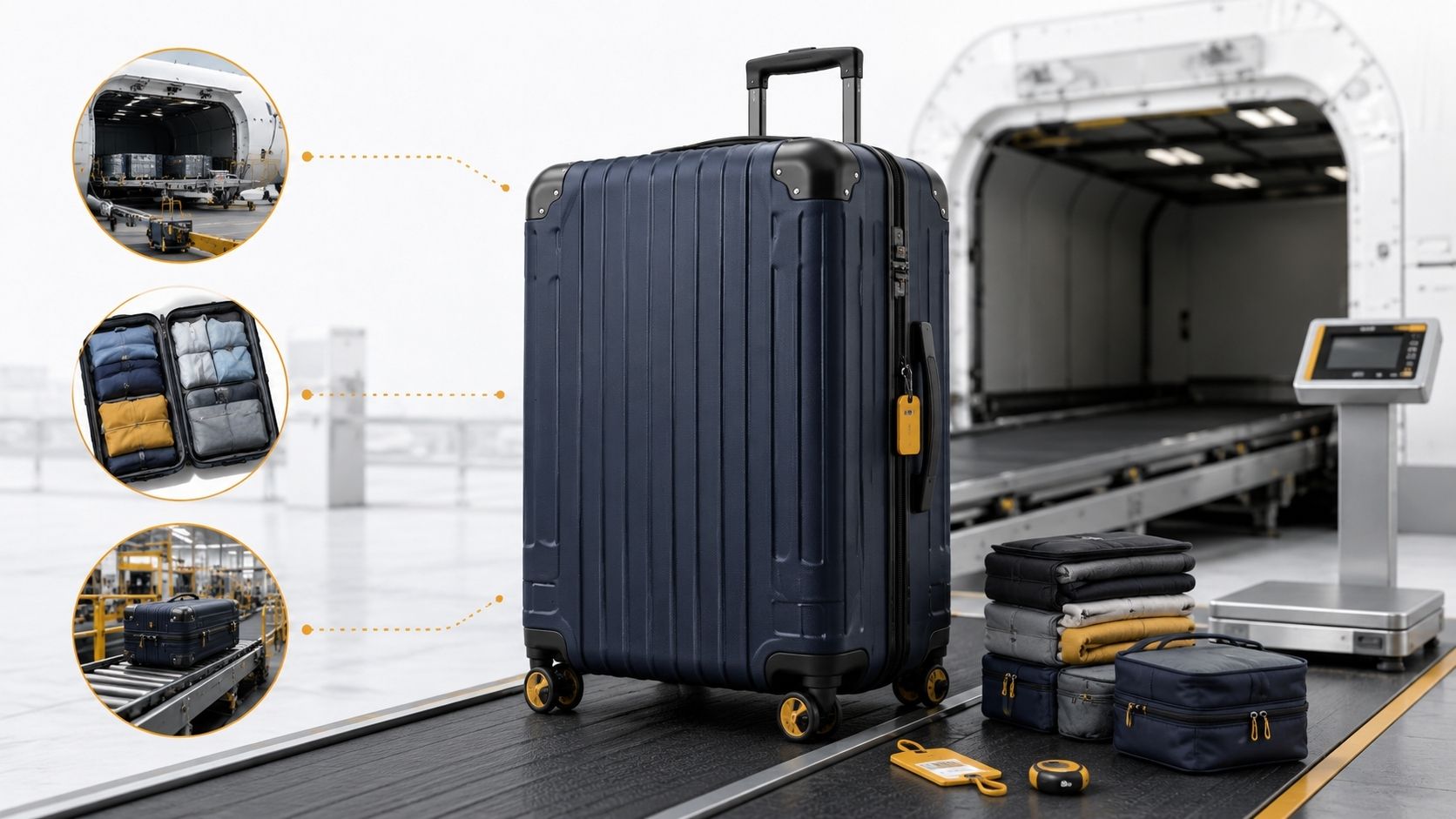
Where Does Checked Luggage Fit Through Cargo-Hold Placement, Large Capacity, and Handling Exposure?
Checked luggage fits into air travel as cargo-hold luggage that offers larger capacity than cabin bags but faces stricter size, weight, handling, packing, and identification risks. It is handed to the airline for cargo-hold transport, so the bag must be chosen and packed for airline rules and baggage-handling exposure.
This article explains checked luggage size and weight rules, shell formats, packing stability, fee and delay prevention, damage-risk reduction, identification steps, lock and tracker limits, and the final drop-off checklist to complete before handing the bag to the airline.
Why does checked luggage need stricter planning than cabin bags?
Checked luggage needs stricter planning than cabin bags because it leaves the passenger’s direct control and moves through airline handling systems before reaching baggage claim. cargo-hold placement explains why the bag enters conveyor belts, sorting systems, cargo loading, stacking pressure, and baggage-claim handling.
The main problem is that many travelers focus only on extra capacity. That extra space can create overweight fees, unstable packing, zipper strain, damaged contents, broken wheels, delayed bags, or lost-bag confusion when the bag is not prepared for checked-baggage movement.
The safer solution is to choose checked luggage by airline limits, shell format, component strength, packing stability, and identification tools before airport drop-off. A larger bag is only helpful when it stays within the rule and survives the route’s handling exposure.
How do checked luggage size and weight rules work before airport drop-off?
Checked luggage size and weight rules work through airline-specific limits for total exterior dimensions, packed weight, fare type, cabin, route, status, and heavy-bag thresholds. capacity allowances should be confirmed before packing because larger bag volume can quickly become overweight.
Many airlines commonly reference 62 linear inches or 158 cm for checked-bag size, but that is not universal. linear dimensions depend on the airline’s length-plus-width-plus-height rule, not the main box alone.
Many standard economy policies commonly reference 50 lb or 23 kg, but that is not universal either. checked weight allowance should be verified by fare, cabin, route, and airline before the bag is packed.
The practical check is to measure the full exterior dimensions, including wheels and handles, then weigh the fully packed bag at home with a small buffer below the airline limit.
| Check | What to Verify |
|---|---|
| Linear size | Airline’s total L + W + H rule |
| Weight limit | Standard checked-bag weight allowance |
| Fare/cabin | Whether your ticket changes the allowance |
| Wheels/handles | Whether full exterior size is included |
| Heavy-bag rule | Extra fee, limit, or rejection threshold |
Which checked luggage shell formats handle baggage exposure best?
Checked luggage shell formats handle baggage exposure best when the shell, wheels, zippers, corners, handles, seams, and frame match the trip’s handling risk and packing load. handling exposure makes component quality part of the durability decision, not just shell material.
When does hardside checked luggage work best?
Hardside checked luggage works best when structure, impact resistance, wipe-clean surfaces, and compression protection matter more than exterior pocket access. Polycarbonate may flex under some impacts better than many budget plastics, but it can still scuff, crack, dent, or fail at wheels, handles, corners, zippers, or frames.
When does softside checked luggage work best?
Softside checked luggage works best when flexibility, outer pockets, lighter handling, and expandable packing matter more than maximum crush protection. Abrasion resistance depends on fabric quality, stitching, reinforcement, and construction, so softside fabric should not be treated as failure-proof.
When does trunk-style checked luggage work best?
Trunk-style checked luggage works best when deep organization, large compartments, and long-trip packing matter more than compact handling or weight control. The main trade-off is that large capacity makes overpacking easier, which can create overweight fees or unstable internal load.
When does aluminum checked luggage work best?
Aluminum checked luggage works best when rigid structure, premium build, and latch-style closure matter more than low weight, low cost, or dent-free appearance. Aluminum can still dent, scratch, bend, or deform under heavy handling, so it should not be treated as damage-proof.
| Format | Best Strength | Main Trade-Off | Best For |
|---|---|---|---|
| Polycarbonate hardside | Flexible impact response | Scuffs and component failure risk | Frequent flights |
| Softside fabric | Flexibility and abrasion resistance | Less crush protection | Bulky clothing |
| Trunk-style | Deep organization | Easy to overpack | Long trips |
| Aluminum | Rigid premium structure | Heavy, dents, costly | Premium/security use |
How should checked luggage be packed to prevent shifting, crushing, and imbalance?
Checked luggage should be packed to prevent shifting, crushing, and imbalance by placing dense items low, filling empty spaces, padding fragile items, balancing clamshell halves, and keeping urgent valuables out of the bag when possible. transit forces make load stability and internal padding more important after the bag leaves your control.
Dense items should sit near the wheel base because lower weight placement helps the bag stand and roll steadily. Empty spaces should be filled with soft items without overstuffing, so contents do not shift during conveyors, sorting, loading, or stacking.
Fragile items should be padded and centered inside clothing rather than placed against the shell edge. Valuables, medication, documents, keys, and urgent electronics should stay out of checked luggage where possible because checked bags can be delayed or mishandled.
| Packing Check | Pass Signal |
|---|---|
| Heavy items | Near wheel base |
| Empty spaces | Filled with soft items |
| Fragile items | Padded and centered |
| Zipper pressure | Closes without force |
| Weight balance | Bag stands and rolls steadily |
Which checked luggage mistakes trigger fees, delays, or damage?
Checked luggage mistakes trigger fees, delays, or damage when travelers guess weight, leave old barcodes, ignore weak components, rely on poor identification, or treat trackers as guarantees.
Why does guessing checked luggage weight cause counter problems?
Guessing checked luggage weight causes counter problems because a bag that feels liftable at home can still exceed the airline’s checked-bag limit at the airport scale. The fix is to use a digital luggage scale and leave a small buffer instead of packing exactly to the limit.
Why can old barcode stickers delay checked luggage?
Old barcode stickers can delay checked luggage because previous routing labels may create confusion during handling, scanning, or manual inspection. The fix is to remove old barcode stickers and airline tags after every trip.
Why can weak components ruin otherwise strong checked luggage?
Weak components can ruin otherwise strong checked luggage because wheels, handles, zipper tracks, corners, seams, or frame parts may fail before the shell. structural integrity depends on wheels, handles, zippers, corners, seams, shell, and frame working together.
The fix is to inspect component quality, wheel housing, stitching, corner protection, and handle stability before using the bag for cargo-hold travel.
Why can poor identification make checked luggage harder to recover?
Poor identification can make checked luggage harder to recover because an outer paper airline tag can be damaged, removed, or separated from the bag. The fix is to add a secure external luggage tag and an internal contact card.
Why can trackers create false confidence in checked luggage recovery?
Trackers can create false confidence in checked luggage recovery because GPS or Bluetooth visibility does not replace airline baggage procedures. The fix is to use trackers as visibility tools alongside tags, photos, receipts, and claim documentation.
| Problem | Likely Cause | Better Fix |
|---|---|---|
| Overweight bag | No home weighing | Use luggage scale |
| Delayed routing | Old barcode labels | Remove old tags |
| Broken wheels | Weak wheel housing | Inspect components |
| Crushed items | Poor internal padding | Center and cushion |
| Hard-to-identify bag | Missing contact details | Add tags inside and outside |
Which checked luggage checklist should you complete before airport drop-off?
A checked luggage drop-off checklist should verify airline rules, packed size, packed weight, old tag removal, identification, valuables, lock use, tracker limits, component condition, and baggage receipt retention before the bag is handed to the airline.
The checklist does not guarantee acceptance, safe handling, or recovery. It helps reduce avoidable size, weight, identification, component, packing, and documentation mistakes before drop-off.
- Confirm your airline’s current checked luggage size rule.
- Confirm your airline’s checked luggage weight limit for your fare, route, and cabin.
- Measure full exterior dimensions, including wheels and handles.
- Weigh the fully packed bag with a luggage scale.
- Leave a small weight buffer instead of packing exactly to the limit.
- Remove all old barcode stickers and airline tags.
- Add a secure external luggage tag.
- Place a contact card inside the main compartment.
- Photograph the bag before drop-off for easier identification if delayed.
- Keep valuables, medication, documents, keys, and urgent electronics out of checked luggage.
- Use a TSA-recognized lock where applicable and allowed.
- Place a tracker inside the bag if you use one, but do not rely on it as a guarantee.
- Confirm zippers, handles, wheels, corners, and seams are not already damaged.
- Keep your baggage receipt until the bag is recovered at your destination.
What should you remember about checked luggage?
Checked luggage is useful for larger packing loads only when the bag is chosen, packed, weighed, labeled, and inspected for cargo-hold handling exposure before airport drop-off. Its main advantage is capacity, but its main trade-off is that the bag leaves your direct control.
Common references such as 62 linear inches, 158 cm, 50 lb, and 23 kg are not universal rules. The safest checked luggage choice is the bag that matches the airline’s current policy, stays under the packed weight limit, protects contents internally, shows strong components, includes clear identification, and treats locks and trackers as risk-reduction tools rather than guarantees.
Frequently Asked Questions About Checked Luggage
What is checked luggage?
Checked luggage is a bag handed to the airline for transport in the aircraft cargo hold. It usually carries more than cabin luggage, but it must follow the airline’s current size, weight, fare, route, and handling rules.
Is 62 linear inches the standard checked luggage size?
62 linear inches is commonly used by many airlines as a checked-bag size reference, but it is not universal. Travelers should verify the exact airline’s length-plus-width-plus-height rule before packing.
Is 50 lb or 23 kg the standard checked luggage weight limit?
50 lb or 23 kg is commonly used by many standard economy checked-bag policies, but it is not universal. Weight limits can change by airline, route, cabin, fare, status, and heavy-bag rules.
What type of checked luggage handles baggage exposure best?
The best checked luggage format depends on the trip. Polycarbonate hardside can offer flexible impact response, softside fabric can help with bulky packing, trunk-style luggage can support deep organization, and aluminum can offer rigid premium structure, but no format is damage-proof.
Should I use a tracker in checked luggage?
A tracker can help you monitor checked luggage location, but it does not guarantee recovery. Use it alongside external tags, an internal contact card, bag photos, baggage receipts, and the airline’s baggage procedures.