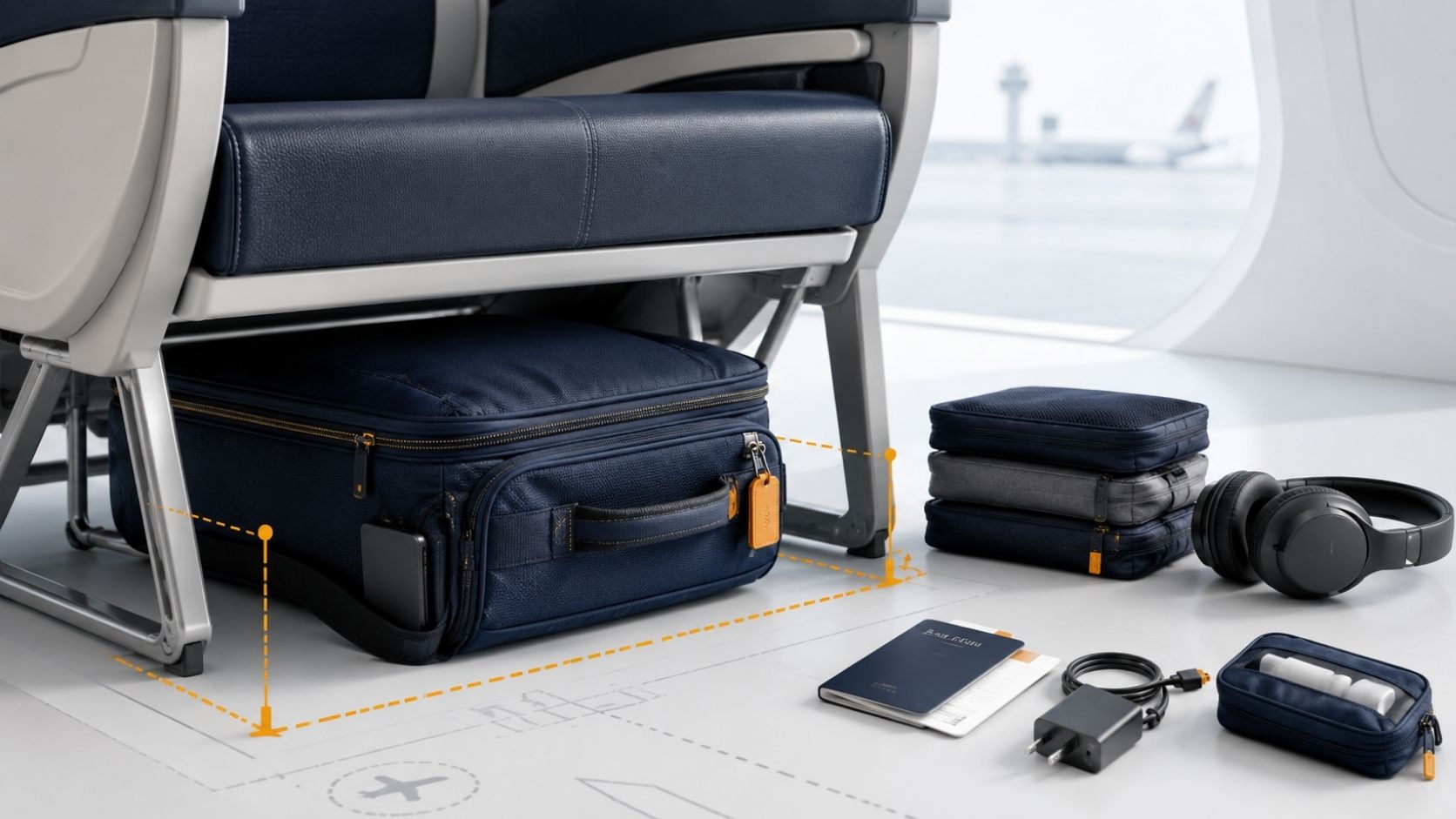
What Defines Underseat Luggage Through Seat-Level Placement, Personal-Item Limits & Compact Mobility?
Underseat luggage is defined by seat-level placement, personal-item limits, compact mobility, and the ability to keep essentials accessible without stealing unnecessary legroom. It is a compact cabin bag intended to fit beneath the seat in front of the traveler when the airline, fare type, aircraft layout, and fully packed exterior dimensions allow it.
This article explains how to verify underseat luggage dimensions, compare wheeled, backpack, tote, duffel, and hybrid styles, pack by compact access zones, match underseat luggage to trip scenarios, prevent common gate and legroom mistakes, and complete a final checklist before boarding.
Why does underseat luggage matter for budget air travel and cabin control?
Underseat luggage matters for budget air travel and cabin control because it can function as a personal-item bag while keeping important items reachable below the seat. seat placement explains why the bag must fit the space below the seat rather than only match a product label.
Underseat luggage should be separated from standard carry-on luggage before booking or packing. Many basic or low-cost fare types may include only a personal item, while larger overhead bags can require an added fee depending on the airline and fare.
Use underseat luggage for medication, passports, headphones, chargers, snacks, documents, and other essentials that should stay reachable during boarding and flight. A stiff or overpacked personal item can reduce foot space, so the better bag is the one that fits the actual seat space, not just the marketing label.
How do underseat luggage dimensions vary by airline, aircraft, and fare type?
Underseat luggage dimensions vary by airline, aircraft, fare type, seat location, and cabin layout, so the fully packed bag must be verified before travel. personal-item limits depend on the airline, fare type, aircraft, and current cabin policy.
The airline rule confirms the personal-item size, the fare rule confirms whether the underseat bag is included, and the aircraft rule explains why smaller seat space may apply. size constraints make wheels, handles, pockets, seams, and packed bulge part of the full exterior check.
The practical measurement rule is to check the fully packed bag, not the empty fabric shell. Leave a safety margin by choosing a bag slightly below the maximum limit when possible, especially if seat supports, entertainment boxes, or life vest storage reduce underseat space.
| Check | What to Verify |
|---|---|
| Airline | Current personal-item size rule |
| Fare type | Whether underseat luggage is included |
| Aircraft | Whether smaller seat space may apply |
| Full exterior | Wheels, handles, pockets, packed bulge |
| Safety margin | Slightly smaller than the maximum limit |
Which underseat luggage styles balance mobility, capacity, and legroom best?
Underseat luggage styles balance mobility, capacity, and legroom best when the bag’s hardware, softness, straps, pockets, and structure match the traveler’s route and seat-space limits. structured and flexible builds change how the bag packs, compresses, and preserves seat-level space.
When does wheeled underseat luggage work best?
Wheeled underseat luggage works best when the traveler wants to reduce shoulder or back load during airport movement. wheeled comfort limits appear when wheels and handles improve airport movement but reduce internal space or exterior compliance.
The trade-off is that wheels and handles can count toward exterior size and reduce packing room. A wheeled underseat bag should be measured as a full object, not as only the fabric compartment.
When does backpack underseat luggage work best?
Backpack underseat luggage works best when stairs, trains, tight aisles, and hands-free movement matter more than rolling comfort. It is useful for quick movement, but it can become uncomfortable if overloaded, poorly fitted, or packed with dense items far from the back panel.
When does tote or duffel underseat luggage work best?
Tote or duffel underseat luggage works best when flexible packing and soft-sided compression matter more than structure or rolling hardware. These bags can compress into tight spaces more easily, but they can become hard to carry if packed too heavily.
When does hybrid underseat luggage work best?
Hybrid underseat luggage works best when travelers need mixed features such as a trolley sleeve, laptop pocket, backpack straps, or soft structure. The trade-off is that extra features can add weight, bulk, cost, or shape stiffness that affects underseat fit.
| Style | Best Strength | Main Trade-Off | Best For |
|---|---|---|---|
| Wheeled underseat bag | Less body strain | Less internal space | Airports and heavier items |
| Backpack | Hands-free mobility | Shoulder load | Trains, stairs, quick movement |
| Tote/duffel | Flexible packing | Can get heavy | Soft clothing and short trips |
| Hybrid bag | Multi-use features | More bulk | Business and weekend travel |
How should underseat luggage be packed for compact space and quick access?
Underseat luggage should be packed by zones so soft items support the base, stable items sit in the middle, and high-priority essentials stay near the opening. volume allowance is limited, so packing zones and a small compression gap matter.
The base zone should hold soft clothing or packing cubes to support the bag shape. The middle zone should hold stable items such as a tech pouch or compact shoes, while the top zone should hold liquids, medication, snacks, or other items that may need quick access.
The front pocket should hold passport, charger, headphones, boarding documents, or valuables that should be reachable in flight. Side pockets should stay slim because bulky bottles or umbrellas can increase width and create sizer or underseat fit problems.
| Packing Zone | Best Items | Purpose |
|---|---|---|
| Bottom/base | Soft clothing, packing cubes | Shape support |
| Middle | Tech pouch, compact shoes | Stable storage |
| Top | Liquids, medication, snacks | Quick access |
| Front pocket | Passport, charger, headphones | In-flight access |
| Side pocket | Slim bottle or umbrella | Avoid width bulge |
Which underseat luggage fits different trip lengths and travel scenarios?
Underseat luggage fits different trip lengths and travel scenarios when the bag style matches the route, packing load, access needs, and airline personal-item rule. The best style is not universal; it depends on what must stay accessible and how the traveler moves between airport, aircraft, train, hotel, or city space.
What underseat luggage works best for a personal-item-only weekend trip?
Soft backpacks, totes, or duffels often work best for a personal-item-only weekend trip because they compress more easily into tight personal-item spaces. The watch-out is overpacking until the bag bulges beyond airline limits or becomes too rigid to slide under the seat.
What underseat luggage works best for business travel?
Structured backpacks, laptop totes, or compact wheeled underseat bags often work best for business travel because they separate laptops, documents, chargers, and clothing. The watch-out is that laptop padding, wheels, and structured panels can increase exterior size.
What underseat luggage works best for travelers carrying medical or accessibility items?
Wheeled underseat bags or organized backpacks can work well for travelers carrying medical or accessibility items when they match body comfort and airline rules. Airline policies for medical devices or assistive items should be confirmed separately from standard personal-item rules.
What underseat luggage works best for train, city, or multi-modal travel?
Backpacks or soft hybrid bags often work best for train, city, or multi-modal travel because stairs, narrow aisles, and uneven routes reward hands-free or flexible luggage. Travelers should not overload the bag just because it fits under the seat.
| Scenario | Best Underseat Luggage Style | Main Risk |
|---|---|---|
| Weekend budget trip | Soft tote, duffel, backpack | Overpacking |
| Business trip | Laptop backpack or wheeled bag | Bulky padding/wheels |
| Medical essentials | Organized wheeled bag or backpack | Policy confusion |
| Train/city travel | Backpack or hybrid bag | Shoulder overload |
| Family travel | Soft personal-item organizer | Hard-to-access essentials |
Which underseat luggage mistakes cause gate fees, poor fit, or lost legroom?
Underseat luggage mistakes cause gate fees, poor fit, or lost legroom when travelers trust product labels, expand the bag, ignore hardware, overfill pockets, or pack until the bag becomes rigid. rigid tradeoffs matter when a stiff or overpacked bag reduces foot space under the seat.
Why does treating underseat luggage like a small carry-on cause problems?
Treating underseat luggage like a small carry-on causes problems because the bag may still be too large for the airline’s personal-item rule, fare allowance, or actual seat space. The fix is to verify exact personal-item dimensions and measure the fully packed bag.
Why do expansion zippers make underseat luggage risky?
Expansion zippers make underseat luggage risky because they can make the bag too deep or too wide for the underseat area. The fix is to use internal compression first and keep the exterior profile within the airline rule.
Why can wheels and handles make underseat luggage fail sizing?
Wheels and handles can make underseat luggage fail sizing because the full exterior may exceed the allowed personal-item size even when the fabric compartment looks compact. The fix is to measure from the lowest wheel point to the highest handle point, then check full width and depth.
Why can overpacked underseat luggage reduce comfort?
Overpacked underseat luggage can reduce comfort because a rigid, rounded, or hard-to-slide bag can steal foot space, block access, or stick out into the cabin area. The fix is to leave a small compression gap and keep frequently used items near the opening.
| Mistake | Risk | Fix |
|---|---|---|
| Trusting product label | Wrong airline fit | Verify current rule |
| Using expansion zipper | Too deep/wide | Compress internally |
| Ignoring wheels/handles | Oversize exterior | Measure full bag |
| Bulging pockets | Sizer failure | Move items inside |
| Overpacking | Lost legroom | Leave compression space |
Which underseat luggage checklist should you complete before boarding?
An underseat luggage checklist should verify personal-item rules, fare allowance, full exterior size, compression space, access items, aircraft notes, and label claims before boarding.
A completed checklist does not guarantee airline acceptance, fee-free boarding, perfect fit, or full legroom. It helps reduce avoidable sizing, packing, access, and comfort mistakes before the bag reaches the aircraft.
- Confirm your airline’s current personal-item size rule.
- Confirm whether your fare includes only underseat luggage or also an overhead carry-on.
- Measure the fully packed bag, including wheels, handles, pockets, and bulge.
- Choose a bag slightly below the maximum limit when possible.
- Keep expansion zippers closed unless the expanded size still complies.
- Leave a small compression gap so the bag can slide under the seat.
- Keep medication, documents, chargers, headphones, and valuables accessible.
- Avoid packing bulky side-pocket items that increase width.
- Use soft packing zones to stabilize contents without making the bag rigid.
- Check aircraft or seat notes when available if underseat space is a concern.
- Keep high-value or urgent essentials in underseat luggage rather than overhead luggage.
- Treat “personal item” and “underseat bag” product labels as claims to verify, not guarantees.
What should you remember about underseat luggage?
Underseat luggage works best when the bag is smaller than the limit, packed without bulging, easy to access, and matched to the airline, fare, aircraft, and seat space. Its strength is close access and compact mobility, not unlimited capacity or guaranteed fit.
Product labels such as “personal item” or “underseat bag” should be treated as claims to verify. The safest choice is the underseat luggage that matches current personal-item rules, fully packed exterior size, route movement, access needs, and legroom preservation.
Frequently Asked Questions About Underseat Luggage
What is underseat luggage?
Underseat luggage is compact cabin luggage intended to fit beneath the seat in front of the traveler when the airline’s personal-item rule, fare type, aircraft layout, and packed exterior size allow it.
Is underseat luggage the same as a personal item?
Underseat luggage often functions as a personal item, but the exact rule depends on the airline and fare type. A product label does not guarantee that the bag qualifies as a personal item.
What size is underseat luggage?
Underseat luggage size varies by airline, aircraft, seat location, and fare type. Travelers should check the current personal-item rule and measure the fully packed bag, including wheels, handles, pockets, and bulge.
Is wheeled underseat luggage better than a backpack?
Wheeled underseat luggage is better when reducing body load in airports matters most, while backpack underseat luggage is better for stairs, trains, tight aisles, and hands-free movement. The better choice depends on route and packing weight.
Can underseat luggage reduce legroom?
Underseat luggage can reduce legroom if it is too rigid, too tall, overpacked, or difficult to slide fully under the seat. Leaving a small compression gap and choosing a slightly smaller bag can help preserve foot space.