How Does Suitcase Shell Format Change Suitcase Behavior?
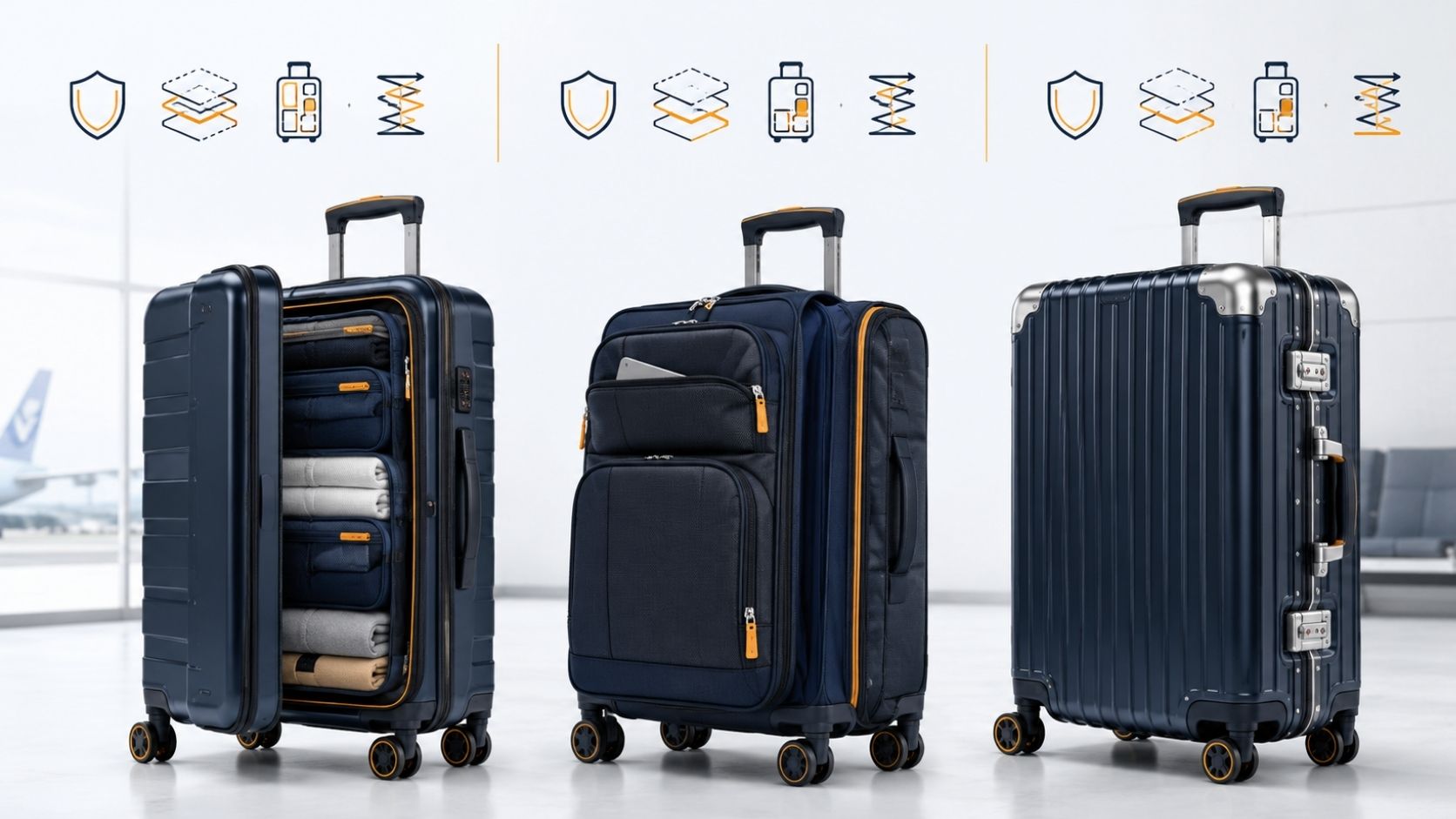
Suitcase shell format changes suitcase behavior by controlling how the bag holds shape, flexes under pressure, resists surface wear, supports packing, and responds to handling. It includes the exterior structure and material system, from hardside plastics and aluminum frames to softside fabrics and expandable panels.
This article explains material behavior, travel scenario fit, packing rules, shell damage warning signs, and a final inspection checklist before travel.
Why does suitcase shell format matter for durability, flexibility, and packing style?
Suitcase shell format matters for durability, flexibility, and packing style because the outer structure changes how luggage reacts to pressure, abrasion, moisture exposure, closure stress, and handling.
Travelers often compare suitcase size, wheels, or color first, but shell behavior shapes how a bag packs and wears. Hardside shells usually keep a fixed shape, while softside shells can flex, bulge, and provide exterior-pocket access.
Shell format affects scratches, dents, compression response, moisture exposure, zipper strain, and fabric abrasion. The practical takeaway is to choose suitcase shell format by travel environment, packing habit, and handling exposure rather than by one “best” material claim.
How does suitcase shell format change how luggage reacts to travel pressure?
Suitcase shell format changes how luggage reacts to travel pressure by altering flexibility, compression response, surface wear, cracking risk, fabric abrasion, and closure stress.
Hardside luggage explains why fixed shell structure changes packing behavior, surface wear, and closure stress. Hardside shell materials should be compared by material grade, structure, weight, and design rather than name alone.
Polycarbonate hardside may flex more than some rigid plastics but can still scratch or crack under extreme force. ABS hardside is often used for lower-cost shells, while polypropylene can offer lightweight flexibility with a different feel.
Aluminum shell formats add rigid structure and visible frame strength, but they can dent, scratch, and add weight. Softside luggage behaves differently because fabric can flex, bulge, and provide exterior-pocket access, while softside fabrics should be judged by weave, seam strength, coating, reinforcement, and construction quality.
| Suitcase Shell Format | Main Strength | Main Trade-Off |
|---|---|---|
| Polycarbonate hardside | Flexible rigid shell | Can scratch or crack under extreme force |
| ABS hardside | Lower cost | Less impact tolerance than stronger plastics |
| Polypropylene hardside | Lightweight flexibility | May feel less premium |
| Aluminum shell | Strong rigid frame | Dents, scratches, and heavier weight |
| Nylon softside | Abrasion resistance and flexibility | Can bulge if overpacked |
| Polyester softside | Lightweight and affordable | May wear faster |
| Behavior Factor | Hardside Shell | Softside Shell |
|---|---|---|
| Shape control | Fixed exterior shape | Flexible fabric body |
| Exterior access | Usually limited | Often has pockets |
| Packing behavior | Balanced clamshell packing | Bulge and pocket control |
| Compression response | May resist light pressure | Can flex or deform |
| Closure stress | Zippers, latches, hinges | Zippers, seams, pockets |
| Main risk | Scratches, cracks, dents | Abrasion, tears, bulging |
Which suitcase shell format fits different travel environments best?
Suitcase shell format fits different travel environments best when material behavior, weight, handling exposure, access needs, moisture conditions, and packing habits match the trip.
Which suitcase shell format works best for checked travel?
Suitcase shell format works best for checked travel when the shell, corners, wheels, handles, closure system, and internal packing can handle more baggage-system exposure. Polycarbonate, polypropylene, aluminum, or reinforced softside formats may help, but hardside content protection improves only when the internal load is padded, balanced, and not forced against shell edges.
Which suitcase shell format works best for cabin travel?
Suitcase shell format works best for cabin travel when the bag stays light enough to lift, compact enough to measure, and structured enough for the traveler’s packing style. Lightweight hardside and softside cabin formats can both work, but hardside bags may offer less outer access, while softside pockets can bulge.
Which suitcase shell format works best for business travel?
Suitcase shell format works best for business travel when access needs, document storage, laptop movement, formalwear, and packed profile are balanced. Softside nylon can improve exterior access, while structured hardside can support a cleaner fixed profile.
Which suitcase shell format works best for rough handling?
Suitcase shell format works best for rough handling when higher-quality hardside shells, reinforced softside construction, or aluminum frames support corners, handles, and wheel areas. Hardside impact resistance depends on shell material, thickness, corner structure, packing density, and handling conditions, while weight, dents, scratches, and repair cost may still increase.
Which suitcase shell format works best for wet or humid travel?
Suitcase shell format works best for wet or humid travel when the product has better water resistance, protected zippers, sealed seams, or coated fabric suited to moisture exposure. No normal suitcase should be treated as fully waterproof unless the manufacturer specifically rates it that way.
| Travel Scenario | Better Shell Format | What to Check |
|---|---|---|
| Checked flight travel | Polycarbonate, polypropylene, aluminum, reinforced softside | Corners, wheels, handles |
| Cabin travel | Lightweight hardside or softside | Packed size and weight |
| Business travel | Softside nylon or structured hardside | Access pockets and profile |
| Wet climate | Water-resistant shell or coated fabric | Zippers, seams, care label |
| Budget travel | ABS, polyester, polypropylene | Durability trade-offs |
| Premium durability focus | Polycarbonate or aluminum | Weight, dents, scratches |
How should suitcase shell format guide packing strategy?
Suitcase shell format should guide packing strategy because hardside, softside, aluminum, lightweight plastic, fabric, and expandable shells each fail differently when overloaded.
Hardside clamshell packing should be balanced across both halves to reduce closure strain. Softside shell format needs flat pockets and controlled bulge, while aluminum shell format should never be forced shut if latches or frames resist alignment.
Lightweight plastic shells benefit from filled voids so contents shift less, while fabric shells need rigid items padded away from panels. Softside content protection limits appear when fabric panels, seams, pockets, or soft bulging face too much pressure.
| Shell Format | Packing Rule | Main Benefit |
|---|---|---|
| Hardside clamshell | Balance both halves | Less closure strain |
| Softside fabric | Keep pockets flat | Less bulging |
| Aluminum frame | Do not force latches | Better frame alignment |
| Lightweight plastic | Fill empty voids | Less shifting |
| Fabric shell | Pad rigid items | Less puncture risk |
| Expandable shell | Recheck packed size | Better travel fit |
What mistakes damage suitcase shell format faster during travel?
Suitcase shell format is damaged faster when travelers overpack, distribute weight poorly, clean with harsh methods, ignore cracks, or travel with frayed fabric before repair.
How does overpacking damage suitcase shell format?
Overpacking damages suitcase shell format when the shell, zipper, latch, frame, fabric, or seams are forced closed under pressure. Removing bulky items or redistributing the load creates less stress on zippers, seams, latches, shell edges, and frames.
How does poor weight distribution damage suitcase shell format?
Poor weight distribution damages suitcase shell format when dense items sit unevenly near one side, corner, wheel mount, or handle area. Keeping dense items low and balanced near the wheel base reduces uneven stress.
How does incorrect cleaning damage suitcase shell format?
Incorrect cleaning damages suitcase shell format when harsh solvents, abrasive scrubbing, or heat are used before checking manufacturer care guidance. Starting with mild, manufacturer-approved cleaning reduces finish damage, discoloration, coating wear, and fabric weakening.
How should cracked suitcase shell format be handled?
Cracked suitcase shell format should be handled by checking warranty coverage, manufacturer repair guidance, replacement parts, or professional luggage repair before the next trip. Major cracks, wheel-mount damage, latch failure, or frame bending should not be treated as simple cosmetic problems.
How should torn fabric suitcase shell format be handled?
Torn fabric suitcase shell format should be handled with manufacturer-approved repair options or professional repair when seams, base corners, or structural panels are affected. Repairing structural tears before travel reduces the chance of the damage expanding during handling.
| Warning Sign | Possible Issue | Safer Response |
|---|---|---|
| Hairline shell crack | Impact or flex stress | Check warranty or repair guidance |
| Loose wheel mount | Hardware or shell stress | Avoid travel until inspected |
| Bent frame or latch | Alignment damage | Use professional repair |
| Frayed fabric seam | Wear or overpacking | Repair before travel |
| Sticky zipper | Dirt or strain | Clean gently; avoid forcing |
| Deep dent | Impact damage | Inspect structure before reuse |
Which pre-trip checklist keeps suitcase shell format ready for travel?
A pre-trip checklist keeps suitcase shell format ready for travel by verifying shell condition, corners, wheel mounts, handles, closures, seams, packing pressure, cleaning safety, and repair needs.
This checklist does not make any suitcase damage-proof, crush-proof, waterproof, or guaranteed to protect contents. It helps catch visible shell, closure, wheel, seam, and packing-pressure issues before travel.
- Check the shell for cracks, dents, deep scratches, soft spots, or fabric tears.
- Inspect corners, wheel mounts, side grips, and top handles.
- Test the zipper, latch, frame, or closure system without forcing it.
- Check that the telescoping handle moves smoothly and locks correctly.
- Inspect softside seams, base corners, and exterior pockets for fraying or bulging.
- Confirm hardside halves close evenly without pressure.
- Keep sharp or rigid items padded away from fabric panels.
- Keep dense items low and balanced near the wheel base.
- Fill large empty spaces with soft clothing or packing cubes.
- Clean the shell using manufacturer-safe care steps.
- Avoid harsh solvents, open flames, excessive heat, or aggressive scraping.
- Check warranty or repair guidance before attempting major repairs.
- Recheck the packed bag after adding last-minute items.
- Do not travel with major cracks, broken wheels, failing latches, or severe fabric tears unless repaired.
What should you remember about suitcase shell format?
Suitcase shell format works best when material behavior, packing strategy, travel environment, maintenance, and damage response all match the trip. Hardside, softside, aluminum, plastic, nylon, and polyester formats each trade structure, flexibility, access, weight, wear, and repair limits.
Real performance depends on material grade, product design, frame structure, wheel mounts, zippers, latches, packing density, and handling conditions. No suitcase shell format should be treated as universally best or guaranteed protection.
Frequently Asked Questions About Suitcase Shell Format
What is suitcase shell format?
Suitcase shell format is the exterior structure and material system of a suitcase. It includes hardside plastic shells, aluminum frames, softside fabrics, coated textiles, and expandable fabric formats.
Is hardside or softside suitcase shell format better?
Neither suitcase shell format is universally better. Hardside shells offer fixed shape and structure, while softside shells offer flexibility and exterior-pocket access. The better choice depends on packing style, travel placement, surface conditions, and handling exposure.
Which suitcase shell format is best for checked luggage?
Polycarbonate, polypropylene, aluminum, or reinforced softside formats may work well for checked luggage, but no shell format guarantees protection. Checked bags still need balanced packing, padded contents, strong wheels, secure closures, and weight control.
Which suitcase shell format is best for cabin travel?
Lightweight hardside and softside shell formats can both work for cabin travel. The best choice depends on packed size, weight, liftability, pocket bulge, and the traveler’s need for quick exterior access.
Can suitcase shell format be repaired?
Some suitcase shell format problems can be repaired, but the safe route depends on the damage. Major cracks, bent frames, broken wheel mounts, latch failure, and structural fabric tears should be checked through manufacturer guidance, warranty support, replacement parts, or professional repair.