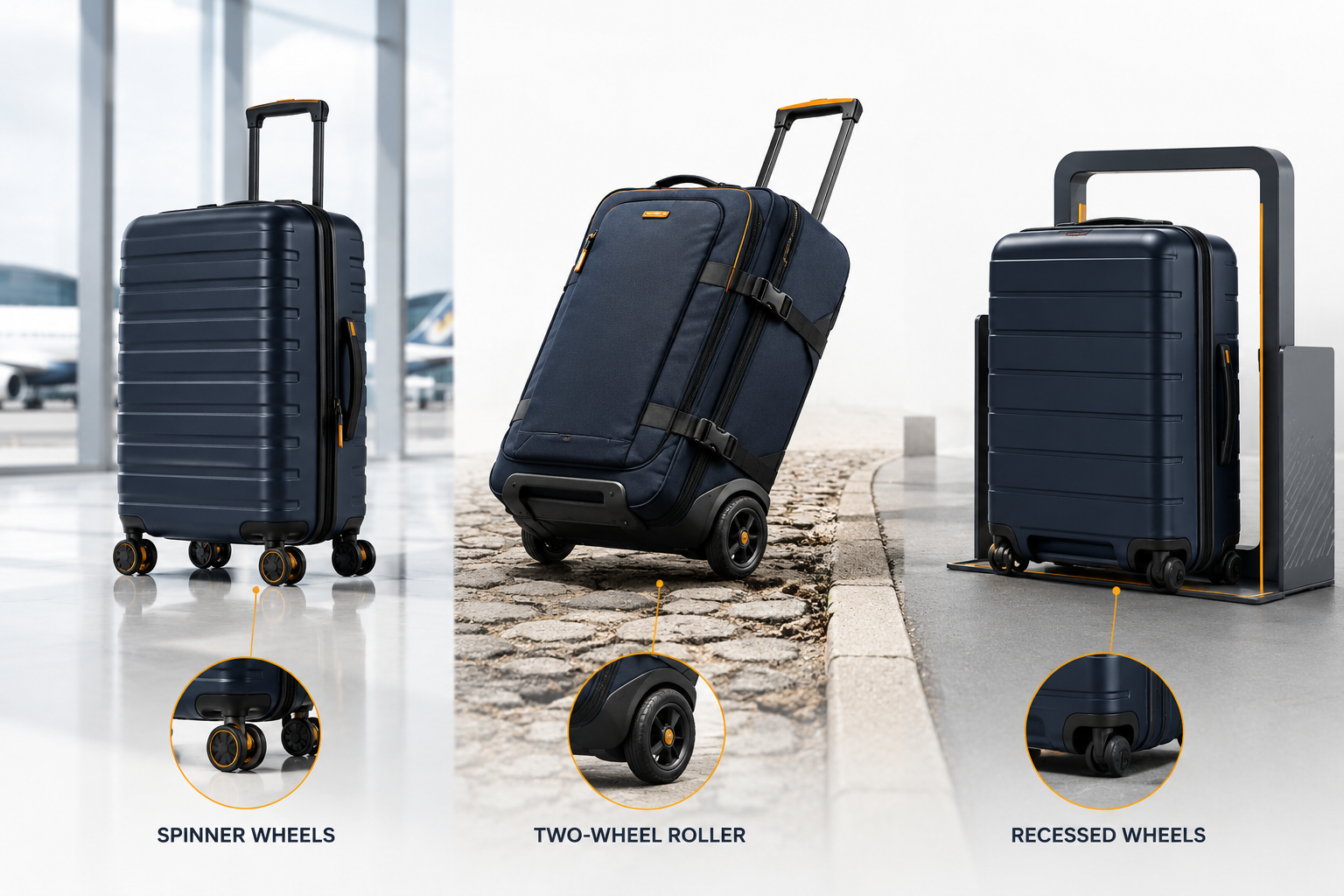
Which Suitcase Wheel Systems Define Suitcase Mobility?
Suitcase wheel systems define suitcase mobility by controlling how a bag rolls, turns, pulls, tips, vibrates, and handles smooth or rough travel surfaces. A wheel system includes wheels, casters, axles, housings, mounts, tread surfaces, and the layout that connects them to the suitcase body.
This article explains spinner systems, two-wheel systems, terrain fit, airline sizer risk, cleaning habits, damage prevention, and a final pre-trip wheel inspection checklist.
Why do suitcase wheel systems matter for travel mobility and physical strain?
Suitcase wheel systems matter for travel mobility and physical strain because wheel layout changes pulling effort, turning control, vibration, tipping, and surface handling.
Travelers often compare size, shell material, and color before wheels, but luggage wheels are stress points. Poor wheel design can increase wrist, shoulder, and arm effort, especially with heavy bags or uneven surfaces.
Exposed spinner wheels can add to the measured exterior profile, while recessed wheels may reduce protrusion depending on design. Wheel systems should be chosen by surface type, travel style, bag size, packed balance, and airline fit needs.
How do suitcase wheel systems differ between spinner and two-wheel designs?
Suitcase wheel systems differ between spinner and two-wheel designs by changing whether the suitcase rolls upright beside the traveler or tilts behind the traveler for pulling control.
How do spinner suitcase wheel systems behave?
Spinner suitcase wheel systems behave by using four wheel points that let the suitcase roll upright beside the traveler. Spinner wheel system design changes how the bag turns, pivots, rolls upright, and handles smooth airport floors, but exposed spinner wheels can catch, wobble, or take more stress on rough surfaces.
How do double-spinner suitcase wheel systems behave?
Double-spinner suitcase wheel systems behave by using paired wheels at each corner for potentially better balance and turning control. Spinner four wheels support upright rolling, but each exposed corner wheel still depends on housing strength, axle quality, and surface condition.
How do two-wheel suitcase wheel systems behave?
Two-wheel suitcase wheel systems behave by pulling behind the traveler at an angle instead of gliding upright beside the body. Roller two wheels usually trade sideways glide for more predictable pulling across uneven ground, but they require more pulling effort.
How do recessed suitcase wheel systems behave?
Recessed suitcase wheel systems behave by sitting partly inside the suitcase structure to reduce wheel exposure and support exterior profile control. Recessed housings may reduce internal packing space or add structure.
| Wheel System | Main Strength | Main Trade-Off |
|---|---|---|
| Four-wheel spinner | Upright rolling and easy turning | Less ideal on rough surfaces |
| Double-spinner | Better balance and control | More exposed parts |
| Two-wheel roller | Better rough-surface pulling | Must be tilted |
| Recessed wheels | Reduced protrusion | May reduce internal space |
| Exposed caster wheels | Smooth movement on flat floors | More vulnerable to impact |
| Larger rear wheels | Better curb/sidewalk handling | Less sideways mobility |
Which suitcase wheel systems fit different travel surfaces and airline sizer needs?
Suitcase wheel systems fit different travel surfaces and airline sizer needs when wheel layout, wheel exposure, packed weight, and exterior profile match the route.
Which suitcase wheel systems work best for smooth airports?
Spinner or double-spinner suitcase wheel systems usually work best for smooth airports because they roll upright and turn easily in queues, terminals, and hotel lobbies. Smooth performance still depends on wheel quality, load balance, and floor surface.
Which suitcase wheel systems work best for rough sidewalks?
Two-wheel roller suitcase wheel systems or larger recessed wheels often work best for rough sidewalks because tilted pulling can handle cracks, curbs, and uneven pavement more predictably. Roller rough terrain performance depends on wheel size, wheel protection, pulling angle, packed weight, and surface condition.
Which suitcase wheel systems work best for cobblestones or city travel?
Two-wheel suitcase wheel systems with sturdy housings often work best for cobblestones or city travel because larger protected wheels may roll better over uneven surfaces than small exposed casters. Travelers may still need to lift the suitcase over stairs, gaps, or broken pavement.
Which suitcase wheel systems work best for strict airline sizers?
Recessed or lower-profile suitcase wheel systems often work best for strict airline sizers because wheels can count as part of the suitcase’s full exterior profile. The packed suitcase still needs to be measured with wheels, handles, pockets, and expansion panels included.
| Travel Surface | Better Wheel System | Why |
|---|---|---|
| Smooth airport floor | Spinner or double-spinner | Easy upright control |
| Hotel lobby | Spinner | Smooth turning |
| Rough sidewalk | Two-wheel roller | Better pulling stability |
| Cobblestones | Larger two-wheel system | Better over uneven gaps |
| Tight airplane aisle | Spinner | Sideways movement may help |
| Strict sizer check | Recessed wheel profile | Less wheel protrusion risk |
| Wheel / Profile Factor | Why It Matters | Safer Check |
|---|---|---|
| Exposed spinner wheels | Can add visible protrusion | Measure total height and depth |
| Recessed wheels | May reduce protrusion | Still measure full exterior |
| Two-wheel rear layout | Often more protected | Include wheels in measurement |
| Grab handles | Add exterior profile | Measure beyond shell body |
| Expansion panels | Increase packed depth | Recheck after packing |
| Soft bulging | Changes true shape | Measure fully packed bag |
How should suitcase wheel systems be cleaned and protected before travel?
Suitcase wheel systems should be cleaned and protected before travel by removing visible debris, wiping dirty wheel surfaces, avoiding soaked housings, checking for wobble, and following manufacturer care guidance.
Remove visible hair, thread, lint, and debris with gentle tools rather than forcing sharp objects deep inside the housing. Wipe dirty wheel surfaces after muddy or dusty travel, then dry the area instead of soaking the wheel assembly.
After rough trips, inspect wheel housings, mounts, tread, and tracking. Lubrication and repairs should follow manufacturer guidance, warranty support, replacement parts, or professional luggage repair rather than risky disassembly.
| Maintenance Task | Safe Method | Avoid |
|---|---|---|
| Remove hair/thread | Soft brush or careful tweezers | Forcing sharp tools deep inside |
| Clean wheel tread | Damp cloth, then dry | Soaking wheel housing |
| Check wobble | Spin and gently test movement | Ignoring loose wheels |
| Check housing | Look for cracks or looseness | Traveling with broken mounts |
| Lubrication | Follow manufacturer guidance | Random sprays or heavy grease |
| Repairs | Warranty/professional support | Unsafe disassembly |
What mistakes damage suitcase wheel systems or create rolling problems?
Suitcase wheel systems become damaged or harder to roll when travelers drag spinner wheels over rough ground, overpack the bag, ignore debris, choose the wrong surface, or force stuck wheels. Spinner wheel vulnerability increases when exposed casters meet rough pavement, curbs, gravel, or long tilted pulling.
How does dragging spinner suitcase wheel systems damage them?
Dragging spinner suitcase wheel systems on two wheels across rough surfaces for long distances can create uneven stress on caster housings. Using upright rolling on smooth floors and lifting or carefully pulling only when terrain requires it reduces uneven stress.
How does overpacking damage suitcase wheel systems?
Overpacking damages suitcase wheel systems when heavy loads place excessive stress on wheel mounts, housings, and axles. Weighing the packed bag and keeping dense items low and balanced lowers tipping, drag, and mount strain.
How does ignoring wheel debris damage suitcase wheel systems?
Ignoring wheel debris damages suitcase wheel systems when hair, thread, sand, or grit remains wrapped around wheels after travel. Cleaning visible debris before storage supports smoother rolling and less drag.
How does poor surface choice damage suitcase wheel systems?
Poor surface choice damages suitcase wheel systems when small exposed spinner wheels are rolled over gravel, broken pavement, stairs, or deep cracks. Lifting the bag over severe obstacles or choosing a two-wheel design for frequent rough-surface travel reduces housing and corner stress.
How should stuck suitcase wheel systems be handled?
Stuck suitcase wheel systems should be handled by stopping heavy travel use until the wheel is inspected, repaired, or replaced. Forcing a stuck wheel to roll or attempting risky disassembly can worsen damage.
| Warning Sign | Possible Cause | Safer Response |
|---|---|---|
| Grinding sound | Debris or bearing wear | Clean visible debris; inspect |
| Wheel wobble | Loose housing or axle issue | Check manufacturer repair options |
| Bag pulls sideways | Uneven wheel wear or load | Rebalance load; inspect wheels |
| Wheel does not spin | Debris or seized part | Avoid forcing; repair/replace |
| Cracked housing | Impact or overload | Do not rely on it for travel |
| Missing tread | Wear or rough terrain | Replace wheel if possible |
Which pre-trip checklist keeps suitcase wheel systems ready for departure?
A pre-trip checklist keeps suitcase wheel systems ready for departure by testing wheel spin, tracking, wobble, tread condition, housing strength, debris, airline profile, and packed balance.
This checklist does not guarantee effortless mobility or permanent durability. It helps catch common wheel, housing, tread, debris, and load-balance issues before travel.
- Spin each wheel by hand and check for grinding, sticking, or uneven movement.
- Roll the packed suitcase on a flat surface to see if it tracks straight.
- Check whether the suitcase tips, wobbles, or pulls to one side.
- Inspect wheel housings for cracks, looseness, missing pieces, or bent mounts.
- Check wheel treads for flat spots, deep cuts, or missing rubber.
- Remove visible hair, string, lint, or debris around the wheel area.
- Wipe dirt or grit from the wheel surface and dry the area.
- Confirm wheels, handles, and corners are included in airline size measurements.
- Keep dense items low and balanced near the wheel base.
- Avoid forcing stuck wheels to roll.
- Follow manufacturer care instructions before applying lubricant or attempting repairs.
- Use warranty support, replacement parts, or professional repair for broken wheel assemblies.
- Choose two-wheel systems for frequent rough-surface travel.
- Choose spinner systems mainly for smooth airport and hotel surfaces.
- Recheck the suitcase after packing because weight distribution affects wheel performance.
What should you remember about suitcase wheel systems?
Suitcase wheel systems work best when wheel layout, surface type, packed balance, airline profile, cleaning habits, and repair decisions all match the trip. Spinner systems often suit smooth airports and hotels, while two-wheel systems often suit rougher sidewalks and outdoor routes.
No wheel system is universally better or guaranteed to remove strain. Real performance depends on wheel size, housing design, axle quality, bearing type, load weight, surface condition, and suitcase construction.
Frequently Asked Questions About Suitcase Wheel Systems
What are suitcase wheel systems?
Suitcase wheel systems are the wheels, casters, axles, housings, mounts, and layouts that control how a suitcase rolls, turns, pulls, tips, and handles different travel surfaces.
Are spinner suitcase wheel systems better than two-wheel systems?
Spinner suitcase wheel systems are better for smooth airport floors, hotel lobbies, and upright rolling. Two-wheel systems are often better for rough sidewalks, curbs, cobblestones, and outdoor paths. Neither system is universally better.
Do suitcase wheel systems count in airline size checks?
Wheels can count as part of the full exterior profile in many airline fit checks. Travelers should measure the packed suitcase including wheels, handles, pockets, expansion panels, and soft bulging.
How should suitcase wheel systems be cleaned?
Suitcase wheel systems should be cleaned by removing visible hair, thread, lint, and debris, wiping dirty tread with a damp cloth, drying the area, and following manufacturer guidance before using lubricants or repair products.
When should suitcase wheel systems be repaired or replaced?
Suitcase wheel systems should be inspected, repaired, or replaced when wheels wobble, grind, stop spinning, pull sideways, lose tread, crack housings, or show loose mounts. For structural damage, use manufacturer guidance, warranty support, replacement parts, or professional repair.