Where does carry-on luggage fit during air transit?
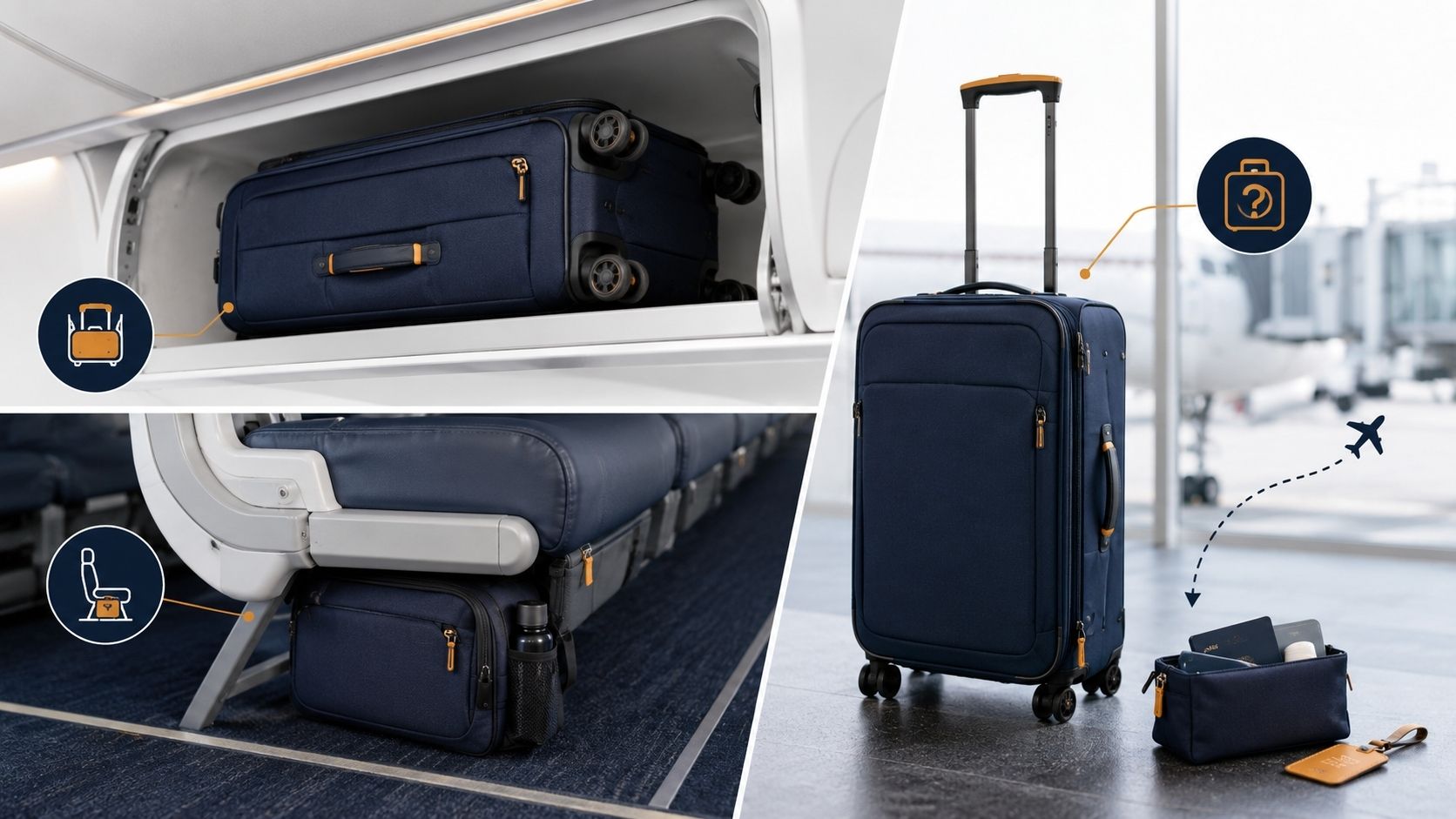
Carry-on luggage fits during air transit through overhead-bin or underseat placement depending on bag type, packed profile, airline rule, ticket allowance, aircraft layout, and boarding conditions. Rolling cabin bags usually need overhead space, while smaller personal-item bags may fit under the seat when allowed.
This article explains cabin zones, luggage-type placement, packing profile, boarding mistakes, gate-check risk, and a final checklist for preparing carry-on luggage before boarding.
Why does carry-on luggage placement matter during boarding?
Carry-on luggage placement matters during boarding because overhead bins and underseat areas serve different bag types, access needs, and cabin-space limits.
Travelers often treat all cabin storage space as equal, but carry-on luggage may be moved to another bin, become hard to access, or be redirected for gate-check when space is limited. Medication, documents, electronics, valuables, and flight essentials should be easy to remove before the bag leaves your control.
Overhead space can become limited during full flights, late boarding, regional flights, or aircraft swaps. Carry-on luggage placement works best when the traveler plans for airline rules, real cabin conditions, and a backup access plan.
How do aircraft cabin zones determine where carry-on luggage fits?
Aircraft cabin zones determine where carry-on luggage fits by separating larger overhead storage from smaller underseat access space.
Carry-on cabin storage depends on whether the bag belongs overhead, under the seat, or needs a backup plan. The overhead-bin zone is best for rolling suitcases, spinners, structured cabin bags, and larger soft bags that need more length, height, and wheel clearance.
The underseat zone is best for compact bags that need in-flight access. Underseat space is limited by aircraft layout, seat position, support bars, and equipment boxes, so underseat personal-item limits should be checked before assuming a soft backpack or laptop bag will fit below the seat.
| Cabin Zone | Best Carry-On Luggage Type | Main Strength | Main Risk |
|---|---|---|---|
| Overhead bin | Roller, spinner, cabin suitcase | Larger packing capacity | Bin space may fill |
| Underseat area | Backpack, tote, compact soft bag | Easy access | Space varies by seat |
| Regional aircraft | Smaller soft bag or compact carry-on | Better flexibility | Gate-check more likely |
| Full flight | Personal item + compact carry-on | Backup access | Overhead space limited |
| Mixed itinerary | Flexible carry-on luggage | Adapts to aircraft changes | Rules may differ by leg |
Which cabin storage location works best for different carry-on luggage types?
The best cabin storage location for carry-on luggage depends on whether the bag is rolling, soft, tech-focused, garment-focused, bulky, or needed during the flight.
Where should rolling carry-on luggage fit?
Rolling carry-on luggage should usually fit in the overhead bin because rollers and spinners need more height, length, and wheel clearance than underseat space provides. Carry-on overhead bin fit depends on packed size, wheels, handles, pocket shape, and available bin space, while regional aircraft or full flights may still require gate-checking.
Where should soft backpack-style carry-on luggage fit?
Soft backpack-style carry-on luggage should usually fit under the seat when it matches the airline’s personal-item rule. Overpacking can make a soft backpack too bulky for underseat space, especially when front pockets, side pockets, or rigid tech items change the real shape.
Where should laptop or tech-focused carry-on luggage fit?
Laptop or tech-focused carry-on luggage should usually fit under the seat or inside a smaller personal item so electronics, documents, and medication stay accessible. Battery-powered items and electronics still need to follow airline and security rules.
Where should garment-focused carry-on luggage fit?
Garment-focused carry-on luggage should usually fit overhead when allowed and packed flat. Garment bags vary widely in packed size, fold depth, and hanger structure, so they may not fit every bin.
Where should bulky carry-on luggage fit?
Bulky carry-on luggage should usually fit in the overhead bin or move to checked placement if it exceeds cabin rules. Airline rules and aircraft storage conditions decide final placement.
| Carry-On Luggage Type | Better Placement | Why |
|---|---|---|
| Hardside roller | Overhead bin | Fixed shape and wheel clearance |
| Softside roller | Overhead bin | Larger clothing capacity |
| Compact backpack | Underseat area | Easy access and flexibility |
| Laptop bag | Underseat area | Fast access to essentials |
| Garment bag | Overhead when allowed | Reduces compression |
| Small duffel | Underseat or overhead | Depends on packed profile |
How should carry-on luggage be packed for overhead or underseat fit?
Carry-on luggage should be packed for overhead or underseat fit by keeping the exterior profile flat, hard items inward, expansion controlled, essentials accessible, and overhead bags liftable.
Keep pockets flat, tuck straps, move hard items away from bulge points, and measure the bag after packing. Carry-on size limits should be checked against the fully packed exterior profile, not the empty shell alone.
Expansion zippers are conditional because they can increase true packed depth. Underseat items should keep essentials near the opening, while overhead carry-on luggage should stay light enough to lift safely without forcing the bag into the bin.
| Packing Goal | Better Action | Main Benefit |
|---|---|---|
| Overhead fit | Keep pockets flat | Cleaner profile |
| Underseat access | Put essentials near opening | Faster retrieval |
| Lift control | Keep dense items low and balanced | Easier handling |
| Bulge control | Move hard items inward | Better fit |
| Expansion control | Recheck packed profile | Lower gate-check risk |
| Strap control | Tuck loose straps | Less snagging |
What boarding mistakes cause carry-on luggage to be gate-checked or difficult to place?
Carry-on luggage becomes gate-checked or difficult to place when boarding is late, overhead space is misused, pockets bulge, straps dangle, or aircraft storage is smaller than expected. Carry-on baggage handling risks increase when a cabin bag is redirected to gate-check or valet-check handling.
How does late boarding affect carry-on luggage placement?
Late boarding affects carry-on luggage placement because overhead-bin space may be limited by the time the traveler reaches the aircraft. Keeping essential items in a smaller personal item protects access if the carry-on is redirected.
How does using overhead space incorrectly affect carry-on luggage placement?
Using overhead space incorrectly affects carry-on luggage placement when both a rolling suitcase and a small personal item are placed overhead during a full flight. Placing the smaller personal item under the seat when instructed or allowed leaves more overhead room for larger carry-on bags.
How do bulging pockets affect carry-on luggage placement?
Bulging pockets affect carry-on luggage placement by increasing the bag’s real packed depth and making it harder to measure, slide, or place. Moving bulky items into the main bag or personal item creates a cleaner cabin-fit profile.
How do loose straps affect carry-on luggage placement?
Loose straps affect carry-on luggage placement when backpack straps, drawstrings, luggage tags, or dangling handles catch on bins, seats, or aisle hardware. Tucking or securing loose parts before boarding lowers snag risk.
How does regional aircraft storage affect carry-on luggage placement?
Regional aircraft storage affects carry-on luggage placement because smaller aircraft may have tighter cabin storage than the traveler expects. Checking aircraft and airline rules when possible and keeping essentials removable improves preparation for gate-check or valet-check handling.
| Problem | Likely Cause | Safer Fix |
|---|---|---|
| Overhead bins full | Full flight or late boarding | Keep essentials in personal item |
| Bag too deep | Expanded zipper or full pockets | Flatten packed profile |
| Bag snags | Loose straps or tags | Tuck loose parts |
| Underseat bag too bulky | Soft bag overpacked | Remove or redistribute items |
| Regional aircraft issue | Smaller cabin storage | Prepare for gate-check |
| Valuables at risk | Essentials packed deep inside | Use removable pouch |
Which pre-boarding checklist keeps carry-on luggage ready for overhead or underseat placement?
A pre-boarding checklist keeps carry-on luggage ready for overhead or underseat placement by verifying ticket allowance, airline rules, packed profile, expansion depth, pocket shape, loose straps, essentials access, and gate-check readiness.
This checklist does not guarantee cabin placement or fee avoidance. It helps keep carry-on luggage more compact, accessible, measurable, and ready if cabin placement changes.
- Check whether your ticket includes carry-on luggage, a personal item, or both.
- Confirm the airline’s current carry-on and personal-item rules for your route and fare type.
- Measure the fully packed bag, including wheels, handles, pockets, straps, and expansion panels.
- Keep expansion zippers closed unless the expanded size is still allowed.
- Keep front and side pockets flat.
- Tuck loose straps, drawstrings, luggage tags, and dangling handles.
- Keep medication, documents, valuables, and permitted critical electronics easy to remove.
- Use a smaller personal item for in-flight essentials.
- Keep overhead carry-on luggage light enough to lift safely.
- Follow airline and security rules for batteries, liquids, tools, and restricted items.
- Prepare for possible gate-check if the flight is full or the aircraft has smaller bins.
- Remove essential items before handing over a bag for gate-check.
- Place personal items under the seat when instructed or when overhead space is limited.
- Recheck the bag after adding last-minute jackets, souvenirs, or snacks.
What should you remember about carry-on luggage placement?
Carry-on luggage placement works best when overhead-bin fit, underseat access, ticket allowance, packed profile, aircraft storage, and boarding conditions are planned together. The better location depends on whether the bag needs capacity, access, liftability, or a backup gate-check plan.
No carry-on luggage placement is universal. Airline rules, fare type, aircraft layout, seat position, available cabin space, and packed profile decide whether the bag belongs overhead, underseat, or needs to be redirected.
Frequently Asked Questions About Carry-On Luggage Placement
Where does carry-on luggage fit during air transit?
Carry-on luggage usually fits in the overhead bin when it is a rolling suitcase, spinner, cabin suitcase, or structured travel bag. Smaller personal-item bags, backpacks, totes, and tech bags may fit under the seat when allowed by the airline and ticket type.
Can carry-on luggage go under the seat?
Carry-on luggage can go under the seat only when it is small enough for the airline’s personal-item rule and the aircraft seat space. Underseat space varies by aircraft, seat position, support bars, entertainment boxes, and cabin layout.
Does carry-on luggage always stay in the cabin?
No. Carry-on luggage may be gate-checked or redirected if cabin space is limited, the aircraft has smaller bins, the ticket allowance is different, or the packed bag does not match the airline’s current rule.
What should go in underseat carry-on luggage?
Underseat carry-on luggage should hold items needed during travel, such as medication, documents, valuables, chargers, snacks, electronics, and permitted flight essentials.
How should carry-on luggage be packed for overhead-bin fit?
Carry-on luggage should be packed with a flat exterior profile, closed expansion zippers, tucked straps, balanced weight, and pockets kept slim. Measure the fully packed bag, including wheels, handles, pockets, straps, and expansion panels.