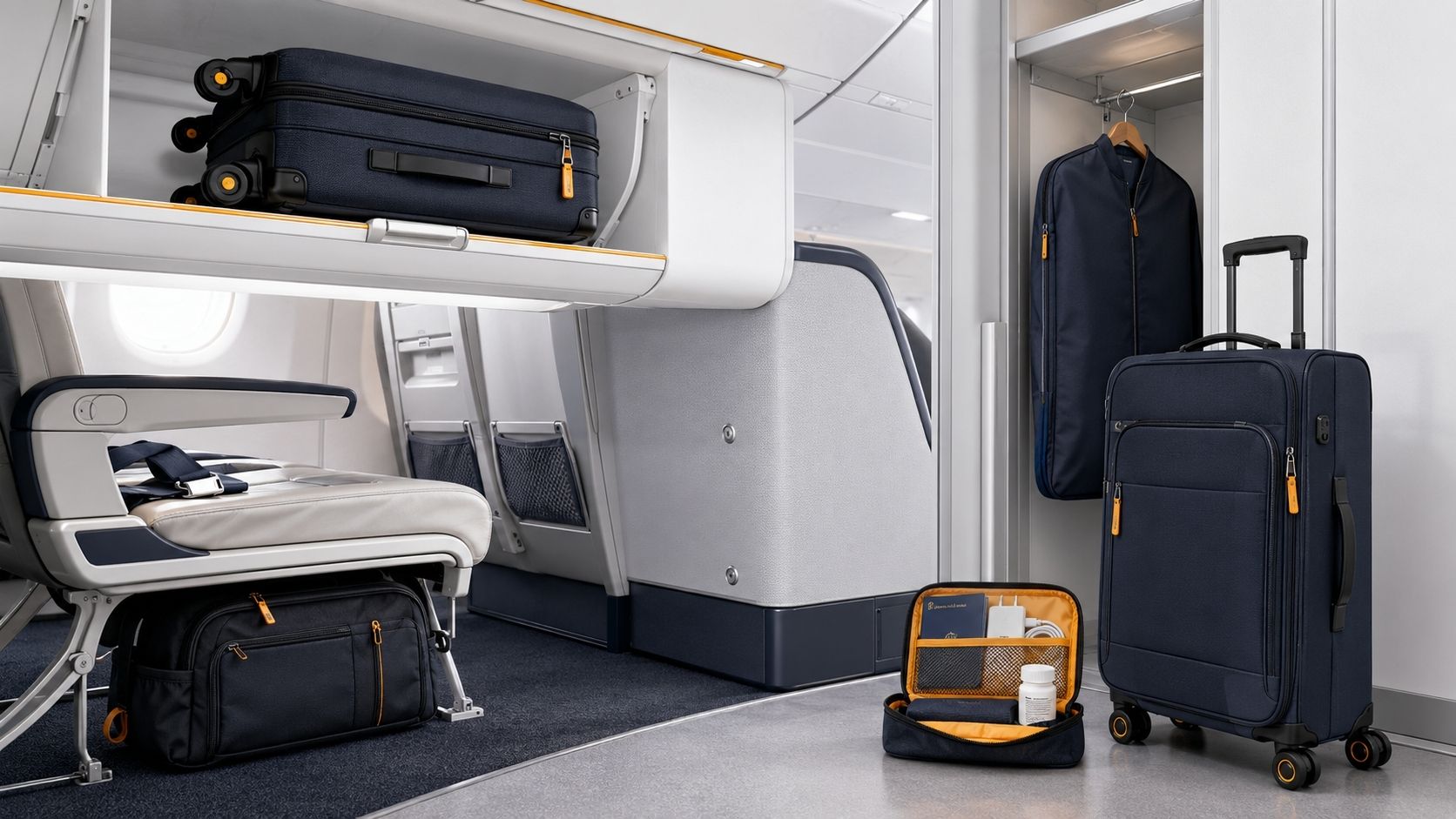
Which Cabin Storage Zones Hold Carry-On Luggage?
Cabin storage zones hold carry-on luggage in overhead bins, underseat areas, and limited-use storage spaces depending on bag type, aircraft layout, airline rules, seat position, and boarding conditions.
This guide explains how each cabin zone works, which bag types fit each area, how to keep packed profiles controlled, what to do when space is full, and how to finish a pre-boarding storage check.
Why do cabin storage zones matter for carry-on luggage placement?
Cabin storage zones matter for carry-on luggage placement because overhead bins, underseat spaces, and limited-use storage areas serve different bag types and access needs.
Travelers often assume any cabin bag can go anywhere, but wrong placement may delay boarding, block legroom, or be moved by crew. Carry-on cabin placement depends on whether the bag belongs overhead, under the seat, or needs a backup plan.
Medication, documents, valuables, electronics, and essentials may become harder to access if a bag is moved or gate-checked. Plan each bag’s storage zone before boarding and keep essentials removable.
How do cabin storage zones differ across overhead bins, underseat areas, and limited-use closets?
Cabin storage zones differ across overhead bins, underseat areas, and limited-use closets because each area has different space, access, availability, and crew-control limits.
Overhead bins are usually best for larger carry-on bags, but space can fill. Underseat areas are better for quick-access personal items, but underseat personal-item limits should be checked before assuming a backpack, tote, or laptop bag will fit below the seat.
Closets or wardrobe spaces may reduce compression for coats or garment items when allowed, but they are not always available and may depend on airline policy, cabin class, crew instructions, and safety needs.
| Cabin Storage Zone | Best Bag Type | Main Strength | Main Limitation |
|---|---|---|---|
| Overhead bin | Roller, spinner, cabin suitcase | Larger capacity | Space may fill |
| Underseat area | Backpack, tote, laptop bag | Easy access | Seat-space variation |
| Bulkhead overhead | Personal item or carry-on | Required when no underseat area exists | Limited shared space |
| Closet/wardrobe | Coat or garment item when allowed | Reduced compression | Not always available |
| Gate-check/valet handling | Larger cabin bag when required | Backup option | Handling process varies |
Which cabin storage zones should travelers choose for different bag types?
Travelers should choose cabin storage zones for different bag types by matching rolling suitcases, backpacks, laptop bags, garment bags, and bulkhead items to the safest practical storage area.
Which cabin storage zones work best for rolling suitcases?
Cabin storage zones work best for rolling suitcases when larger rollers, spinners, and cabin suitcases are placed in the overhead bin. Carry-on overhead bin fit depends on packed size, wheel clearance, handles, pocket shape, and available bin space.
Which cabin storage zones work best for backpacks?
Cabin storage zones work best for backpacks when compact soft backpacks fit under the seat and match the airline’s personal-item rule. Overpacked backpacks can become too bulky for underseat space.
Which cabin storage zones work best for laptop or tech bags?
Cabin storage zones work best for laptop or tech bags when electronics, documents, medication, and chargers remain underseat or otherwise easy to remove. Battery-powered items must still follow airline and security rules.
Which cabin storage zones work best for garment bags?
Cabin storage zones work best for garment bags when they can lie overhead or use a closet or wardrobe space only when crew and airline policy allow. Garment bags vary in size and onboard closets are not guaranteed.
Which cabin storage zones work best for bulkhead seats?
Cabin storage zones work best for bulkhead seats when personal items are placed overhead during required flight phases if there is no underseat space. Crew instructions and aircraft layout decide final placement.
| Bag Type | Better Cabin Storage Zone | Why |
|---|---|---|
| Hardside roller | Overhead bin | Fixed shape and wheel clearance |
| Softside roller | Overhead bin | Larger packing capacity |
| Compact backpack | Underseat area | Easy access |
| Laptop bag | Underseat area | Fast retrieval |
| Garment sleeve | Overhead or closet if allowed | Less compression |
| Bulkhead personal item | Overhead during required phases | No underseat space |
How should bags be packed to fit cabin storage zones without bulging or blocking access?
Bags should be packed to fit cabin storage zones without bulging or blocking access by keeping profiles flat, hard items inward, essentials reachable, expansion controlled, and loose parts secured.
Keep the full exterior profile flat, measure the bag after packing, and keep hard items away from outer bulge points. Carry-on size limits should be checked against the fully packed exterior profile, including wheels, handles, pockets, straps, and expansion panels.
Underseat bags should keep essentials near the opening, while overhead bags should stay controlled enough to lift and place. Expansion zippers are conditional, and loose straps, buckles, drawstrings, and luggage tags should be secured before boarding.
| Packing Goal | Better Action | Main Benefit |
|---|---|---|
| Overhead fit | Keep pockets flat | Cleaner profile |
| Underseat access | Put essentials near opening | Faster retrieval |
| Bulge control | Move hard items inward | Easier placement |
| Expansion control | Recheck packed size | Lower gate-check risk |
| Strap control | Tuck loose parts | Less snagging |
| Bulkhead readiness | Keep essentials removable | Faster compliance |
What should travelers do when cabin storage zones are full or reassigned?
Travelers should respond to full or reassigned cabin storage zones by keeping essentials separate, following crew instructions, flattening the packed profile, and preparing calmly for gate-check or valet-check. Carry-on baggage handling risks increase when a cabin bag is redirected to gate-check or valet-check handling.
What if overhead cabin storage zones are full?
When overhead cabin storage zones are full, travelers should keep essentials in a smaller personal item and follow crew instructions if the larger bag must be moved or checked. Important items remain accessible even if placement changes.
What if underseat cabin storage zones are unavailable?
When underseat cabin storage zones are unavailable, especially in bulkhead rows or certain aircraft layouts, travelers should use overhead storage when instructed and keep essentials in a removable pouch. The passenger can comply while keeping critical items manageable.
What if a small bag is taking overhead cabin storage zones during a full flight?
When a small bag is taking overhead cabin storage zones during a full flight, moving it under the seat when allowed can leave more room for larger bags. Overhead space remains available for bags that cannot fit underseat.
What if a bag fails the cabin storage zones fit check?
When a bag fails the cabin storage zones fit check, bulging pockets, open expansion panels, wheels, or handles may be making the profile too large. Removing bulky items, closing expansion zippers, flattening pockets, and keeping essentials separate may make the bag easier to place or prepare for gate-check.
What if cabin storage zones require gate-check or valet-check?
When cabin storage zones require gate-check or valet-check, travelers should ask where the bag will be returned, remove essentials, and follow airline instructions. The traveler understands the process and protects important items.
| Problem | Likely Cause | Safer Fix |
|---|---|---|
| Overhead bins full | Full flight or late boarding | Keep essentials in personal item |
| No underseat space | Bulkhead or aircraft layout | Use overhead when instructed |
| Small bag overhead | Personal item placed above | Move underseat when allowed |
| Bag fails fit check | Bulging or expanded profile | Flatten and remove bulky items |
| Loose straps catch | Dangling parts | Tuck straps and tags |
| Gate-check required | Aircraft or bin limitation | Remove essentials first |
Which cabin storage zones checklist should travelers complete before boarding?
A cabin storage zones checklist should verify ticket allowance, airline rules, seat position, packed profile, pocket shape, loose straps, essentials access, overhead readiness, and gate-check preparation before boarding.
This checklist does not guarantee cabin space or fee avoidance. It helps keep carry-on luggage measurable, accessible, and ready for overhead, underseat, bulkhead, gate-check, or valet-check handling.
- Check whether your ticket includes a carry-on bag, personal item, or both.
- Confirm your airline’s current carry-on and personal-item rules for your route and fare type.
- Identify whether your seat is bulkhead, exit row, aisle, middle, or window if storage space may matter.
- Measure the fully packed bag, including wheels, handles, pockets, straps, and expansion panels.
- Keep expansion zippers closed unless the expanded size is still allowed.
- Keep front and side pockets flat.
- Tuck loose straps, buckles, drawstrings, and luggage tags.
- Keep medication, documents, valuables, and permitted electronics easy to remove.
- Use a smaller personal item for in-flight essentials.
- Keep larger rolling bags prepared for overhead placement.
- Prepare for possible gate-check or valet-check on smaller aircraft or full flights.
- Ask where a gate-checked or valet-checked bag will be returned.
- Follow crew instructions for bulkhead, exit-row, and takeoff/landing storage.
- Recheck the bag after adding last-minute jackets, snacks, or souvenirs.
What should you remember about cabin storage zones?
Cabin storage zones work best when bag type, access needs, ticket allowance, aircraft layout, seat position, packed profile, and boarding conditions are planned together.
Overhead bins, underseat areas, bulkhead conditions, limited-use closets, and gate-check or valet-check processes all affect where a carry-on bag can go. Final placement depends on airline rules, aircraft layout, seat position, fare type, boarding conditions, crew instructions, and whether essential items remain accessible.
Frequently Asked Questions About Cabin Storage Zones
What are cabin storage zones?
Cabin storage zones are aircraft cabin areas used to store carry-on luggage and personal items. They usually include overhead bins, underseat areas, and sometimes limited-use closets or wardrobe spaces controlled by crew or airline policy.
Which cabin storage zones hold rolling carry-on luggage?
Rolling carry-on luggage usually belongs in the overhead bin because rollers, spinners, and cabin suitcases need more length, height, and wheel clearance than most underseat spaces provide.
Which cabin storage zones hold personal items?
Personal items usually belong under the seat when they fit the airline’s personal-item rule and do not block required space. Bulkhead rows or some aircraft layouts may require personal items to go overhead during taxi, takeoff, and landing.
Are aircraft closets part of cabin storage zones?
Aircraft closets or wardrobe spaces may be part of cabin storage zones on some aircraft, but they are not always available to passengers. Access may depend on airline policy, crew instructions, cabin class, item type, and safety needs.
What happens if cabin storage zones are full?
If cabin storage zones are full, crew may move bags, ask passengers to place smaller items underseat, or require gate-check or valet-check handling. Travelers should remove medication, documents, valuables, and permitted electronics before handing over a bag.