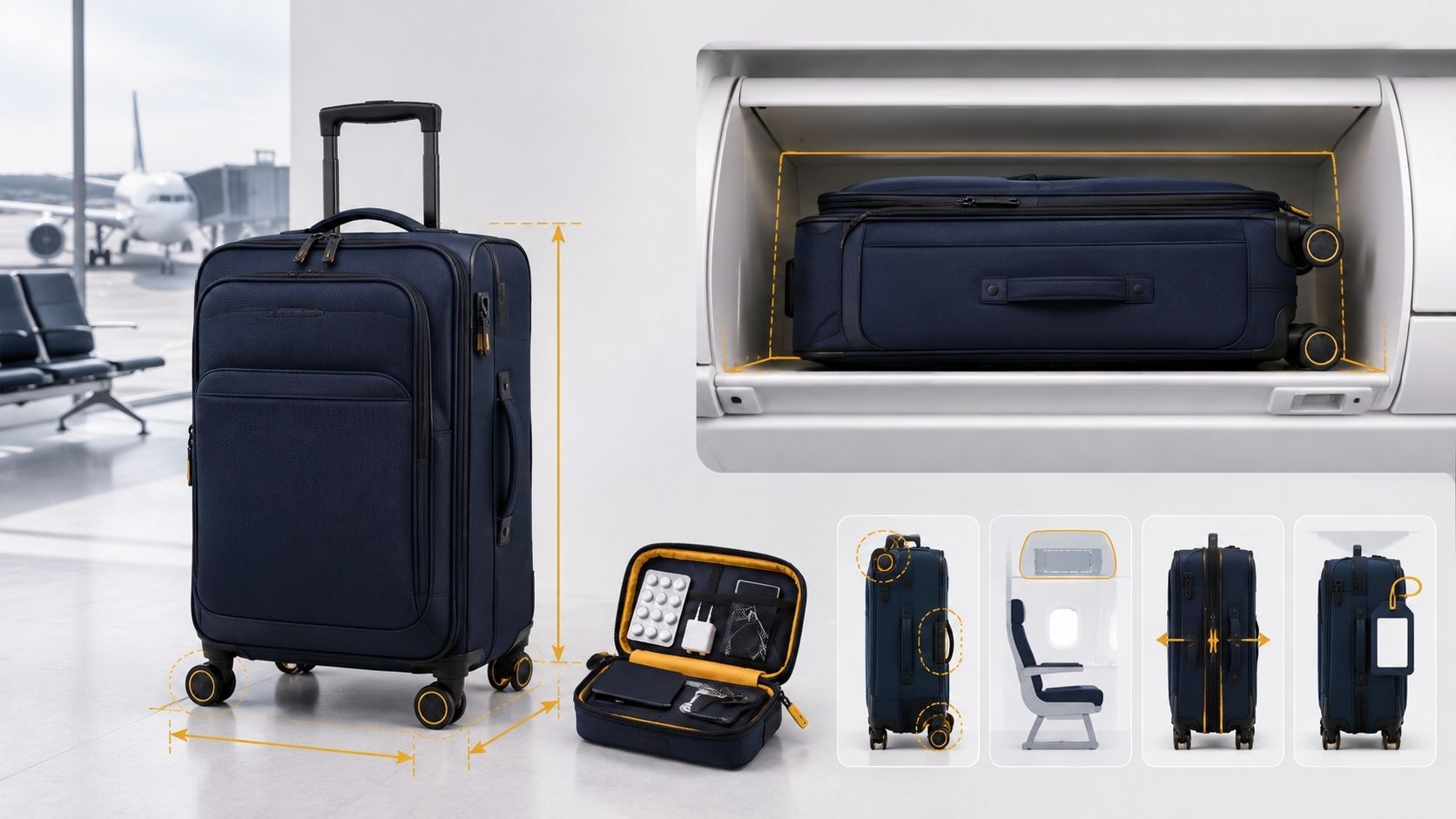
How do carry-on dimensions affect overhead-bin fit?
Carry-on dimensions affect overhead-bin fit by determining whether the fully packed bag profile can match the airline’s current rule, aircraft storage, and boarding conditions.
This guide explains airline rules, aircraft layouts, safer bag profiles, measuring workflow, packing mistakes, and a final dimension checklist for checking carry-on dimensions before boarding.
Why do carry-on dimensions matter for overhead-bin fit?
Carry-on dimensions matter for overhead-bin fit because wheels, handles, pockets, straps, expansion panels, and packed bulges can change the real size of the bag.
Travelers may trust “carry-on approved” labels without checking the airline’s current rule, but a bag can become harder to place overhead when protruding parts extend beyond the expected profile.
Overhead-bin space varies by aircraft model, cabin layout, airline configuration, and flight load. A bag that meets one airline’s rule may still face gate-check risk elsewhere, so measure the fully packed bag and keep essential items removable before boarding.
How do airline rules and aircraft layouts shape carry-on dimensions?
Airline rules and aircraft layouts shape carry-on dimensions by setting the size allowance, ticket allowance, sizer policy, possible weight rule, and real cabin storage limits.
Carry-on size limits should be checked against the fully packed bag, not only the empty suitcase shell. Carry-on cabin storage depends on overhead-bin space, aircraft layout, underseat access, and crew instructions.
Fare rules can decide whether a carry-on is included, while sizer and visual checks make protruding parts more important. Personal-item rules should also be checked separately so suitcase dimensions are not confused with underseat allowances.
| Rule Area | What to Check | Why It Matters |
|---|---|---|
| Airline size rule | Current carry-on dimensions | Rules vary by carrier |
| Fare type | Carry-on included or not | Allowance may depend on ticket |
| Aircraft type | Mainline, regional, mixed itinerary | Bin space may differ |
| Sizer policy | Physical sizer or visual check | Packed profile matters |
| Weight rule | Airline-specific weight limit | Some routes enforce weight |
| Personal item rule | Separate underseat allowance | Avoids cabin confusion |
Which carry-on dimensions reduce overhead-bin fit risk across different flights?
Carry-on dimensions reduce overhead-bin fit risk across different flights when the fully packed bag profile matches the strictest relevant airline, fare, aircraft, and boarding condition.
Which carry-on dimensions work better for single-airline trips?
Carry-on dimensions work better for single-airline trips when the packed bag matches that airline’s current carry-on rule. Aircraft changes and full cabins can still affect overhead-bin placement.
Which carry-on dimensions work better for multi-airline trips?
Carry-on dimensions work better for multi-airline trips when the bag fits the strictest airline rule on the itinerary. Travelers should check every operating airline, not only the booking airline.
Which carry-on dimensions work better for budget airlines?
Carry-on dimensions work better for budget airlines when the bag matches the exact paid or included allowance for that fare. A bag marketed as “carry-on” may still be too large for a specific fare.
Which carry-on dimensions work better for regional aircraft?
Carry-on dimensions work better for regional aircraft when the bag has a smaller or more flexible profile. Some bags may still need gate-check or valet-check handling.
Which carry-on dimensions work better for overhead-bin loading?
Carry-on dimensions work better for overhead-bin loading when the bag has flat pockets, closed expansion panels, secure straps, and minimal protrusions. Overhead fit still depends on bin availability and crew instructions.
| Flight Situation | Safer Carry-On Dimensions Strategy | Main Risk |
|---|---|---|
| Single airline | Match that airline’s current rule | Aircraft storage variation |
| Multi-airline trip | Use the strictest rule on itinerary | Rule mismatch |
| Budget fare | Confirm paid/included allowance | Carry-on not included |
| Regional aircraft | Choose compact or flexible profile | Smaller bin space |
| Full flight | Keep essentials removable | Gate-check risk |
| International trip | Check both size and weight rules | Different carrier policies |
How should travelers measure carry-on dimensions before travel?
Travelers should measure carry-on dimensions before travel by checking the fully packed bag’s height, width, depth, expansion state, loose parts, and weight when the airline applies a limit.
Carry-on packing capacity should be controlled so the packed profile stays compact, liftable, and easier to measure. Height should include wheels, feet, and the top handle; width should include side handles, trim, and seams; depth should include front pockets and the back panel.
Suitcase wheel mobility affects movement, but wheels also count as part of the real exterior profile when measuring many carry-on bags. Expansion panels, loose belts, luggage tags, and packed weight should be checked after the bag is filled.
| Measurement Area | Include These Parts | Common Mistake |
|---|---|---|
| Height | Wheels, feet, top handle | Measuring only shell body |
| Width | Side handles, trim, seams | Ignoring side protrusions |
| Depth | Front pockets, back panel | Forgetting pocket bulge |
| Expansion | Open panels and zippers | Assuming empty-bag size |
| Straps | Loose belts and tags | Letting parts dangle |
| Weight | Fully packed bag | Checking size but not weight |
What packing mistakes change carry-on dimensions and block overhead-bin fit?
Packing mistakes change carry-on dimensions and block overhead-bin fit when pockets bulge, expansion zippers stay open, wheels or handles are ignored, loose packing distorts the bag, or unsafe gate fixes are attempted. Carry-on baggage handling risks increase when a cabin bag is redirected to gate-check because of fit, space, or aircraft limits.
How do overfilled pockets change carry-on dimensions?
Overfilled pockets change carry-on dimensions by increasing the bag’s real depth and making the profile harder to measure or place. Moving bulky items into the main compartment or a permitted personal item creates a flatter profile.
How do open expansion zippers change carry-on dimensions?
Open expansion zippers change carry-on dimensions by increasing the packed depth beyond the empty-bag measurement. Closing the expansion zipper or remeasuring the expanded bag shows the real packed profile before the gate.
How do wheels and handles change carry-on dimensions?
Wheels and handles change carry-on dimensions because they extend beyond the rectangular shell and may count in the full exterior profile. Measuring from the outermost points gives a more realistic fit check.
How does loose packing change carry-on dimensions?
Loose packing changes carry-on dimensions when dense or rigid items press into soft panels and distort the bag shape. Placing hard items inside the main structure and using clothing near outer panels helps stabilize the exterior profile.
How do unsafe gate fixes create more problems?
Unsafe gate fixes create more problems when travelers force, squeeze, tap, or aggressively angle a carry-on bag into a sizer or overhead bin. Removing bulky items, closing expansion panels, flattening pockets, or accepting gate-check when required is safer than forcing the bag.
| Packing Issue | Safer Packing Move | Main Benefit |
|---|---|---|
| Front-pocket bulge | Move bulky items inward | Cleaner depth profile |
| Side distortion | Repack rigid items | More stable width |
| Open expansion panel | Close or remeasure | More realistic fit check |
| Loose straps | Tuck or secure | Less snag risk |
| Heavy top load | Move dense items low | Easier lifting and balance |
| Last-minute items | Recheck dimensions | Lower surprise risk |
| Fit Problem | Likely Cause | Safer Fix |
|---|---|---|
| Bag too deep | Bulging pocket or open expansion | Flatten and remeasure |
| Bag too tall | Wheels or handle not counted | Measure full exterior |
| Bag too wide | Side handle or packed distortion | Repack and recheck |
| Bag hard to lift | Dense overpacking | Reduce or redistribute weight |
| Bag snags | Loose straps or tags | Tuck dangling parts |
| Bag may be gate-checked | Full cabin or smaller aircraft | Remove essentials first |
Which checklist verifies carry-on dimensions before boarding?
A checklist verifies carry-on dimensions before boarding by confirming ticket allowance, airline rules, fully packed measurement, protruding parts, pocket shape, expansion depth, loose straps, weight, and essentials access.
This checklist does not guarantee overhead-bin fit or cabin approval. It helps travelers check the packed dimensions that most often create overhead-bin fit risk.
- Check whether your ticket includes a carry-on bag, personal item, or both.
- Confirm the airline’s current carry-on dimensions for your route and fare type.
- Check every operating airline on a multi-carrier itinerary.
- Measure the fully packed bag, not only the empty suitcase.
- Include wheels, feet, handles, side grips, trim, pockets, straps, and expansion panels.
- Keep expansion zippers closed unless the expanded size is still allowed.
- Keep front and side pockets flat.
- Tuck loose straps, buckles, belts, and luggage tags.
- Weigh the packed bag if your airline applies a cabin weight limit.
- Keep the bag light enough to lift safely if overhead placement is expected.
- Keep medication, documents, valuables, and permitted electronics easy to remove.
- Prepare for possible gate-check if the flight is full or the aircraft has smaller bins.
- Remove essentials before handing over a bag for gate-check.
- Recheck the dimensions after adding jackets, snacks, souvenirs, or last-minute items.
What should you remember about carry-on dimensions?
Carry-on dimensions work best for overhead-bin fit when the packed bag, airline rule, aircraft storage, ticket allowance, boarding conditions, and essentials-access plan are checked together.
Overhead-bin fit depends on more than retail dimensions. It depends on the airline’s current rule, the fully packed exterior profile, protruding parts, expansion depth, aircraft storage, boarding conditions, and whether essential items remain removable if the bag must be gate-checked.
Frequently Asked Questions About Carry-On Dimensions
What are carry-on dimensions?
Carry-on dimensions are the height, width, and depth of a carry-on bag, measured as the full exterior profile. Wheels, handles, pockets, straps, expansion panels, and soft bulging can affect the real measurement.
Do carry-on dimensions guarantee overhead-bin fit?
No. Carry-on dimensions do not guarantee overhead-bin fit. Fit also depends on airline rules, aircraft storage, fare type, cabin layout, boarding conditions, and the fully packed bag shape.
Should carry-on dimensions be measured before or after packing?
Carry-on dimensions should be measured after packing because the bag can bulge, expand, or change shape once filled.
Do wheels and handles count in carry-on dimensions?
Wheels and handles can count as part of the exterior profile in many airline fit checks. Measure from the outermost points rather than only the suitcase shell.
What should I do if my carry-on dimensions are too large?
Remove bulky items, close expansion zippers, flatten pockets, tuck straps, remeasure the packed bag, and keep essentials separate. If gate-check is required, remove medication, documents, valuables, and permitted electronics first.