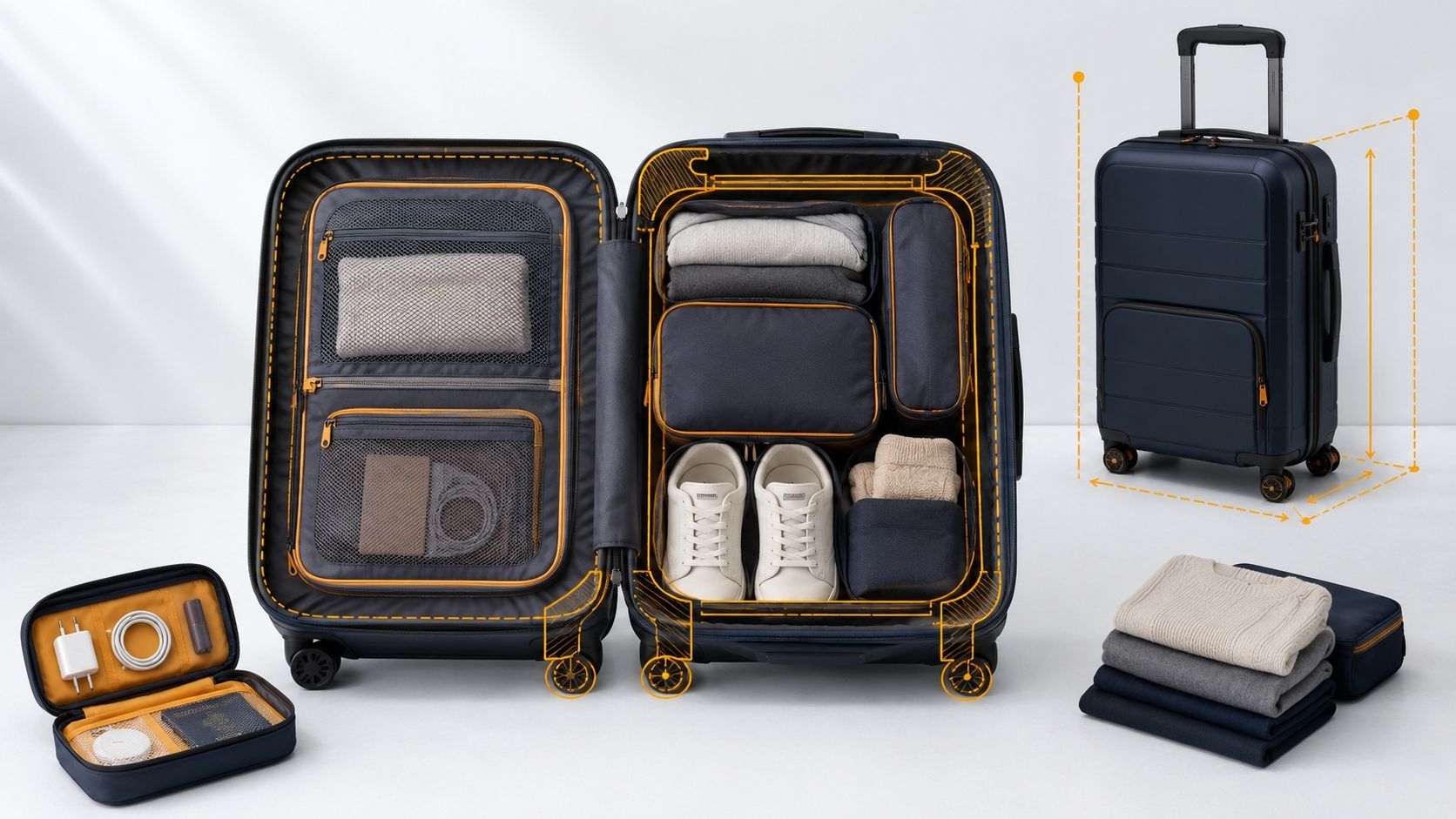
How Does Carry-On Capacity Limit Packing Volume?
Carry-on capacity limits packing volume by controlling how much usable interior space remains after wheels, handles, dividers, pockets, linings, shell thickness, and bag shape reduce the space available for clothing and gear.
This guide explains usable space, trip-based capacity planning, packing efficiency, bulge control, wasted-space mistakes, and a final checklist for optimizing carry-on capacity before travel.
Why does carry-on capacity matter for packing volume and airline-fit risk?
Carry-on capacity matters for packing volume and airline-fit risk because a bag can hold many items but still become too bulky, heavy, or misshapen for cabin travel.
Travelers often rely on labels like “carry-on size” or “large capacity,” but poor interior layout may reduce usable space. Wheels, handle rails, dividers, linings, and shell thickness can reduce the packing room that looks available from the outside.
Carry-on size limits should be checked after packing because usable capacity can still create a larger exterior profile. Plan around usable interior space, packed exterior shape, airline allowance, compactness, liftability, and cabin readiness.
How does carry-on capacity differ from external suitcase size?
Carry-on capacity differs from external suitcase size because the outside measurements show the bag’s exterior profile, while usable capacity describes the interior space available for packing.
Exterior size explains what the bag looks like from the outside, but usable capacity is shaped by spinner wheels, recessed wheel wells, telescoping handle rails, dividers, linings, shell thickness, and pocket layout.
A practical check is to compare the stated capacity with the actual interior layout. A bag with clean dimensions may still lose usable room to rails, corners, dividers, or thick panels.
| Bag Feature | Effect on Carry-On Capacity | Practical Packing Impact |
|---|---|---|
| Spinner wheels | May reduce internal corner space | Less flat packing area |
| Recessed wheels | Can protect wheels but shape the interior | Uneven base or wheel wells |
| Telescoping handle rails | Create raised channels | Small items may fill gaps better |
| Hardside shell | Holds shape well | Less flexible when overpacked |
| Softside body | Offers some flexibility | Can bulge if overfilled |
| External pockets | Adds quick-access space | Can increase exterior depth |
Which carry-on capacity fits different trip types and packing styles?
Carry-on capacity fits different trip types and packing styles when usable space matches trip length, climate, clothing needs, work gear, fare allowance, and return-trip space.
Which carry-on capacity works for short trips?
Carry-on capacity works for short trips when a compact carry-on or personal-item-sized bag can hold light clothing needs without encouraging overpacking. Carry-on short trips depend on matching usable capacity to light clothing needs and compact movement.
Which carry-on capacity works for business trips?
Carry-on capacity works for business trips when structured interior space separates clothing, shoes, tech, and documents without wasting too much room. Structured interiors can reduce flexible packing space when dividers and sleeves are too rigid.
Which carry-on capacity works for cold-weather travel?
Carry-on capacity works for cold-weather travel when the bag has enough usable space for layers and the traveler uses compression and outfit planning carefully. Compression can save space, but it may also make the bag heavier or harder to close.
Which carry-on capacity works for longer trips?
Carry-on capacity works for longer trips when the traveler uses the largest usable capacity that still fits the airline’s current carry-on rule after packing. More capacity can encourage overpacking, weight issues, and bulging.
Which carry-on capacity works for budget or strict-fare travel?
Carry-on capacity works for budget or strict-fare travel when the bag matches the exact allowance included with the fare. Underseat personal-item limits matter when a smaller bag must replace or support carry-on capacity.
| Travel Situation | Better Capacity Strategy | Main Risk to Avoid |
|---|---|---|
| Short trip | Compact, simple capacity | Carrying unnecessary space |
| Business trip | Organized interior capacity | Wasted space from rigid layouts |
| Cold-weather trip | Layer-friendly capacity | Bulky clothing expansion |
| Longer trip | Maximum allowed usable capacity | Overweight or bulging bag |
| Budget fare | Fare-matched capacity | Paying for the wrong allowance |
| Souvenir travel | Leave spare packing space | Returning with an overfilled bag |
How should travelers pack to improve carry-on capacity without creating bulge?
Travelers should improve carry-on capacity without creating bulge by filling structural gaps, keeping dense items low, using cubes for shape control, compressing selectively, and keeping exterior pockets flat.
Fill structural gaps first because wheel wells, corners, and handle channels can waste space if left empty. Keep dense items low and centered so the bag stays balanced and easier to lift.
Carry-on overhead bin fit depends on the packed bag shape, not just the stated volume or exterior dimensions. Carry-on risk reduction starts with controlling bulge, weight, expansion, and essentials access before boarding.
| Packing Method | Best Use | Main Caution |
|---|---|---|
| Flat folding | Shirts, trousers, formalwear | Can leave unused corners |
| Rolling | T-shirts, casual clothing | Can create uneven lumps |
| Packing cubes | Outfit or category control | Cubes can be overfilled |
| Compression cubes | Soft clothing and layers | May increase packed weight |
| Gap filling | Socks, belts, small items | Avoid hard bulges |
| External pockets | Thin documents or flat items | Avoid bulky items |
What mistakes reduce carry-on capacity and waste packing space?
Carry-on capacity is reduced by loose packing, unused corners, overfilled pockets, poor outfit planning, and over-compression that makes the bag heavy, stiff, or misshapen.
How does loose packing reduce carry-on capacity?
Loose packing reduces carry-on capacity when items are placed randomly and leave shifting gaps inside the bag. Cubes, pouches, or flat layers make the interior easier to stack and control.
How do unused corners reduce carry-on capacity?
Unused corners reduce carry-on capacity when wheel wells, handle channels, and shaped corners are left empty. Socks, underwear, accessories, or soft items capture more usable space without expanding the bag.
How do overfilled pockets reduce carry-on capacity?
Overfilled pockets reduce carry-on capacity by moving bulky items into outer compartments that distort the bag’s exterior profile. Keeping pockets flat preserves a cleaner cabin-fit shape.
How does poor outfit planning reduce carry-on capacity?
Poor outfit planning reduces carry-on capacity when travelers pack single-use clothing instead of reusable layers, neutral colors, and mix-and-match outfits. Fewer items can cover more travel situations.
How does over-compression reduce carry-on capacity usefulness?
Over-compression reduces carry-on capacity usefulness when the bag closes but becomes heavy, stiff, bulging, or difficult to handle. Selective compression keeps the bag easier to handle and less likely to create fit problems.
| Space-Wasting Mistake | Why It Hurts Capacity | Safer Fix |
|---|---|---|
| Loose packing | Creates shifting gaps | Use cubes or flat layers |
| Empty wheel wells | Wastes shaped spaces | Fill with soft items |
| Overfilled pockets | Adds outer bulge | Keep pockets flat |
| Too many shoes | Consumes rigid space | Limit pairs and fill inside shoes |
| Single-use outfits | Adds unnecessary clothing | Pack mix-and-match items |
| Over-compression | Adds weight and stiffness | Compress selectively |
Which pre-flight checklist helps optimize carry-on capacity before travel?
A pre-flight checklist helps optimize carry-on capacity by verifying ticket allowance, usable interior layout, dead-space control, pocket shape, expansion status, weight, packed exterior profile, and essentials access.
This checklist does not guarantee airline compliance, free boarding, or gate-check avoidance. It helps travelers keep carry-on capacity useful without turning usable volume into outer bulge or excess weight.
- Check whether your ticket includes a carry-on bag, personal item, or both.
- Confirm the airline’s current carry-on and personal-item rules for your route and fare type.
- Compare the bag’s stated capacity with its actual interior layout.
- Check whether wheels, handle rails, dividers, pockets, or shell shape reduce usable space.
- Fill small interior gaps with soft items instead of leaving dead space.
- Keep dense items low, centered, and away from outer bulge points.
- Use packing cubes or pouches to control shape and prevent shifting.
- Use compression only where it does not create excessive weight or bulge.
- Keep external pockets flat.
- Keep expansion zippers closed unless the expanded profile is still allowed.
- Leave some spare space if you expect souvenirs, laundry, or return-trip changes.
- Keep medication, documents, valuables, and permitted electronics easy to remove.
- Weigh the packed bag if your airline applies a cabin weight limit.
- Measure the fully packed exterior if overhead-bin or sizer fit matters.
- Recheck the bag after adding last-minute items.
What should you remember about carry-on capacity?
Carry-on capacity works best when usable interior space, packed exterior shape, airline rules, trip length, packing density, and liftability are planned together.
Capacity is not only the bag’s retail number or exterior size. Real packing volume depends on usable interior space, wheels, handle rails, shell shape, dividers, pockets, packing density, compression choices, bulge control, packed weight, airline rules, and trip needs.
Frequently Asked Questions About Carry-On Capacity
What is carry-on capacity?
Carry-on capacity is the usable interior packing space inside a carry-on bag. It is different from external suitcase size because wheels, handle rails, dividers, linings, shell thickness, pockets, and bag shape can reduce the space available for clothing and gear.
Does higher carry-on capacity mean better luggage?
Not always. Higher carry-on capacity can help on longer trips, but it can also encourage overpacking, bulging, heavier weight, and airline-fit problems. The best capacity is the usable space that still keeps the packed bag compact and manageable.
Why does carry-on capacity feel smaller than the bag’s outside size?
Carry-on capacity can feel smaller because wheel wells, handle channels, dividers, compression panels, linings, pockets, and shell shape reduce the flat interior area available for packing.
How can I improve carry-on capacity without overpacking?
Use packing cubes, fill small gaps with soft items, keep dense items low and centered, keep exterior pockets flat, compress only soft clothing selectively, and recheck the packed exterior profile before travel.
Can expansion zippers increase carry-on capacity safely?
Expansion zippers can increase capacity, but they also increase the packed exterior profile. Use expansion only when the expanded bag still fits the airline’s current rule and remains easy to lift and handle.