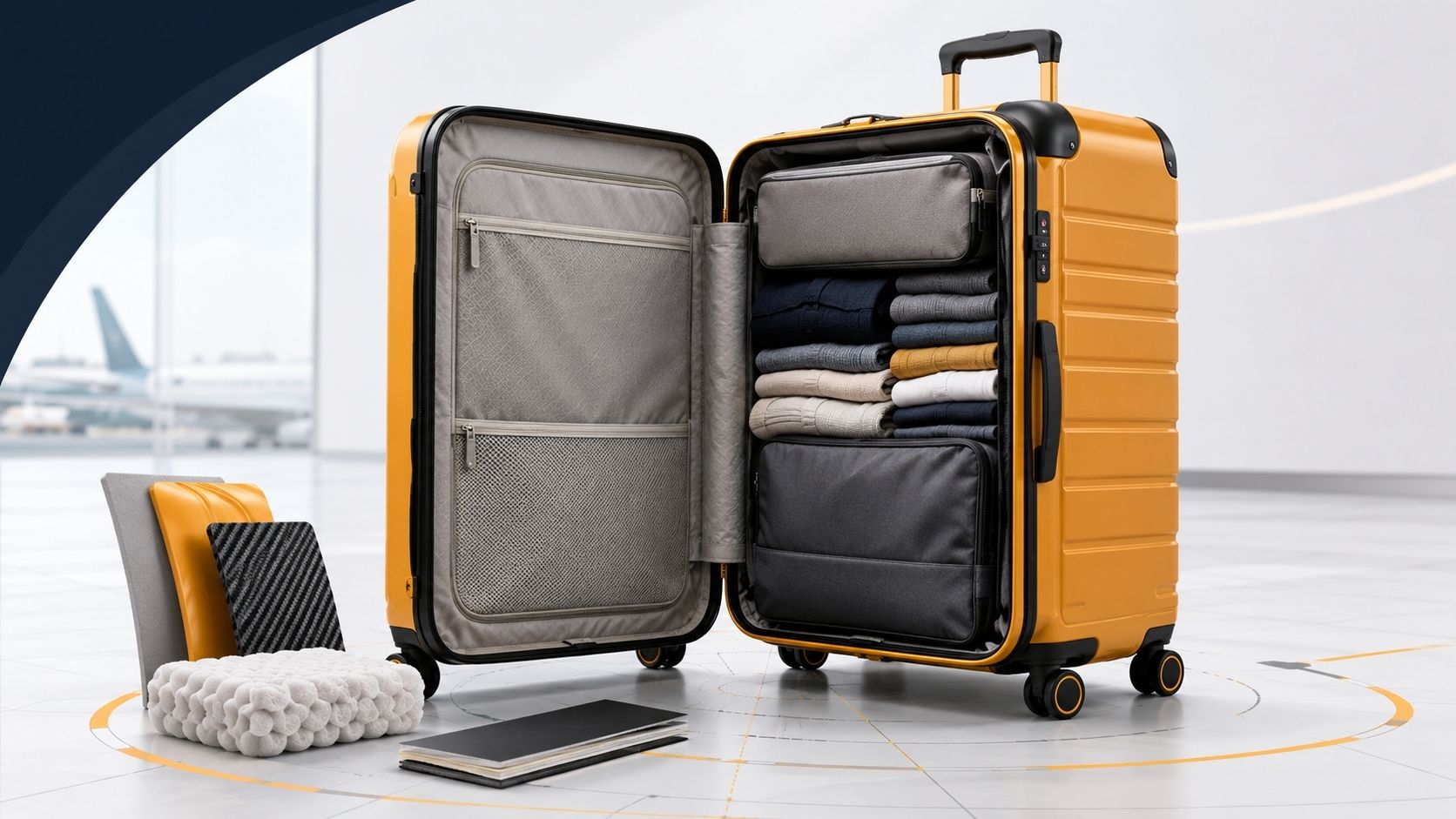
What Separates Hardside Luggage Through Rigid Shells, Fixed Capacity & Impact Protection?
Hardside luggage is separated by its rigid shell structure, fixed capacity, and ability to reduce direct compression on packed items during travel. It usually uses a structured clamshell format built from materials such as ABS, polypropylene, polycarbonate, or aluminum.
This article explains how hardside luggage materials differ, which protective features matter, how fixed-capacity clamshell packing should be controlled, how scratches, dents, cracks, wheels, and handles should be handled safely, and which structural checks to complete before travel.
Why does hardside luggage matter for protecting packed items during travel?
Hardside luggage matters for protecting packed items during travel because its rigid shell can help distribute pressure and reduce direct compression in some handling conditions. Checked bags and cabin bags can face stacking, conveyor movement, drops, compression, and rough handling.
The protection logic is that a rigid outer barrier can spread some pressure across the shell instead of allowing soft fabric to press directly into packed items. content protection works best when the shell and internal padding protect items together.
The boundary is important: hardside luggage does not guarantee item safety. impact resistance depends on shell material, shell thickness, corner design, handling exposure, wheels, zippers, frames, and how the bag is packed inside.
How do hardside luggage materials affect weight, impact response, and durability?
Hardside luggage materials affect weight, impact response, and durability by changing how the shell resists pressure, flexes, scratches, dents, and supports the bag’s structure. shell materials change weight, impact response, scratch visibility, and long-term durability trade-offs.
ABS hardside luggage is often budget-friendly and light, but it may have lower impact tolerance than stronger constructions. Polypropylene can offer lightweight flexibility, while polycarbonate often balances durability and flex, though it can still scuff, scratch, crack, or fail at components.
Aluminum hardside luggage can provide rigid premium structure and latch-style closure, but it is usually heavier, more expensive, and visibly prone to dents or deformation. Material matters, but whole-bag durability also depends on shell thickness, wheel housing, handles, zippers, latches, corners, and frame design.
| Material | Best Strength | Main Trade-Off | Best For |
|---|---|---|---|
| ABS | Low cost, light weight | Lower impact tolerance | Occasional travel |
| Polypropylene | Lightweight flexibility | Less premium feel | Weight-conscious flyers |
| Polycarbonate | Balanced durability and flex | Scratches/scuffs | Frequent travel |
| Aluminum | Rigid premium structure | Heavy, dents, costly | Premium/security-focused travel |
Which hardside luggage features improve protection, closure strength, and handling durability?
Hardside luggage features improve protection, closure strength, and handling durability when they protect common failure points such as wheels, corners, zipper tracks, latch frames, shell surfaces, and internal dividers.
When does zipperless hardside luggage make sense?
Zipperless hardside luggage makes sense when closure rigidity, latch alignment, and reduced zipper-track vulnerability matter more than low weight or overpacking flexibility. Framed closures can feel stronger, but they are often heavier, more expensive, and not theft-proof.
When does zippered hardside luggage make sense?
Zippered hardside luggage makes sense when lower weight, lower cost, flexible access, and broader product choice matter more than framed closure rigidity. The main warning is that zipper tracks can strain if the bag is overpacked or the shell is forced closed.
Why do recessed wheels and reinforced corners matter in hardside luggage?
Recessed wheels and reinforced corners matter in hardside luggage because wheels and corners are common high-impact zones during airport and cargo handling. Reinforcement can help protect vulnerable zones, but it may add weight or slightly reduce interior volume.
Why do textured finishes matter in hardside luggage?
Textured finishes matter in hardside luggage because matte, brushed, ribbed, or micro-textured shells can make scuffs less obvious after repeated trips. The trade-off is that textured shells may look less sleek than glossy shells and still cannot prevent all wear.
| Closure Type | Main Benefit | Main Trade-Off | Best For |
|---|---|---|---|
| Zippered | Lighter, common, flexible | Zipper strain risk | General travel |
| Zipperless framed | Stronger closure feel | Heavier, costly | Premium checked travel |
| Feature | Helps With | Watch Out For |
|---|---|---|
| Recessed wheels | Wheel protection | Slight space/weight trade-off |
| Reinforced corners | Impact zones | Adds weight |
| Textured shell | Scratch visibility | Less glossy appearance |
| Framed latch closure | Closure rigidity | Higher cost |
| Internal dividers | Packing stability | Can limit bulky items |
How should hardside luggage be packed to handle fixed capacity and clamshell balance?
Hardside luggage should be packed to handle fixed capacity and clamshell balance by distributing weight evenly, keeping dense items low, filling voids softly, and avoiding shell bulge. fixed volume makes overpacking risk easier to spot because the shell has limited expansion.
Pack both clamshell halves evenly so the bag closes without twisting the zipper line, latch frame, or shell edge. clamshell floor space affects how both halves are filled, balanced, and closed.
Keep dense items near the wheel base, use clothing cubes or soft items to fill empty spaces, and keep fragile items padded away from corners and shell edges. packing flexibility depends on divider layout, compression panels, and how the shell is filled.
Stop before the shell bows outward or the zipper or latch line strains. A hard shell can help protect contents, but it cannot rescue fragile items from poor internal padding or unstable packing.
| Packing Zone | Best Items | Purpose |
|---|---|---|
| Wheel-side base | Shoes, dense pouches | Balance |
| Center zones | Clothing cubes | Stability |
| Lid side | Soft layers, light items | Even fill |
| Corners | Avoid fragile items | Impact protection |
| Divider panels | Secured clothing | Shift control |
How can hardside luggage be maintained or repaired when wear appears?
Hardside luggage should be maintained or repaired cautiously because scratches, dents, cracks, jammed wheels, and sticky handles can require different responses depending on material, warranty, and manufacturer guidance.
How should scratches on hardside luggage be handled?
Scratches on hardside luggage should be handled by cleaning the shell gently according to manufacturer guidance before trying abrasive treatments. Harsh abrasives should be avoided unless the brand specifically recommends them for that shell material and finish.
How should dents in hardside luggage be handled?
Dents in hardside luggage should be handled by checking the shell material and manufacturer instructions before attempting heat, pressure, or reshaping. Aluminum dents or severe deformation should be handled through a luggage repair service or warranty process.
How should cracks in hardside luggage be handled?
Cracks in hardside luggage should be handled by checking warranty coverage before using adhesives, tapes, patches, or other repair methods. Structural cracks near wheels, corners, handles, hinges, zippers, latches, or frames should be treated as repair-or-replace issues.
How should hardside luggage wheels and handles be maintained?
Hardside luggage wheels and handles should be maintained by gently removing visible debris and keeping wheel housings and telescoping handle tracks clean. Modular wheels should only be replaced when the manufacturer provides compatible parts or repair instructions.
| Issue | Safer First Step | When to Escalate |
|---|---|---|
| Scratches | Clean gently | Deep gouges |
| Dents | Check material guidance | Aluminum or severe dents |
| Cracks | Check warranty first | Load-bearing cracks |
| Jammed wheels | Remove debris | Damaged wheel housing |
| Sticky handle | Clean tracks | Bent telescoping rails |
Which hardside luggage checks should you complete before airport drop-off?
A hardside luggage structural integrity check should confirm shell condition, wheels, handles, closures, packing balance, airline weight compliance, old tag removal, and bag identification before airport drop-off.
structural integrity depends on wheels, handles, zippers, corners, seams, shell, and frame working together, so the final inspection should test the whole bag rather than only the shell.
- Inspect shell corners for cracks, dents, deep gouges, or weak spots.
- Check wheel housings for looseness, wobbling, cracks, or trapped debris.
- Roll the bag on a flat surface to confirm smooth wheel movement.
- Extend and retract the telescoping handle several times.
- Check side and top handles for looseness or tearing.
- Confirm zippers, latches, or frame closures align without force.
- Avoid overpacking until the shell bulges or the zipper/latch strains.
- Balance heavy items between both clamshell halves.
- Keep fragile items padded and away from shell corners.
- Confirm the packed bag weight is within the airline’s checked or carry-on rule.
- Remove old airline tags and barcode stickers before checking the bag.
- Photograph the bag before airport drop-off if checking it.
What should you remember about hardside luggage?
Hardside luggage works best when its rigid shell, shell material, closure system, wheels, corners, packing balance, and maintenance condition all support the same trip need. The shell can add structure and reduce direct compression, but it is not indestructible, waterproof, crack-proof, or baggage-handler-proof.
The safest approach is to treat material choice as only one part of durability. Real hardside luggage performance depends on construction quality, component strength, fixed-volume packing discipline, warranty-aware repair decisions, and a final structural check before travel.
Frequently Asked Questions About Hardside Luggage
What is hardside luggage?
Hardside luggage is luggage built with a rigid outer shell, usually made from ABS, polypropylene, polycarbonate, or aluminum. It is designed to add structure, reduce direct compression, and keep a fixed suitcase shape during travel.
Is hardside luggage better than softside luggage?
Hardside luggage is better when rigid structure, impact protection, wipe-clean surfaces, and fixed shape matter most. Softside luggage can be better when exterior pockets, flexible packing, and squeeze space matter more. The better choice depends on the trip and packing style.
What is the best hardside luggage material?
The best hardside luggage material depends on the traveler’s priorities. ABS is usually more budget-friendly, polypropylene is often lightweight, polycarbonate often balances flex and durability, and aluminum offers rigid premium structure with more weight and visible dent risk.
Does hardside luggage scratch or dent?
Hardside luggage can scratch, scuff, dent, crack, or deform depending on material, finish, handling exposure, and construction quality. Textured finishes may make scuffs less visible, but no shell finish prevents all wear.
Can cracked hardside luggage be repaired?
Cracked hardside luggage may be repairable in some cases, but warranty coverage and manufacturer guidance should be checked first. Cracks near wheels, corners, handles, hinges, or closures should be treated as structural repair-or-replace issues.