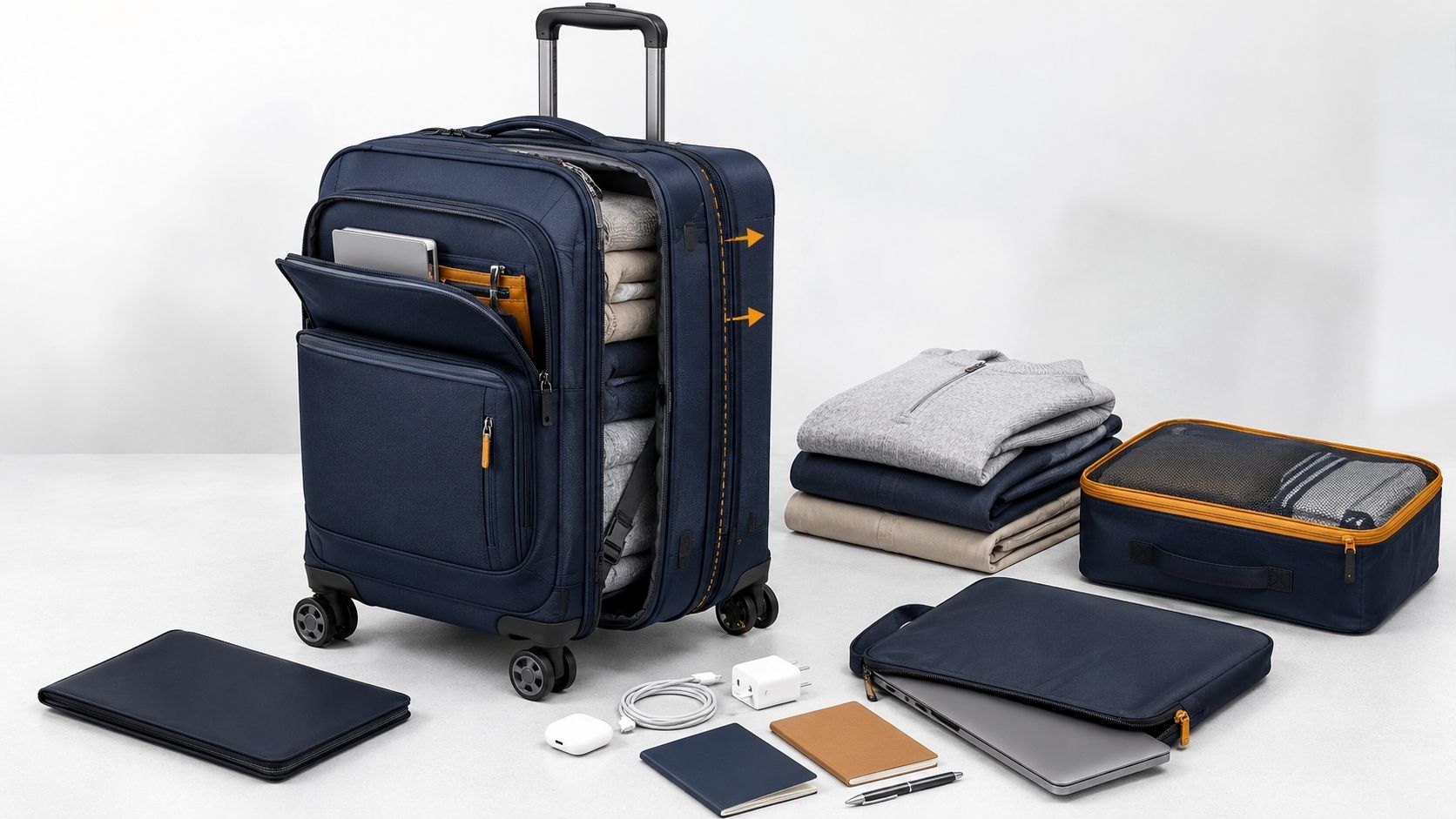
What Defines Softside Luggage Through Fabric Flexibility, Expandable Capacity, and Exterior Access?
Softside luggage is defined by flexible fabric panels, expandable capacity, exterior access, and a packing style that must control bulge, pocket pressure, and fabric stress. It uses textile panels, exterior pockets, expansion sections, and lighter construction to support adaptable packing and quick access.
This article explains softside luggage fabrics, denier limits, feature selection, packing zones, trip scenarios, textile and hardware maintenance, and the final transit checklist that helps prevent sizing, durability, and protection problems.
Why does softside luggage matter for flexible packing and travel access?
Softside luggage matters for flexible packing and travel access because fabric panels, expansion sections, and exterior pockets can help travelers manage tight spaces and changing packing needs. Travelers often need bags that work in overhead bins, car trunks, hotel storage, and last-minute packing situations.
The advantage is adaptability: softside luggage can use flexible fabric panels, exterior access, and expansion zones to hold documents, laptops, chargers, jackets, toiletries, or transit items without opening the main compartment. fabric flexibility helps the bag adapt to tight spaces, but it still needs controlled packing.
The boundary is that flexibility can become a problem when the bag is abused. Softside luggage can overexpand, bulge, tear, strain zippers, stress seams, or fail airline sizers if packed carelessly.
How do softside luggage fabrics, denier, and weave affect durability?
Softside luggage fabrics, denier, and weave affect durability by changing abrasion resistance, weight, flexibility, coating behavior, stitch strength, and long-term wear. softside fabrics change abrasion resistance, flexibility, weight, and long-term wear behavior.
Polyester softside luggage is often lower cost and practical for occasional travel, but it may wear sooner depending on grade and construction. Standard nylon can offer better strength-to-weight performance, while Cordura-style nylon and ballistic nylon are often associated with heavier-duty abrasion resistance and denser weave structures.
Denier is only one durability signal, not a complete quality score. Full build quality also depends on weave, coating, backing, stitching, seams, zippers, wheel mounts, handle mounts, and any internal frame support.
| Fabric Type | Best Strength | Main Trade-Off | Best For |
|---|---|---|---|
| Polyester | Lower cost | May wear sooner | Occasional travel |
| Standard nylon | Better strength-to-weight | Varies by grade | Carry-on use |
| Cordura-style nylon | Abrasion resistance | Can cost more | Rugged travel |
| Ballistic nylon | Dense, durable weave | Heavier, premium | Frequent travel |
Which softside luggage features balance expansion, structure, and protection?
Softside luggage features balance expansion, structure, and protection when extra capacity, exterior access, reinforcement, and shape control are matched to realistic packing and sizing limits. exterior access helps travelers reach documents, tech, jackets, and toiletries without opening the main compartment.
When do expansion zippers improve softside luggage?
Expansion zippers improve softside luggage when extra depth is needed temporarily and the fully packed bag still stays within the allowed size. expandable zippers add depth, but packed dimensions must still match airline limits.
They can help with return-trip purchases, bulky clothing, or flexible packing, but expanded depth can also make the bag fail airline size limits or increase zipper strain.
When do exterior pockets improve softside luggage?
Exterior pockets improve softside luggage when documents, laptops, jackets, chargers, or small essentials need to stay accessible during travel. front pockets work best when they stay shallow, flat, and protected from internal pressure.
When do reinforced corners and skid guards improve softside luggage?
Reinforced corners and skid guards improve softside luggage when high-wear areas need extra protection from curbs, baggage belts, and rough floors. The trade-off is that reinforcement may add weight, reduce flexibility, or make the bag look less sleek.
When does a structured frame improve softside luggage?
A structured frame improves softside luggage when the traveler wants shape control, rolling stability, and better organization without losing all fabric flexibility. More structure can reduce compressibility, so the frame should match the trip rather than fight the bag’s flexible purpose.
| Feature | Helps With | Watch Out For |
|---|---|---|
| Expansion zipper | Extra capacity | Oversize risk |
| Exterior pockets | Quick access | Pocket bulge |
| Reinforced corners | Wear protection | Added weight |
| Skid guards | Abrasion zones | Less sleek look |
| Internal frame | Shape control | Less compression |
How should softside luggage be packed to protect pockets, balance weight, and avoid bulging?
Softside luggage should be packed by keeping dense items low, protecting exterior-pocket space, compressing internally before expansion, avoiding sharp pressure points, and keeping quick-access items flat. overpacking can create pocket bulge, zipper strain, fabric stress, and sizer risk.
Pack dense items near the wheel base to improve balance and rolling stability. Keep soft layers behind the front wall so exterior pockets remain usable instead of being pushed outward from inside the main cavity.
Use expansion only after internal compression, and avoid sharp pressure points against fabric walls. Quick-access items should stay shallow and flat so front pockets do not bulge beyond the bag’s intended exterior shape.
| Packing Zone | Best Items | Purpose |
|---|---|---|
| Wheel base | Shoes, dense pouches | Balance |
| Center cavity | Clothing cubes | Main volume |
| Front wall | Soft layers | Pocket protection |
| Exterior pockets | Flat essentials | Quick access |
| Expansion zone | Backup space | Controlled overflow |
Which softside luggage style fits different trip scenarios best?
Softside luggage style fits different trip scenarios best when fabric flexibility, exterior access, structure, reinforcement, and packing discipline match the travel environment.
What softside luggage works best for carry-on travel?
Lightweight softside carry-ons with exterior pockets often work best for carry-on travel because quick access and slight flexibility help in airport and cabin settings. The risk is that expansion zippers and overfilled pockets can cause sizer problems.
What softside luggage works best for checked travel?
Structured softside checked bags with reinforced corners, strong wheels, and durable fabric often work best for checked travel when flexibility is needed but handling exposure is higher. content protection limits matter when fragile or crush-sensitive items need extra padding.
The warning is that softside checked luggage usually offers less crush protection than many hardside shells, so fragile items should still be padded and positioned carefully.
What softside luggage works best for business travel?
Softside spinners or rollers with laptop/document pockets and organized front panels often work best for business travel because exterior access separates work items from clothing. Electronics still need padded sleeves or dedicated protection.
What softside luggage works best for road trips?
Expandable softside suitcases or rolling duffels often work best for road trips because flexible fabric can fit better in trunks, hotel rooms, and mixed packing spaces. Loose packing can shift if the bag is not stabilized with cubes, straps, or soft filler.
| Scenario | Best Softside Luggage Style | Main Risk |
|---|---|---|
| Carry-on flight | Lightweight pocketed carry-on | Sizer bulge |
| Checked flight | Structured reinforced softside | Less crush protection |
| Business travel | Organized front-pocket suitcase | Tech protection needed |
| Road trip | Expandable softside or rolling duffel | Shifting contents |
| Family travel | Large softside with pockets | Overpacking |
How can softside luggage be maintained or repaired when fabric, zipper, or seam wear appears?
Softside luggage should be maintained or repaired carefully because fabric, zipper, seam, wheel, and handle wear can become structural if ignored or treated with the wrong method.
How should zipper snags on softside luggage be handled?
Zipper snags on softside luggage should be handled by stopping force immediately, backing the slider up gently, and clearing trapped fabric or threads. Escalate to repair service or warranty support if teeth, slider, or track are damaged.
How should small fabric scuffs or punctures on softside luggage be handled?
Small fabric scuffs or punctures on softside luggage should be handled by cleaning the area and checking manufacturer repair guidance before using patches or adhesives. Fabric-compatible patches should only be used for minor non-load-bearing damage.
How should water exposure on softside luggage be handled?
Water exposure on softside luggage should be handled by emptying the bag, air-drying it fully, and avoiding storage while damp. Use only manufacturer-approved water-repellent treatments when appropriate, and do not treat ordinary fabric as waterproof unless verified.
How should frayed piping or seam wear on softside luggage be handled?
Frayed piping or seam wear on softside luggage should be handled by checking whether the damage is cosmetic or structural. Structural seam separation should be repaired professionally or evaluated under warranty.
| Issue | Safer First Step | When to Escalate |
|---|---|---|
| Zipper snag | Back up gently, clear fabric | Damaged teeth/slider |
| Fabric scuff | Clean and inspect | Deep puncture |
| Wet fabric | Empty and air-dry | Odor, staining, soaked lining |
| Frayed piping | Inspect stress area | Seam separation |
| Wheel/handle stress | Check screws and mounts | Loose housing or torn fabric |
Which softside luggage checks should you complete before travel?
A softside luggage transit check should confirm size compliance, expansion control, pocket shape, weight balance, seam condition, zipper movement, wheel cleanliness, fabric dryness, and fragile-item protection before travel.
This checklist does not guarantee airline fit, waterproofing, tear resistance, or crush protection. It helps reduce avoidable bulge, seam stress, zipper strain, and weak-point failures before the bag is used.
- Confirm the packed bag fits the airline size rule if used as carry-on luggage.
- Keep expansion zippers closed unless the expanded size is still allowed.
- Check exterior pockets for bulging.
- Pack heavy items near the wheel base.
- Leave front-pocket space usable by placing soft clothing behind it.
- Inspect seams around handles, wheels, corners, and zipper tracks.
- Clear dirt, hair, or debris from wheels.
- Test all zippers without forcing them.
- Confirm compression straps are secure and not dangling.
- Check for wet fabric, odor, or damp lining before storage.
- Use only manufacturer-approved fabric protectors or treatments.
- Keep fragile items padded because softside luggage offers limited crush protection.
- Remove old airline tags before checking the bag.
- Photograph the bag before airport drop-off if checking it.
What should you remember about softside luggage?
Softside luggage works best when fabric flexibility, exterior access, expansion, pocket use, and packing control support the trip without creating bulge, seam strain, or weak-point stress. Its main advantage is adaptability, not guaranteed fit or indestructible protection.
The safest approach is to treat fabric type, denier, pockets, expansion, zippers, seams, wheels, handle mounts, and internal frame support as one system. Softside luggage performs better when flexibility is controlled, repair advice follows manufacturer guidance, and fragile contents receive extra internal padding.
Frequently Asked Questions About Softside Luggage
What is softside luggage?
Softside luggage is luggage built with flexible fabric panels, usually using materials such as polyester, nylon, Cordura-style nylon, or ballistic nylon. It often includes exterior pockets, expansion zippers, and lighter construction than many hardside bags.
Is softside luggage better than hardside luggage?
Softside luggage is better when flexible packing, exterior access, lighter handling, and pocket organization matter most. Hardside luggage can be better when rigid shell structure and crush protection matter more. The better choice depends on the trip.
Does softside luggage fit airline sizers more easily?
Softside luggage can flex into tight spaces, but it can also bulge beyond airline limits when overpacked. The fully packed bag, including pockets and expansion depth, should be measured before travel.
Is softside luggage waterproof?
Softside luggage is usually not waterproof unless a product has verified waterproof construction. Many fabric bags may be water-resistant or water-repellent, but seams, zippers, pockets, and fabric backing can still allow moisture exposure.
Can damaged softside luggage be repaired?
Damaged softside luggage may be repairable when the issue is minor and non-load-bearing, but warranty and manufacturer guidance should be checked first. Structural seam damage, zipper track failure, loose wheel housing, or torn handle mounts need professional repair or replacement evaluation.