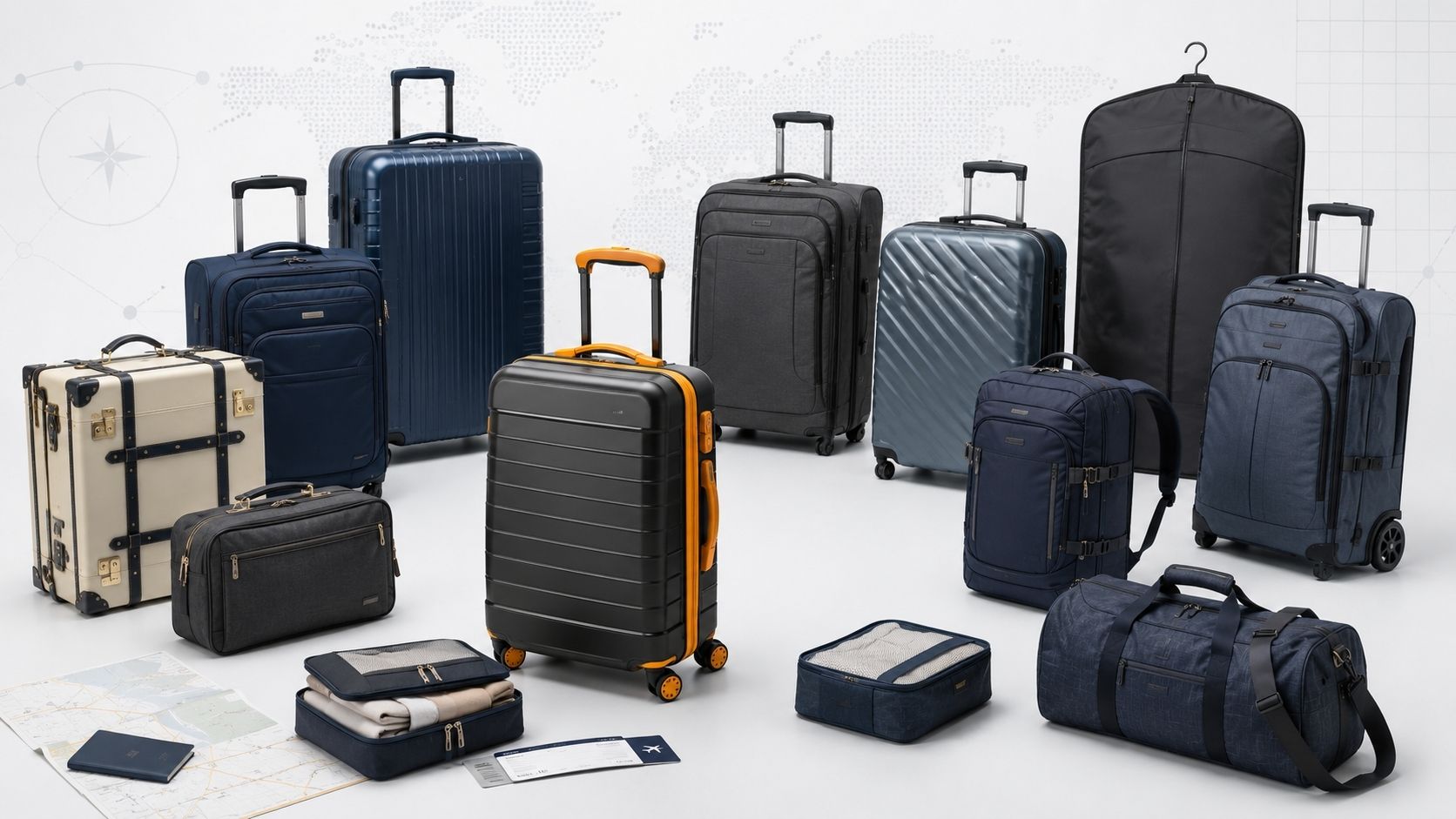
12 Luggage Types Explained by Fit, Structure, Capacity, and Mobility
Luggage types are best understood by how they fit into travel spaces, how much they carry, how they protect packed items, and how easily they move through airports, streets, stairs, trains, and hotels. They are not just bag names; the right luggage type depends on travel placement, packing load, protection needs, route terrain, and airline rules.
This page explains why luggage choice matters, how luggage types are classified, how overhead-bin, cargo-hold, and underseat bags differ, how hardside, softside, trunk, and garment structures work, how spinner, roller, backpack, duffel, and suitcase formats move, which travel scenarios they suit, which mistakes to avoid, and what to check before packing.
This article is for general luggage education and trip-planning support. Always verify current airline baggage rules, fare conditions, aircraft storage limits, and product specifications before packing, purchasing, or relying on a luggage type for a specific trip.
Why does choosing the right luggage type matter before a trip?
Choosing the right luggage type matters because the wrong bag can create airline fees, mobility problems, wasted packing space, damaged belongings, or unnecessary travel strain. A bag that looks practical at home can become the wrong tool when it meets an airline sizer, a crowded train platform, a cobblestone street, or a long hotel corridor.
Luggage selection should happen before packing, not after the bag is already full. The trip condition comes first, then the bag choice: airline rules affect fit, trip length affects capacity, terrain affects mobility, packing load affects weight, item protection affects structure, and traveler comfort affects carrying style.
A large trunk may hold more than a standard suitcase, but that extra depth can encourage overpacking and make checked-bag weight limits harder to manage. A compact underseat bag may reduce airport friction, but it can fail quickly when the trip needs bulky clothing, extra shoes, or family essentials.
How should luggage types be classified before comparing travel bags?
Luggage types should be classified by transit placement, capacity class, structural format, mobility method, and carrying style before any travel bag is compared. Without that classification, travelers end up comparing a carry-on to a trunk, a spinner to a garment bag, or a backpack to a checked suitcase as if they solve the same problem.
Transit placement means where the bag travels: overhead bin, underseat area, or cargo hold. Capacity class explains how much the bag can reasonably carry before size or weight becomes a problem. Structural format shows whether the bag is rigid, flexible, deep, foldable, or garment-focused.
Mobility method explains how the traveler moves the bag through airports, streets, stairs, trains, and hotels. Carrying style covers wheels, shoulder straps, backpack harnesses, hand grips, and rolling systems. Before comparing luggage types, suitcase classification separates bags by structure, placement, and travel role.
Category overlap is normal. One bag can be carry-on, hardside, and spinner at the same time; another can be checked, softside, and roller. The useful question is not what the bag is called, but which travel pressure it solves and which trade-off it creates.
| Luggage Type | Classification Lens | Best For | Main Limitation |
|---|---|---|---|
| Carry-on luggage | Transit placement | Short trips and overhead-bin travel | Airline size limits vary |
| Checked luggage | Transit placement | Long trips and bulky packing | Weight limits and baggage handling |
| Underseat luggage | Transit placement | Minimal packing and personal-item travel | Very limited capacity |
| Hardside luggage | Structure | Impact protection and cleaner exterior | Less flexible packing |
| Softside luggage | Structure | Expandability and outer pockets | Less shell protection |
| Trunk luggage | Structure/capacity | Bulky or compartment-heavy packing | Easy to overpack |
| Garment bag | Purpose/structure | Suits, dresses, and formalwear | Poor bulk-packing efficiency |
| Spinner luggage | Mobility method | Smooth airport floors | Weaker on rough ground |
| Roller luggage | Mobility method | Uneven streets and curbs | Less agile in tight spaces |
| Travel backpack luggage | Carrying style | Stairs, trains, and hands-free movement | Can strain shoulders when overloaded |
| Duffel luggage | Form factor | Road trips, sports gear, flexible packing | Poor structure unless reinforced |
| Standard suitcase | Parent/form format | General travel packing | Less specialized than purpose-built bags |
Which luggage types fit overhead bins, cargo holds, and underseat spaces?
Carry-on, checked, and underseat luggage types differ mainly by where the bag travels during a flight and how much packing capacity the traveler needs. Transit placement is the first luggage decision for air travel because it controls cabin access, cargo-hold exposure, packing volume, and item availability during the trip.
Airline rules vary by carrier, fare class, route, aircraft, cabin storage, and personal-item policy. Suitcase flight placement changes whether a bag belongs in the cabin, underseat area, or cargo hold.
Wheels, handles, and expansion zippers can affect real measurements. A bag may fit when empty but fail when packed, especially if the expanded depth pushes it beyond an airline sizer or overhead-bin limit.
When should carry-on luggage be your main travel bag?
Carry-on luggage should be your main travel bag when you want overhead-bin storage, faster airport exit, and enough capacity for a short or lightly packed trip. It is designed for cabin overhead-bin travel when the airline rules, fare conditions, and packed dimensions support that use.
Carry-on luggage can support short trips, lighter packing, faster airport exits, and keeping key belongings closer than checked bags. Carry-on luggage works best when cabin rules match the packed size and travel load.
The trade-off is that carry-on luggage does not automatically avoid fees or fit every aircraft. Wheels and handles may count toward the total measurement, and a fully packed bag may become deeper than the traveler expects.
When does checked luggage make more sense than carry-on luggage?
Checked luggage makes more sense than carry-on luggage when the trip requires more capacity, bulkier clothing, family packing, or items that cannot fit within cabin limits. It is designed for cargo-hold travel and usually supports longer trips or larger packing loads.
Checked luggage can help with winter clothing, family items, bulky gear, multiple outfits, and travel plans that exceed cabin-bag capacity. Checked luggage gives more capacity but adds cargo-hold handling exposure and weight-limit pressure.
The trade-off is that checked luggage faces more baggage handling than cabin luggage and can create overweight-fee risk when larger capacity encourages overpacking. The bag should be weighed before travel, not estimated by feel.
When is underseat luggage the smartest choice?
Underseat luggage is the smartest choice when a traveler needs a compact personal-item bag for essentials, strict budget fares, or one-to-two-day minimalist travel. It is intended to fit below the seat in front of the traveler, but that space is not identical across airlines and aircraft.
Underseat luggage can support electronics, medication, documents, chargers, valuables, strict personal-item fares, and minimal overnight packing. Underseat luggage depends on personal-item limits and seat-space constraints, not the label alone.
The trade-off is capacity. Underseat bags can be very useful for essentials and minimalist travel, but they should not be treated as a guaranteed replacement for all trip luggage or as universally accepted on every aircraft.
| Type | Travel Position | Best Trip Length | Capacity Level | Main Risk |
|---|---|---|---|---|
| Underseat luggage | Below seat | 1–2 days | Low | Too small for bulky items |
| Carry-on luggage | Overhead bin | 2–5 days | Medium | May fail size check |
| Checked luggage | Cargo hold | 5+ days | High | Weight fees or rough handling |
How do hardside, softside, trunk, and garment luggage types differ by structure?
Hardside, softside, trunk, and garment luggage types differ by shell rigidity, packing flexibility, item protection, access style, and the kind of belongings they handle best. Structure changes how a bag protects contents, how it opens, how it expands, and how easily the traveler can reach packed items.
Suitcase shell format changes protection, flexibility, opening style, and packing access. A rigid shell can help with structure, while a fabric body can help with pockets and flexibility, but neither format is automatically better for every route or packing style.
The practical choice is structure type, benefit, trade-off, and use case. Hardside luggage supports protection and shape, softside luggage supports flexibility and access, trunk luggage supports deep capacity, and garment bags support formalwear organization.
Why choose hardside luggage for protective travel?
Hardside luggage is a strong choice for protective travel because its rigid shell can help resist impact, keep a cleaner exterior, and give packed items a more structured enclosure. Common shell materials include polycarbonate, ABS, and aluminum, but material names alone do not prove durability without product-specific details.
Hardside luggage can suit fragile items, checked bags, rainy conditions, and travelers who want a fixed packing structure. Its limitation is that it usually offers less flexible packing, fewer exterior pockets, and more fixed volume than softside formats.
The boundary is simple: hardside luggage may improve structure and exterior protection, but it does not prevent all damage. Packing method, baggage handling, product build, and contents still matter.
Why choose softside luggage for flexible packing?
Softside luggage is a strong choice for flexible packing because its fabric body can offer exterior pockets, expansion panels, and more give in tight travel spaces. Common fabric materials include nylon and polyester, but the exact fabric, weave, coating, seams, and product build affect real performance.
Softside luggage can suit carry-on travelers, road trips, frequent item access, flexible packing, and exterior-pocket use. Its limitation is less shell protection and greater exposure to tearing, staining, or moisture compared with a rigid case.
The hidden risk is expansion. A softside bag that fits before packing may become too deep when expanded, especially when airline size limits are tight.
When does trunk luggage work better than a standard suitcase?
Trunk luggage works better than a standard suitcase when a traveler needs deep capacity, compartment-heavy organization, or bulk packing for long stays. Its deep rectangular body can handle bulky clothing, relocation-style packing, and separated compartments better than many standard suitcase layouts.
The trade-off is overpacking. Trunk luggage can become heavy quickly, and extra depth can make checked-bag weight limits, lifting, storage, and small-space movement harder to manage.
Trunk luggage should be chosen for a clear capacity need, not because bigger looks safer. A luggage scale and a packing limit should be used before the bag is full.
When should garment bags be used for formal clothing?
Garment bags should be used when formal clothing needs wrinkle control, hanging structure, and separation from casual packed items. They are fold-out or hanging luggage structures designed for suits, dresses, uniforms, weddings, conferences, business trips, and formal events.
The trade-off is bulk efficiency. Garment bags are less useful for dense casual clothing, extra shoes, heavy gear, or trips where every inch of packing space must hold mixed items.
A garment bag can support better formalwear organization, but it cannot eliminate wrinkles completely. Fabric type, folding method, garment weight, and how tightly the bag is packed still matter.
| Structure Type | Protection | Flexibility | Packing Access | Best Use |
|---|---|---|---|---|
| Hardside | High | Low | Moderate | Fragile or checked items |
| Softside | Moderate | High | High | Carry-on and flexible packing |
| Trunk | High | Low | High capacity | Bulky or long-stay packing |
| Garment bag | Moderate | Specialized | Formalwear-focused | Suits, dresses, uniforms |
How do spinner, roller, backpack, duffel, and suitcase luggage types move through real trips?
Spinner, roller, backpack, duffel, and suitcase luggage types move differently because wheels, straps, handles, frame shape, and carrying position change how the bag performs on smooth floors, rough streets, stairs, and trains. The best mobility method is the one that matches the route, not just the airport.
Suitcase wheel mobility affects how luggage moves through airports, streets, curbs, and train stations. Smooth terminals reward spinner wheels, rough streets often reward roller wheels, stairs reward backpack carry, and road trips often reward flexible duffel shapes.
The wrong mobility match can make a good bag feel bad. A spinner that glides through a hotel lobby may struggle on broken pavement, while a travel backpack that works on stairs may become uncomfortable if overloaded or poorly fitted.
When is spinner luggage the easiest option?
Spinner luggage is easiest when the trip stays mostly on smooth airport floors, hotel lobbies, and flat terminal surfaces. Four rotating wheels allow the bag to move beside the traveler instead of being dragged behind the body.
Spinner luggage can reduce wrist and shoulder effort on smooth indoor surfaces, especially during airport transfers, hotel check-ins, and long terminal walks. Its weak surfaces are rough pavement, cobblestones, curbs, gravel, and broken sidewalks.
Spinner luggage should be treated as a smooth-route choice, not a universal mobility solution. It can be excellent in airports and frustrating when the destination route is rough.
When is roller luggage better than spinner luggage?
Roller luggage is better than spinner luggage when the route includes rough streets, curbs, uneven sidewalks, or train-station movement. Two fixed wheels are often more stable on uneven ground than small rotating spinner wheels.
Roller luggage can suit urban routes, cobblestone streets, curb-heavy walks, station platforms, and destinations where the bag must be pulled across imperfect surfaces. Its limitation is that it is less agile in tight spaces and must usually be pulled behind the body.
Roller luggage is not automatically stronger than spinner luggage. The product build, wheel housing, wheel size, axle design, and route conditions still matter.
When does travel backpack luggage outperform wheeled luggage?
Travel backpack luggage outperforms wheeled luggage when stairs, buses, hostels, trains, uneven paths, or fast hands-free movement matter more than rolling convenience. It uses shoulder straps, harness systems, and sometimes hip belts to move the load with the traveler.
Travel backpack luggage can suit stair-heavy routes, hostels, buses, train platforms, uneven streets, and fast transfers. It also keeps both hands free when rolling a suitcase would be awkward.
The trade-off is body load. Travel backpacks can strain shoulders and the back when overloaded or poorly fitted, so they should not be recommended for travelers who cannot comfortably carry the packed weight.
When should duffel luggage be used instead of a suitcase?
Duffel luggage should be used instead of a suitcase when flexible shape, gear storage, car-trunk fit, or casual road-travel packing matters more than rigid structure. A duffel is a soft-bodied bag with handles, a shoulder strap, wheels, or a combination of carrying options.
Duffel luggage can suit road trips, sports gear, camping equipment, gym travel, flexible packing, and car-trunk storage. Its soft form can fit spaces where framed suitcases feel too rigid.
The trade-off is support. Non-wheeled duffels become difficult when heavy, and dense gear can be uncomfortable to carry over long distances. A rolling duffel is usually a better match when flexible gear is also heavy.
When is a standard suitcase still the safest all-purpose luggage type?
A standard suitcase remains the safest all-purpose luggage type when the traveler wants one simple framed bag for airports, hotels, general packing, and predictable organization. It usually has a rectangular frame, handles, wheels, and a familiar packing layout.
A standard suitcase works well for general travel because it balances structure, packing order, rolling movement, and hotel storage. It can be easier to organize than a duffel and less specialized than a garment bag, trunk, or travel backpack.
The limitation is specialization. A standard suitcase is less suited to stairs, formalwear, rough terrain, adventure routes, or flexible gear loads than luggage types designed for those pressures. A suitcase is one form of luggage, not the same thing as all luggage.
| Mobility Type | Smooth Airports | Rough Streets | Stairs | Wrist Strain | Best Traveler |
|---|---|---|---|---|---|
| Spinner luggage | Excellent | Weak | Weak | Low | Airport-focused travelers |
| Roller luggage | Good | Stronger | Weak | Moderate | Urban and train travelers |
| Travel backpack | Good | Excellent | Excellent | None, but shoulder load | Hands-free travelers |
| Duffel luggage | Moderate | Moderate | Moderate | High if not wheeled | Road trip and gear travelers |
How can you choose the right luggage type for each travel scenario?
The right luggage type should be chosen by matching the bag to the trip scenario, not by choosing the largest, newest, or most popular option. Each travel scenario has a different pressure point: fees, terrain, formalwear, family essentials, gear flexibility, lifting difficulty, or access needs.
A weekend budget flight rewards compact control. A train route rewards mobility over smooth showroom rolling. A destination wedding rewards clothing separation. A family vacation rewards separating bulk from urgent items. An adventure or road trip rewards flexible gear handling.
What luggage type works best for a weekend budget flight?
Underseat luggage or a compact carry-on works best for a weekend budget flight because the traveler usually needs minimal packing and tighter control over airline fees. The main pressure point is fare rules, especially when overhead-bin luggage is restricted or charged separately.
Underseat luggage can work for a strict personal-item trip, while a compact carry-on can work when the fare includes overhead-bin access. Expanded softside bags should be avoided if they might fail the personal-item or carry-on sizer after packing.
What luggage type works best for two weeks in Europe by train?
Roller luggage or travel backpack luggage works best for two weeks in Europe by train because stations, stairs, platforms, and uneven streets punish oversized or spinner-only setups. The main pressure point is movement between stations, lodging, sidewalks, and train storage areas.
Roller luggage can handle uneven streets better than many spinner bags, while travel backpack luggage can help when stairs dominate the route. Oversized checked luggage should be avoided when it is difficult to lift onto trains or manage in tight storage spaces.
What luggage type works best for a destination wedding?
A garment bag paired with hardside checked luggage or a structured carry-on works best for a destination wedding because formalwear needs wrinkle control and item protection. The main pressure point is keeping suits, dresses, uniforms, and delicate clothing separated from dense casual packing.
A garment bag can support hanging structure, while hardside checked luggage or a structured carry-on can help protect surrounding items. Overstuffed duffels should be avoided because they can crush delicate clothing and make formalwear harder to manage.
What luggage type works best for a family vacation?
Checked luggage plus one underseat or carry-on essentials bag works best for a family vacation because bulk items and urgent items should travel separately. The main pressure point is access: medication, electronics, snacks, chargers, documents, valuables, and a practical clothing backup should not all disappear into checked luggage.
Checked luggage can handle the bulk of family packing, while underseat or carry-on luggage can keep urgent items close. Family travel benefits from separation and access, not one overloaded bag that becomes hard to lift, track, or reorganize.
What luggage type works best for adventure or road travel?
Duffel luggage, rolling duffel luggage, or travel backpack luggage works best for adventure or road travel because flexible shapes handle gear loads and non-airport routes better than formal suitcases. The main pressure point is gear movement through car trunks, campsites, sports settings, and irregular routes.
Duffel luggage can flex around camping equipment, sports gear, and casual packing. Travel backpack luggage can help when hands-free carrying matters. Glossy hardside cases may scratch or crack under rough use, depending on material, construction, and handling conditions.
| Trip Scenario | Best Luggage Type | Why It Works | Avoid |
|---|---|---|---|
| Weekend budget flight | Underseat luggage | Minimal, compact, fee-conscious | Oversized carry-on |
| Business trip | Carry-on or garment bag | Fast airport exit, formalwear support | Large checked trunk |
| Two-week train trip | Roller or travel backpack | Handles stairs and rough streets | Spinner-only setup |
| Family vacation | Checked + underseat essentials | Separates bulk from urgent items | One overloaded bag |
| Adventure travel | Duffel or backpack luggage | Flexible and terrain-friendly | Delicate hardside-only setup |
Which luggage type mistakes cause fees, strain, or damaged belongings?
The most common luggage type mistakes happen when travelers ignore airline fit, packed weight, destination terrain, carrying strain, or expansion size before leaving home. Most of these problems are preventable when the bag is matched to the trip before packing begins.
The correction pattern is direct: identify the mistake, understand the consequence, and fix the bag choice before the trip creates pressure. The goal is not to blame the traveler; it is to prevent avoidable fees, awkward movement, and poor packing decisions.
Why is assuming all carry-on luggage fits every airline a mistake?
Assuming all carry-on luggage fits every airline is a mistake because airline size limits, fare rules, aircraft storage, and measurement methods vary. A carry-on label does not guarantee that the bag will fit the exact carrier, fare, aircraft, or packed size requirement.
Wheels, handles, and expansion zippers may add bulk. Airline sizers measure the real packed bag, not the marketing category. The fix is to check the exact airline and fare rules before packing and test packed dimensions before leaving home.
Why can trunk luggage lead to overweight baggage?
Trunk luggage can lead to overweight baggage because deep capacity encourages overpacking before the traveler notices the checked-bag weight limit. The extra volume can make it easy to add shoes, winter clothing, souvenirs, and bulky items until the bag becomes expensive or hard to move.
The consequence can be overweight fees, harder lifting, awkward storage, and difficult movement through small spaces. The fix is to use a luggage scale and set a packing limit before the trunk is full.
Why can spinner luggage become frustrating on rough streets?
Spinner luggage can become frustrating on rough streets because small rotating wheels perform best on smooth floors, not cobblestones, curbs, gravel, or broken pavement. A spinner that feels effortless in an airport can become unstable or noisy outside the terminal.
The consequence is poor control and more stopping, lifting, or dragging. The fix is to choose roller luggage or travel backpack luggage when the route includes rough terrain, while still recognizing that spinner luggage can work well in airports and hotels.
Why is a non-wheeled duffel risky for heavy packing?
A non-wheeled duffel is risky for heavy packing because dense gear shifts the load onto the shoulder, neck, back, or one side of the body. That load becomes more noticeable during terminal walks, hotel corridors, parking areas, stairs, and train platforms.
The consequence is carrying fatigue and awkward movement, especially when the duffel is overloaded. The fix is to use a rolling duffel for heavy flexible gear or split weight between a wheeled suitcase and a smaller personal bag.
Why can softside expansion create hidden size problems?
Softside expansion can create hidden size problems because an expanded zipper can make the packed bag too deep for the airline sizer or overhead space. A bag can fit empty, then fail when clothing, shoes, and compression pressure push the expanded panel outward.
The consequence is a possible gate problem, forced checking, or repacking at the airport. The fix is to compress contents internally, test packed size before leaving home, and avoid expansion when the airline limit is tight.
How should you finalize your luggage type choice before packing?
You should finalize your luggage type choice by checking airline rules, trip length, terrain, packed weight, item protection, and essential-item access before you start packing. This final checkpoint prevents the most common mismatch: choosing a bag by capacity first and discovering the travel limits later.
The decision should end with a practical action. Confirm where the bag must fit, what the route demands, how heavy the load will become, which items need protection, and which essentials must remain close during travel.
- Confirm your airline’s exact carry-on, personal-item, and checked-bag rules.
- Match your luggage type to your trip length.
- Match your wheel style to your destination terrain.
- Choose hardside luggage if protection matters more than flexibility.
- Choose softside luggage if pockets, expansion, and quick access matter more.
- Use garment luggage when formal clothing must stay organized.
- Use travel backpack luggage when stairs, trains, or uneven routes dominate.
- Use a rolling duffel when carrying heavy flexible gear.
- Weigh checked luggage before leaving home.
- Keep medication, documents, chargers, and valuables in underseat or personal-item luggage.
- Avoid using expansion zippers unless the packed bag still meets your airline’s size rules.
- Choose the smallest luggage type that safely fits the trip instead of the largest bag available.
Conclusion
The right luggage type is the bag that matches your actual route, airline rules, packing load, terrain, and access needs without creating avoidable fees or travel strain. Fit, structure, capacity, mobility, and trip scenario all matter, and many luggage categories overlap in the same product.
Luggage Types should be chosen by trip condition, not by popularity or size alone. Bigger is not always better, spinner is not always easier, carry-on luggage does not automatically avoid fees, underseat luggage does not automatically fit every aircraft, and hardside luggage does not prevent all damage. The safest decision is the smallest luggage type that fits the trip, route, airline rules, and packing load.
Frequently Asked Questions
What are the main luggage types?
The main luggage types include carry-on luggage, checked luggage, underseat luggage, hardside luggage, softside luggage, trunk luggage, garment bags, spinner luggage, roller luggage, travel backpack luggage, duffel luggage, and standard suitcases.
What luggage type is best for short trips?
Carry-on luggage or underseat luggage is usually best for short trips because both options reduce baggage-claim delays and keep packing compact. Underseat luggage suits minimalist one-to-two-day travel, while carry-on luggage works better for longer weekend packing.
Is hardside or softside luggage better?
Hardside luggage is better when protection and structure matter most. Softside luggage is better when flexibility, exterior pockets, and quick access matter more. The better choice depends on the trip, packing style, and item-protection needs.
Are spinner wheels better than roller wheels?
Spinner wheels are better on smooth airport floors because they move easily beside the traveler. Roller wheels are better on rough streets, curbs, and uneven surfaces because two fixed wheels usually handle terrain better than small rotating wheels.
What luggage type should I choose for train travel?
Roller luggage or travel backpack luggage is usually better for train travel because both handle stairs, platforms, and uneven streets better than oversized spinner bags. The right choice depends on how much weight you can comfortably lift or carry.