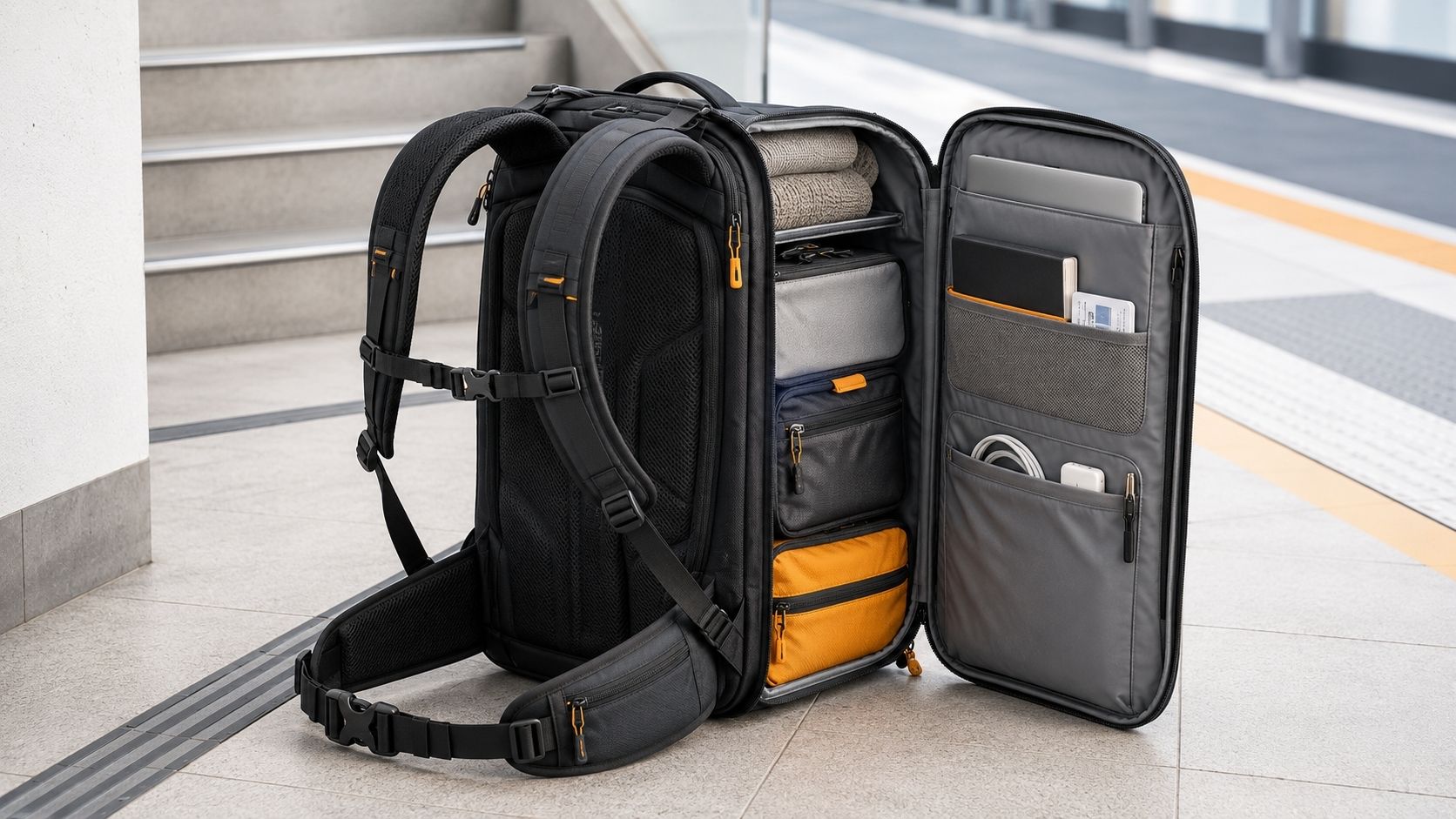
What Defines Travel Backpack Luggage Through Hands-Free Mobility, Harness Support, and Packing Access?
Travel backpack luggage is defined by hands-free mobility, body-supported carrying, harness support, and packing access for routes where wheeled luggage is less practical. It helps travelers move through stairs, public transport, rough streets, hostels, buses, ferries, and multi-stop routes while keeping both hands free.
This article explains travel backpack luggage harness support, opening layouts, capacity choice, packing zones, common mistake prevention, and the final checklist to complete before departure.
Why does travel backpack luggage matter for hands-free mobility?
Travel backpack luggage matters for hands-free mobility because it keeps the load on the body instead of depending on wheels across stairs, transit, uneven streets, and tight boarding areas. Wheeled luggage can become awkward on stairs, curbs, cobblestones, gravel paths, crowded transit, wet streets, and tight boarding areas.
The advantage is route flexibility. hands-free mobility helps when stairs, curbs, crowded transit, and rough paths make rolling luggage less practical.
The boundary is that comfort still depends on harness fit, packed weight, walking distance, and user tolerance. off-road routes show why body-carried luggage can be useful beyond smooth airport floors, but travel backpack luggage still places weight on the body.
How does travel backpack luggage use harness support to manage carried weight?
Travel backpack luggage uses harness support to manage carried weight through shoulder straps, hip belts, sternum straps, load-lifter straps, back panels, and internal structure. harness systems make these parts central to the fit decision.
Shoulder straps control the main carry position, while a hip belt may improve load support when it is shaped and adjusted correctly. A sternum strap can stabilize shoulder straps, and load-lifter straps may improve upper-pack control on designs that include them.
The buyer check is simple: the harness should feel stable when the backpack is loaded, not only when it is empty. harness weight transfer depends on fit, belt shape, packed weight, torso length, and adjustment quality.
| Harness Feature | Helps With | Watch Out For |
|---|---|---|
| Shoulder straps | Main carry control | Thin padding or poor shape |
| Hip belt | Load support | Weak or decorative belts |
| Sternum strap | Strap stability | Over-tightening |
| Load lifters | Upper-pack control | Not useful on every design |
| Back panel | Comfort and airflow | Heat buildup |
| Frame support | Shape stability | Added weight |
Which travel backpack luggage opening layouts improve packing access?
Travel backpack luggage opening layouts improve packing access when the opening style matches the traveler’s packing routine, accommodation type, tech access, and available floor space. opening styles change whether the bag behaves more like a suitcase, outdoor pack, or hybrid travel bag.
When does clamshell travel backpack luggage work best?
Clamshell travel backpack luggage works best for suitcase-style packing, hotel stays, business travel, and packing cubes. The trade-off is that clamshell designs rely heavily on long zipper tracks, so zipper quality matters.
When does panel-loading travel backpack luggage work best?
Panel-loading travel backpack luggage works best when travelers want broad access without opening the pack completely flat. It can help in hostels, airports, and shared rooms where floor space is limited.
When does top-loading travel backpack luggage work best?
Top-loading travel backpack luggage works best for outdoor-leaning travel, simple packing, and rugged routes. Items at the bottom are harder to reach during multi-stop travel.
When does hybrid wheeled travel backpack luggage work best?
Hybrid wheeled travel backpack luggage works best when the traveler wants rolling convenience plus emergency backpack carry. Wheels and handles add weight and can reduce packing space or harness comfort.
| Layout | Best For | Main Trade-Off |
|---|---|---|
| Clamshell | Packing cubes, hotels | Long zipper dependence |
| Panel-loading | Quick access | Partial visibility |
| Top-loading | Outdoor-style travel | Harder bottom access |
| Hybrid wheeled | Mixed airport/street use | Added weight |
| Laptop-access design | Work travel | Tech protection still needed |
How should travel backpack luggage capacity be chosen before airline travel?
Travel backpack luggage capacity should be chosen by packed exterior size, airline rule, trip length, carry comfort, and bag weight, not listed liters alone. Listed volume can describe storage potential, but it does not prove carry-on or personal-item compliance.
Measure the bag after packing, including pockets, straps, handles, and bulging panels. Match the backpack to the airline’s current rule and avoid choosing the largest possible backpack if comfort or long walking distance matters.
Keep external pockets flat when airline fit matters and consider empty bag weight before packing. A larger pack can hold more, but it can also become harder to carry and harder to fit when fully loaded.
| Travel Need | Better Capacity Choice | Main Risk |
|---|---|---|
| Personal-item travel | Compact, flat profile | Pocket bulge |
| Carry-on travel | Structured travel pack | Overpacking |
| Long-term travel | Larger harness-supported pack | Body strain |
| Business travel | Laptop-access pack | Tech weight |
| Mixed terrain | Backpack-only design | Carry comfort depends on fit |
| Airport-heavy trips | Hybrid wheeled pack | Added weight |
How should travel backpack luggage be packed to balance weight and protect gear?
Travel backpack luggage should be packed to balance weight and protect gear by keeping heavy compact items close to the back panel, stabilizing the middle, and keeping quick-access items reachable. packing access improves when quick items stay reachable without unpacking the main compartment.
The back-panel zone should hold compact heavy items such as a laptop or dense organizer when the pocket design supports it. The middle zone can hold clothing cubes and organizers, while soft lightweight items at the bottom can add cushioning.
Outer pockets should stay light and flat, especially when airline fit matters. Documents, chargers, liquids, and essentials can stay in quick-access pockets, while fragile items should sit in a protected core with padding around them.
| Packing Zone | Best Items | Purpose |
|---|---|---|
| Back panel | Laptop, compact heavy items | Better balance |
| Middle | Clothing cubes, organizers | Structure |
| Bottom | Soft lightweight items | Cushioning |
| Front/outer | Light flat items | Shape control |
| Quick-access pocket | Documents, chargers, liquids | Faster access |
| Protected core | Fragile items | Impact buffering |
How can travel backpack luggage mistakes be avoided when sizing, straps, and comfort create risk?
Travel backpack luggage mistakes can be avoided by keeping exterior pockets flat, moving weight closer to the back, securing straps, adjusting the loaded harness, checking airline rules, and testing the packed bag.
How can overpacked travel backpack luggage be corrected?
Overpacked travel backpack luggage can be corrected by removing non-essential items, flattening packing cubes, and keeping outer pockets slim. The result is a bag that becomes easier to carry, measure, and place in luggage spaces.
How can poor travel backpack luggage harness fit be corrected?
Poor travel backpack luggage harness fit can be corrected by adjusting the shoulder straps, hip belt, sternum strap, and load-control straps while the bag is realistically loaded. The result is a pack that feels more stable and easier to control.
How can dangling travel backpack luggage straps be corrected?
Dangling travel backpack luggage straps can be corrected by tucking straps away, using strap keepers, or stowing the harness when the backpack has a cover panel. The result is lower snag risk around doors, conveyor belts, railings, and seats.
How can travel backpack luggage airline-fit problems be reduced?
Travel backpack luggage airline-fit problems can be reduced by measuring the fully packed bag instead of assuming fabric compression will make it acceptable. The result is fewer gate, check-in, and boarding surprises.
How can travel backpack luggage comfort problems be reduced?
Travel backpack luggage comfort problems can be reduced by loading the backpack realistically, walking with it briefly, and adjusting the harness before travel. loaded comfort limits appear when packed weight, distance, harness fit, and body tolerance do not match.
| Mistake | Safer Fix | Main Benefit |
|---|---|---|
| Overstuffed pockets | Keep exterior flat | Better sizing |
| Heavy front loading | Move weight closer to back | Better balance |
| Loose straps | Tuck or secure | Less snag risk |
| Poor harness fit | Adjust loaded pack | Better control |
| Ignoring airline rules | Check current policy | Fewer surprises |
| No loaded test | Walk with packed bag | Earlier fit check |
Which travel backpack luggage checklist should you complete before departure?
A travel backpack luggage checklist should verify packed size, airline rules, weight, pocket shape, load placement, fragile-item protection, strap security, zipper movement, harness adjustment, and loaded comfort before departure.
This checklist does not guarantee airline compliance, fee avoidance, pain prevention, or fatigue elimination. It helps surface fit, balance, size, zipper, and comfort problems before the travel day.
- Measure the backpack after it is fully packed.
- Check the airline’s current carry-on or personal-item rule.
- Weigh the backpack if airline weight limits apply.
- Keep exterior pockets flat when size compliance matters.
- Place heavier compact items near the back panel.
- Keep fragile items padded or protected in the center.
- Keep travel documents, medication, valuables, and essential electronics accessible.
- Tuck loose straps into keepers or stow panels.
- Test the zipper tracks without forcing them.
- Adjust shoulder straps, hip belt, sternum strap, and load-control straps while the bag is loaded.
- Walk with the packed backpack briefly before departure to check balance and comfort.
- Repack if the bag pulls backward, sags, or feels unstable.
- Review manufacturer fit guidance for torso sizing and harness adjustment.
- Avoid carrying more weight than you can manage comfortably.
What should you remember about travel backpack luggage?
Travel backpack luggage works best when hands-free mobility, harness support, packing access, airline fit, and loaded comfort all match the trip. It can improve movement across stairs, transit, rough streets, and multi-stop routes, but it still places weight on the body.
The safest approach is to choose by packed size and route, pack heavy items close to the back panel, keep pockets flat, adjust the harness while loaded, and test the backpack before departure.
Frequently Asked Questions About Travel Backpack Luggage
What is travel backpack luggage?
Travel backpack luggage is body-carried luggage designed for travel movement, packing access, and compact organization. It usually uses backpack straps, travel-focused compartments, and a structure made for airports, trains, hostels, city routes, and multi-stop trips.
Is travel backpack luggage better than a suitcase?
Travel backpack luggage is better when stairs, public transport, uneven streets, tight spaces, and hands-free movement matter most. A suitcase is better when rolling comfort, rigid structure, and lower body-carried weight matter more.
Can travel backpack luggage be used as carry-on?
Travel backpack luggage can be used as carry-on only when its fully packed exterior size matches the airline’s current rule. Listed liters or soft compression do not guarantee carry-on compliance.
What opening style is best for travel backpack luggage?
The best opening style depends on the trip. Clamshell layouts work well for suitcase-style packing, panel-loading layouts help with broad access, top-loading layouts suit rugged travel, and hybrid wheeled layouts help when rolling is sometimes useful.
How should travel backpack luggage fit?
Travel backpack luggage should feel stable when loaded, with shoulder straps, hip belt, sternum strap, and load-control straps adjusted according to the manufacturer’s fit guidance. Comfort depends on torso fit, packed weight, walking distance, and user tolerance.