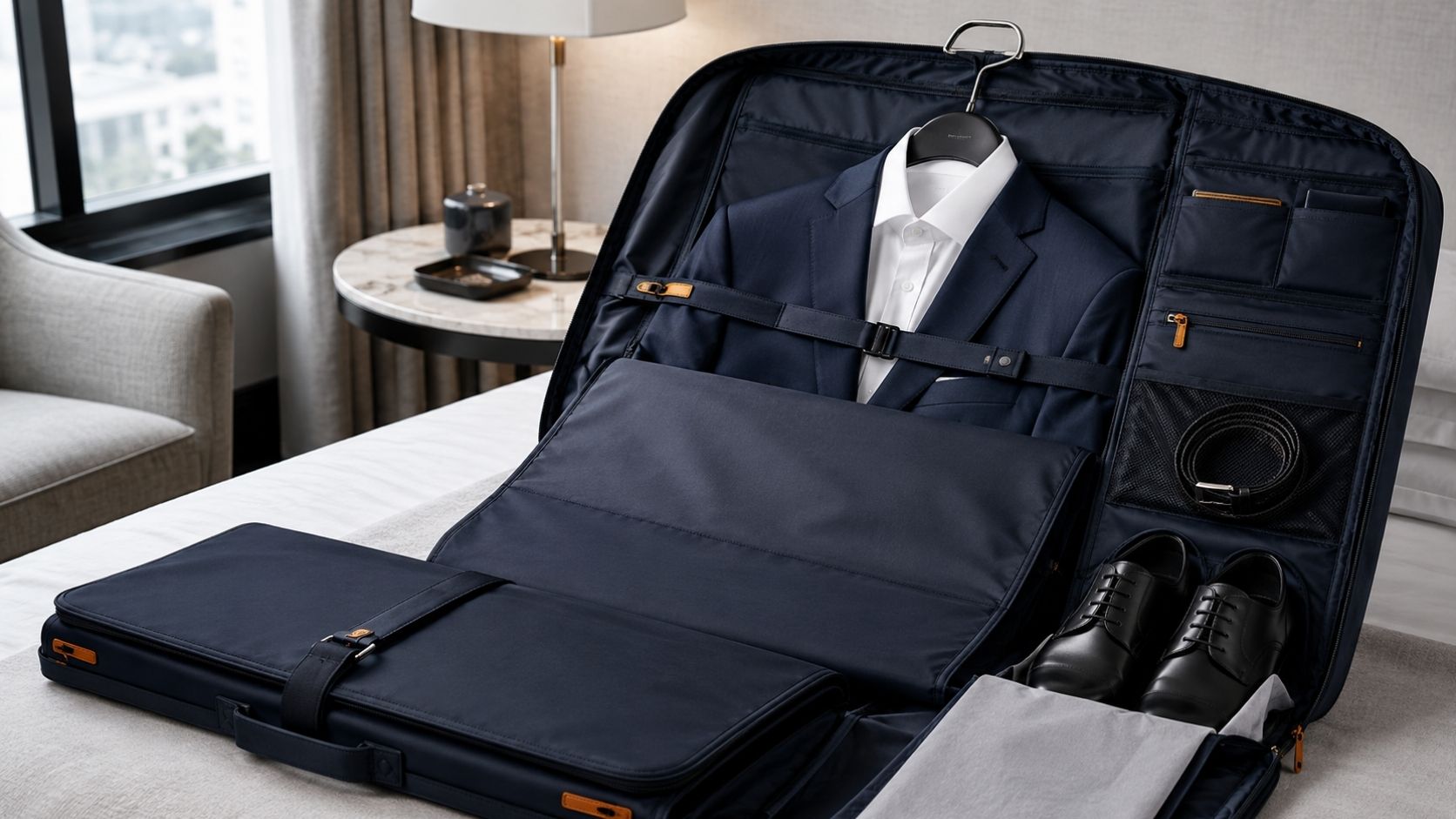
What Defines Garment Bags Through Folded Structure, Formalwear Protection, and Crease Control?
Garment bags are defined by folded structure, hanger support, formalwear protection, and crease control for clothing that should not be tightly compressed. They help suits, dresses, shirts, uniforms, and gowns travel in a flatter, more supported format than ordinary suitcase packing.
This article explains garment bags structural anatomy, format selection, safe packing sequence, wrinkle and shifting mistakes, and the final travel checklist for formalwear trips.
Why do garment bags matter for protecting formalwear during travel?
Garment bags matter for protecting formalwear during travel because suits, dresses, shirts, uniforms, and formal clothing can wrinkle, flatten, or lose structure when tightly compressed. Garment bags help clothing stay on hangers or broader folded panels instead of being folded into a dense suitcase stack.
The protection benefit is better garment organization and faster removal at hotels, events, weddings, business trips, or performances. formalwear protection works best when hanger support, gentle folding, and pressure control support the same outfit.
The boundary is important: garment bags reduce crease risk, but they do not guarantee wrinkle-free clothing. use cases depend on whether the trip involves business clothing, weddings, performances, uniforms, or formal events.
How do garment bags use folded structure to support formal clothing?
Garment bags use folded structure to support formal clothing through hanger clamps, fold panels, gentle straps, smooth lining, accessory separation, and reinforced carry points. structured protection comes from hanger clamps, fold panels, lining, straps, pockets, and reinforced carry points.
The buyer check is simple: hanger support should be secure, zipper movement should be smooth, handles should feel reinforced, and the bag should have enough depth for the garments actually carried. Compression straps should limit movement gently, not crush fabric.
| Component | Helps With | Watch Out For |
|---|---|---|
| Hanger clamp | Keeps garments suspended | Thin hangers may slip |
| Fold panel | Reduces sharp folds | Overpacked bags still crease |
| Compression straps | Limits shifting | Over-tightening can crush fabric |
| Smooth lining | Reduces friction | Rough seams can catch fabric |
| Shoe pockets | Separates dirty items | Shoes can press into garments |
| Reinforced handle | Easier carrying | Weak stitching can fail |
Which garment bags format fits each travel scenario best?
Garment bags format fits each travel scenario best when trip length, formalwear volume, mobility needs, airline storage, and packing style match the bag design.
When do bi-fold garment bags work best?
Bi-fold garment bags work best for short business trips, wedding guests, interviews, and one-outfit formal travel. They are usually simple and lighter, but they often have limited space for shoes, accessories, and extra outfits.
When do tri-fold garment bags work best?
Tri-fold garment bags work best when the traveler wants a more compact folded shape for light formalwear and overhead-bin planning. Extra folds can increase crease risk if the bag is packed too tightly.
When do rolling garment bags work best?
Rolling garment bags work best for heavier formalwear loads, longer trips, or travelers who do not want to shoulder-carry the bag. Wheels and frames add weight and may make the bag less compact.
When do duffel-hybrid garment bags work best?
Duffel-hybrid garment bags work best for trips that mix formalwear with casual clothing, shoes, and accessories. Packing order matters because tight wrapping can increase crease risk if the bag is overfilled.
| Bag Type | Best For | Main Trade-Off |
|---|---|---|
| Bi-fold garment bag | Short formal trips | Limited extra storage |
| Tri-fold garment bag | Compact travel | More fold points |
| Rolling garment bag | Heavier formalwear loads | Added weight |
| Duffel-hybrid garment bag | Formal + casual packing | More complex packing |
| Lightweight garment sleeve | Local car travel | Less protection |
How should garment bags be packed to reduce wrinkles and shifting?
Garment bags should be packed to reduce wrinkles and shifting by starting with clean dry garments, using suitable hangers, fastening clothing, separating hard items, and tightening straps gently.
Use appropriate hangers, button shirts and jackets before folding, and add tissue, garment sleeves, or fabric-safe layers only when appropriate. crease control depends on spacing, fold pressure, garment thickness, and careful strap tension.
Shoes and accessories should stay in separate compartments so they do not press into delicate panels. Internal straps should be gentle, and garment care labels should be checked before steaming, pressing, or treating fabric after arrival.
| Step | Action | Goal |
|---|---|---|
| 1 | Choose suitable hangers | Support garment shape |
| 2 | Button or fasten garments | Reduce shifting |
| 3 | Add fabric-safe layers | Reduce friction |
| 4 | Lock hangers in place | Prevent sliding |
| 5 | Secure straps gently | Limit movement |
| 6 | Separate shoes/accessories | Avoid pressure marks |
| 7 | Fold slowly and check zippers | Prevent fabric catching |
What mistakes cause garment bags to wrinkle, shift, or damage clothing?
Garment bags wrinkle, shift, or damage clothing when hangers slip, straps crush fabric, zippers catch hems, the bag is overpacked, or post-travel care ignores garment labels.
How can slipping inside garment bags be reduced?
Slipping inside garment bags can be reduced by using sturdy hangers that fit the hanger clamp and support the garment shoulders. The result is that garments are less likely to fall or bunch at the bottom.
How can shoulder crushing inside garment bags be reduced?
Shoulder crushing inside garment bags can be reduced by loosening compression slightly and keeping shoes, toiletries, and heavy accessories away from structured jacket shoulders. The result is that jackets and structured garments keep their shape better.
How can zipper snags in garment bags be reduced?
Zipper snags in garment bags can be reduced by tucking sleeves, hems, and lining edges inward before zipping slowly around corners. The result is a lower risk of fabric pulls, snags, and zipper stress.
How can overpacking garment bags be corrected?
Overpacking garment bags can be corrected by removing excess garments, separating bulky pieces, or using checked luggage for overflow. The result is a bag that closes more smoothly and reduces pressure on clothing.
How can post-travel creases in garment bags be handled safely?
Post-travel creases in garment bags should be handled by hanging garments first and checking the care label before steaming, pressing, or applying moisture. The result is that minor wrinkles can be addressed without risking damage to sensitive fabrics.
| Problem | Likely Cause | Safer Fix |
|---|---|---|
| Garment slid downward | Hanger not secured | Use better hanger fit |
| Shoulder flattening | Strap or item pressure | Loosen straps, move hard items |
| Hem bunching | Bag overpacked | Reduce garment count |
| Zipper snag | Fabric near zipper track | Tuck fabric inward |
| Deep wrinkles | Too much compression | Repack with more spacing |
| Moisture marks | Poor fabric-care choice | Follow care label |
Which garment bags checklist should you complete before travel?
A garment bags travel checklist should verify airline rules, folded packed size, zipper closure, hanger fit, fabric separation, gentle strap tension, zipper clearance, and garment-care labels before travel.
This checklist does not guarantee wrinkle-free arrival or universal airline fit. It helps reduce avoidable slipping, shoulder crushing, zipper snags, overpacking, and fabric-care mistakes.
- Check the airline’s current carry-on or checked-bag rule before travel.
- Measure the garment bag after it is packed and folded.
- Confirm the bag closes without forcing the zipper.
- Use hangers that fit the garment bag clamp.
- Button or fasten garments before folding the bag.
- Keep shoes, belts, toiletries, and accessories away from delicate fabric panels.
- Use garment sleeves, tissue, or fabric-safe layers only when appropriate.
- Tighten internal straps gently, not aggressively.
- Check that sleeves, hems, and linings are clear of zipper tracks.
- Retract or secure any external hanger hooks.
- Keep heavy items out of jacket pockets.
- Avoid overpacking until the bag bulges.
- Follow garment care labels before steaming, pressing, or exposing fabric to moisture.
- Hang garments as soon as practical after arrival.
What should you remember about garment bags?
Garment bags work best when folded structure, hanger support, strap tension, garment spacing, fabric care, and travel-fit planning all support the same formalwear need. They can improve formalwear travel condition, but they do not create perfect or wrinkle-proof protection.
The safest approach is to pack clean dry garments, secure hangers, separate hard accessories, tighten straps gently, measure the packed folded bag, check airline rules, and follow garment care labels after arrival.
Frequently Asked Questions About Garment Bags
What are garment bags?
Garment bags are travel bags designed to carry suits, dresses, shirts, uniforms, gowns, or formal clothing with hanger support, folded panels, and reduced compression compared with ordinary suitcase packing.
Do garment bags prevent wrinkles?
Garment bags can reduce wrinkle and crease risk, but they do not guarantee wrinkle-free arrival. Packing method, garment thickness, fold pressure, hanger security, fabric type, and handling all affect the result.
Can garment bags be used as carry-on luggage?
Garment bags can be used as carry-on luggage only when the packed and folded bag matches the airline’s current carry-on rule. Airline size rules vary by airline, fare, route, aircraft, and cabin storage.
Are rolling garment bags better than bi-fold garment bags?
Rolling garment bags are better for heavier formalwear loads or longer trips, while bi-fold garment bags are usually simpler and lighter for short formal trips. The better choice depends on clothing volume, mobility needs, and storage rules.
How should suits be packed in garment bags?
Suits should be packed with suitable hangers, buttoned or fastened garments, gentle strap tension, and separation from shoes or hard accessories. Follow the garment care label before steaming, pressing, or applying moisture after arrival.