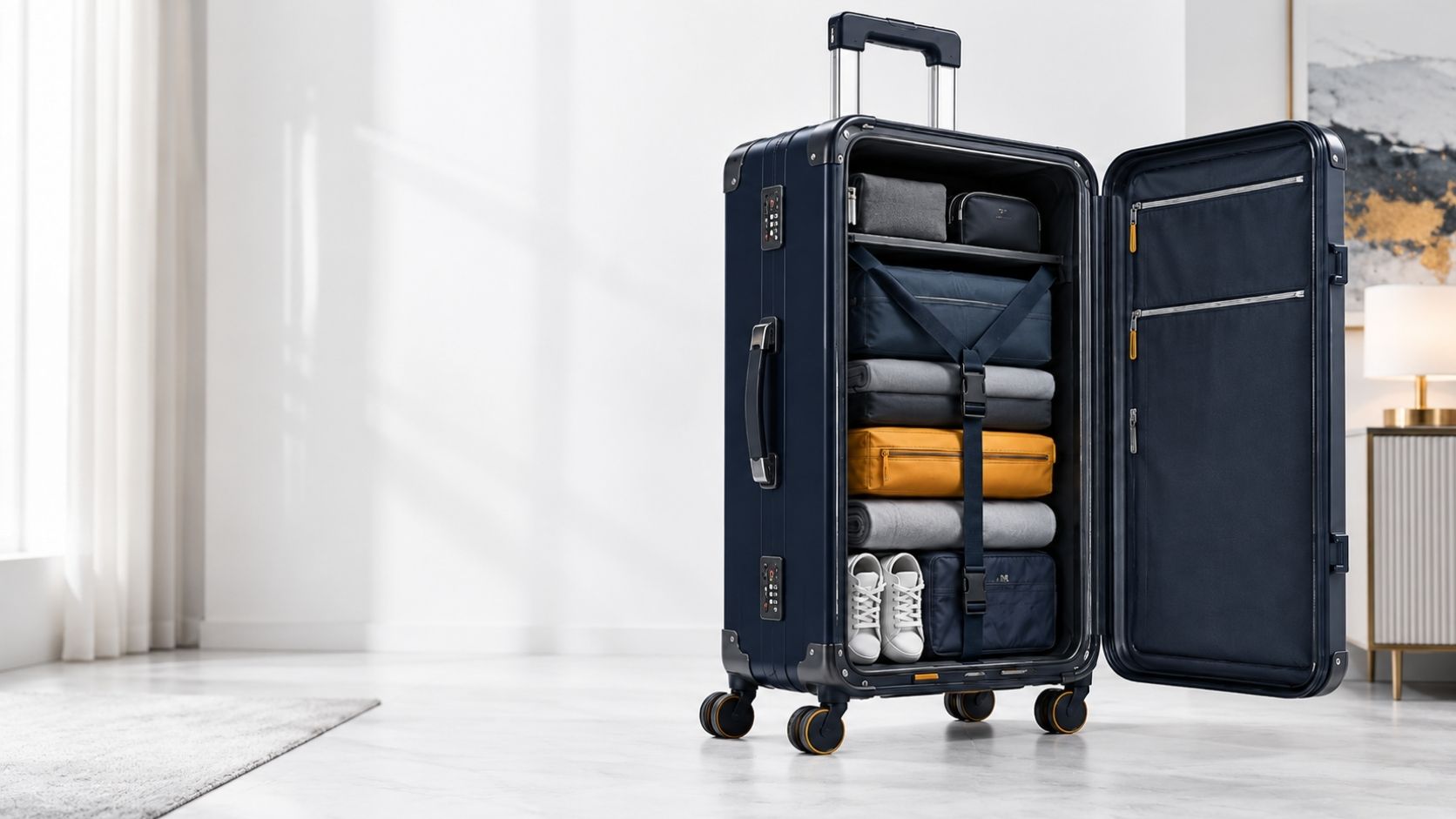
What Defines Trunk Luggage Through Upright Geometry, Deep Capacity, and Small-Footprint Opening?
Trunk luggage is defined by upright geometry, a deep main compartment, and a smaller opening footprint that can make bulky packing and tight-room access easier. Its deeper main tub and shallower lid can help organize structured gear, winter layers, boots, and travel pouches without spreading the suitcase into two equal halves.
This article explains trunk luggage structure, scenario fit, deep-well packing zones, tipping and overweight mistakes, and the final travel-readiness checklist before checked or long-distance travel.
Why does trunk luggage matter for bulky gear and space-efficient packing?
Trunk luggage matters for bulky gear and space-efficient packing because its deeper main compartment can hold structured or uneven items more naturally than two shallow suitcase halves. Standard clamshell suitcases often split packing space into two shallow sections, which can make bulky items feel compressed horizontally.
The advantage is that deep compartment design can help boots, jackets, gear cubes, toiletry cases, camera pouches, or winter layers sit more naturally. A deep main well can also support column-style packing when the load is stabilized with cubes, pouches, straps, and soft gap fillers.
The boundary is that trunk luggage can become heavy quickly if the deep space is overfilled. Deep capacity should be treated as controlled space, not an invitation to fill the bag completely.
How does trunk luggage use upright geometry and a deep main compartment?
Trunk luggage uses upright geometry and a deep main compartment by placing most packing volume in one deeper tub with a shallower lid for flatter items. upright geometry explains why the suitcase opens with a deeper main section instead of two equal clamshell halves.
The compartment split affects how deep items, flat items, and compression panels should be arranged. The deep main tub supports bulkier items, while the shallow lid section works better for flat and light items.
The buyer check should include stable wheels, secure latches or zippers, reinforced handles, strong divider panels, and a shell that does not flex excessively under load. top lid opening can reduce the floor spread needed to access the main compartment.
| Component | Helps With | Watch Out For |
|---|---|---|
| Deep main compartment | Bulky-item packing | Easy overpacking |
| Shallow lid | Flat-item access | Limited depth |
| Internal divider | Load separation | Weak fabric panels |
| Compression straps | Less shifting | Over-tightening |
| Reinforced handles | Heavy lifting | Loose mounts |
| Wheel base | Rolling stability | Tipping if unbalanced |
Which travel scenarios make trunk luggage better than standard suitcases?
Trunk luggage is better than standard suitcases in travel scenarios where deep packing space, smaller opening footprint, bulky-item control, and checked-travel organization matter more than equal split compartments. floor space can be easier to manage than a wide two-half clamshell opening in tight rooms.
When does trunk luggage work best for hotel rooms?
Trunk luggage works best for hotel rooms when floor space is limited and the traveler wants a smaller opening footprint. small spaces matter when a suitcase must open on luggage racks, narrow floors, closets, or shared rooms, but deep compartments can require more digging if items are not organized.
When does trunk luggage work best for bulky gear?
Trunk luggage works best for bulky gear such as boots, outerwear, gear pouches, structured accessories, and thicker packing cubes. The trade-off is that bulky packing can quickly increase weight when dense items stack vertically.
When does trunk luggage work best for road trips?
Trunk luggage works best for road trips when the boxier shape fits well in vehicle cargo areas and the traveler wants upright access. A hard trunk may be less flexible than a soft duffel in tight vehicle corners.
When does trunk luggage work best for checked travel?
Trunk luggage works best for checked travel when the traveler needs deep capacity and does not need constant in-cabin access. handling risk increases when wheels, handles, latches, zippers, corners, or the shell are stressed during transport.
| Feature | Trunk Luggage | Standard Clamshell Suitcase |
|---|---|---|
| Opening footprint | Smaller lid spread | Wider two-half spread |
| Main packing depth | Deeper main compartment | Two shallower halves |
| Bulky-item fit | Often better | Often more restrictive |
| Flat garment organization | More limited lid space | Better split panels |
| Weight control | Easier to overpack | Easier to see split load |
| Hotel-room use | Strong in tight spaces | Needs more open surface |
How should trunk luggage be packed to control weight and protect packed items?
Trunk luggage should be packed to control weight and protect packed items by keeping dense items near the wheel base, building stable vertical layers, filling gaps softly, and keeping the lid light.
The wheel-base zone should hold shoes, dense gear, and compact toiletries to lower the center of gravity. The main-column zone should use packing cubes, folded layers, and pouches so stacked items do not collapse into the deep tub.
Use socks or soft clothing in side gaps to reduce shifting, keep first-night items near the top-access zone, and reserve the lid zone for flat light items. Compression straps should stabilize the load, not crush items or hide overpacking.
| Packing Zone | Best Items | Purpose |
|---|---|---|
| Wheel-base zone | Shoes, dense gear, toiletries | Lower center of gravity |
| Main-column zone | Packing cubes, folded layers | Stable structure |
| Side-gap zone | Socks, soft clothing | Movement control |
| Top-access zone | First-night items | Easy retrieval |
| Lid zone | Flat, light items | Tip prevention |
| Compression zone | Straps/dividers | Load stability |
What mistakes cause trunk luggage to tip, become overweight, or close poorly?
Trunk luggage tips, becomes overweight, or closes poorly when dense items sit in the lid, the deep compartment is overfilled, lower weight is uneven, or the shell is forced shut.
How can trunk luggage tipping be reduced?
Trunk luggage tipping can be reduced by moving dense items away from the lid or front section and placing them near the wheel base and spine side. The result is that the bag stands and rolls more predictably.
How can trunk luggage overweight risk be reduced?
Trunk luggage overweight risk can be reduced by weighing the bag during packing and removing dense non-essential items before the deep compartment is full. The result is a bag less likely to exceed the airline’s current checked-bag weight rule.
How can trunk luggage wheel strain be reduced?
Trunk luggage wheel strain can be reduced by spreading heavy items evenly near the lower base instead of loading one side heavily. The result is less uneven stress on wheels and housings.
How can trunk luggage closure problems be reduced?
Trunk luggage closure problems can be reduced by flattening the top layer, reducing lid contents, and closing the divider before shutting the shell. The result is less strain on latches, zippers, and hinges.
How can trunk luggage tracking visibility be improved?
Trunk luggage tracking visibility can be improved by using a tracker only as a visibility aid while still following airline and device rules. The result is that travelers may gain location clues without relying on the tracker as a recovery guarantee.
| Problem | Likely Cause | Safer Fix |
|---|---|---|
| Bag tips forward | Heavy lid/front packing | Move weight to wheel base |
| Bag feels overweight | Dense items overpacked | Weigh and remove items |
| Wheel drag | Uneven lower load | Rebalance base weight |
| Shell hard to close | Overfilled lid/deep tub | Reduce top layer |
| Items shift vertically | Loose column packing | Use cubes and straps |
| Tracker not updating | Signal/network limits | Treat as visibility aid |
Which trunk luggage checklist should you complete before travel?
A trunk luggage checklist should verify airline rules, packed size, packed weight, base balance, lid load, vertical stability, closure condition, wheel movement, component condition, and tracker limits before travel.
This checklist does not guarantee airline compliance, damage prevention, or tracker recovery. It helps reduce avoidable overpacking, tipping, closure strain, wheel stress, and checked-travel surprises.
- Check the airline’s current checked-bag size and weight rule.
- Measure the fully packed trunk luggage if size compliance matters.
- Weigh the bag after packing, not before packing.
- Keep dense items low and near the wheel-base side.
- Keep the lid section light and flat.
- Use packing cubes or pouches to stabilize deep vertical layers.
- Fill small gaps with soft clothing to reduce shifting.
- Avoid forcing latches, zippers, or hinges closed.
- Confirm the internal divider is closed before shutting the shell.
- Roll the bag on a flat surface to check for tipping, dragging, or wobble.
- Inspect wheels, handles, latches, zippers, and corners before travel.
- Keep valuables, medication, and essential documents out of checked trunk luggage.
- Use a tracker only if it follows airline/device rules, and treat it as a visibility aid.
- Remove old airline tags before checking the bag.
What should you remember about trunk luggage?
Trunk luggage works best when upright geometry, deep capacity, small-footprint access, stable packing, and weight control match the trip. Its deeper structure can improve bulky packing and tight-room access, but it can also encourage overpacking if the load is not controlled.
The safest approach is to keep dense items low, keep the lid light, stabilize vertical layers, weigh the bag after packing, inspect wheels and handles, and treat any tracker as a visibility aid rather than a recovery guarantee.
Frequently Asked Questions About Trunk Luggage
What is trunk luggage?
Trunk luggage is a suitcase format with a deeper main compartment and a shallower lid section. It usually opens with a smaller floor footprint than many standard two-half clamshell suitcases.
Is trunk luggage better than a standard suitcase?
Trunk luggage is better when deep packing space, bulky gear, hotel-room space control, and checked-travel organization matter most. A standard suitcase may be better when equal split compartments and flat garment organization matter more.
Is trunk luggage good for checked travel?
Trunk luggage can work well for checked travel when deep capacity and structured packing matter, but wheels, handles, latches, zippers, corners, and shell materials still face handling stress.
Does trunk luggage help save hotel-room floor space?
Trunk luggage can help reduce opening footprint because the lid section is usually shallower than the main compartment. It still needs enough room to stand, open, and access the deep packing area safely.
Why does trunk luggage become overweight easily?
Trunk luggage can become overweight easily because the deep main compartment encourages dense vertical packing. Weighing during packing and keeping the lid light helps control weight and balance.