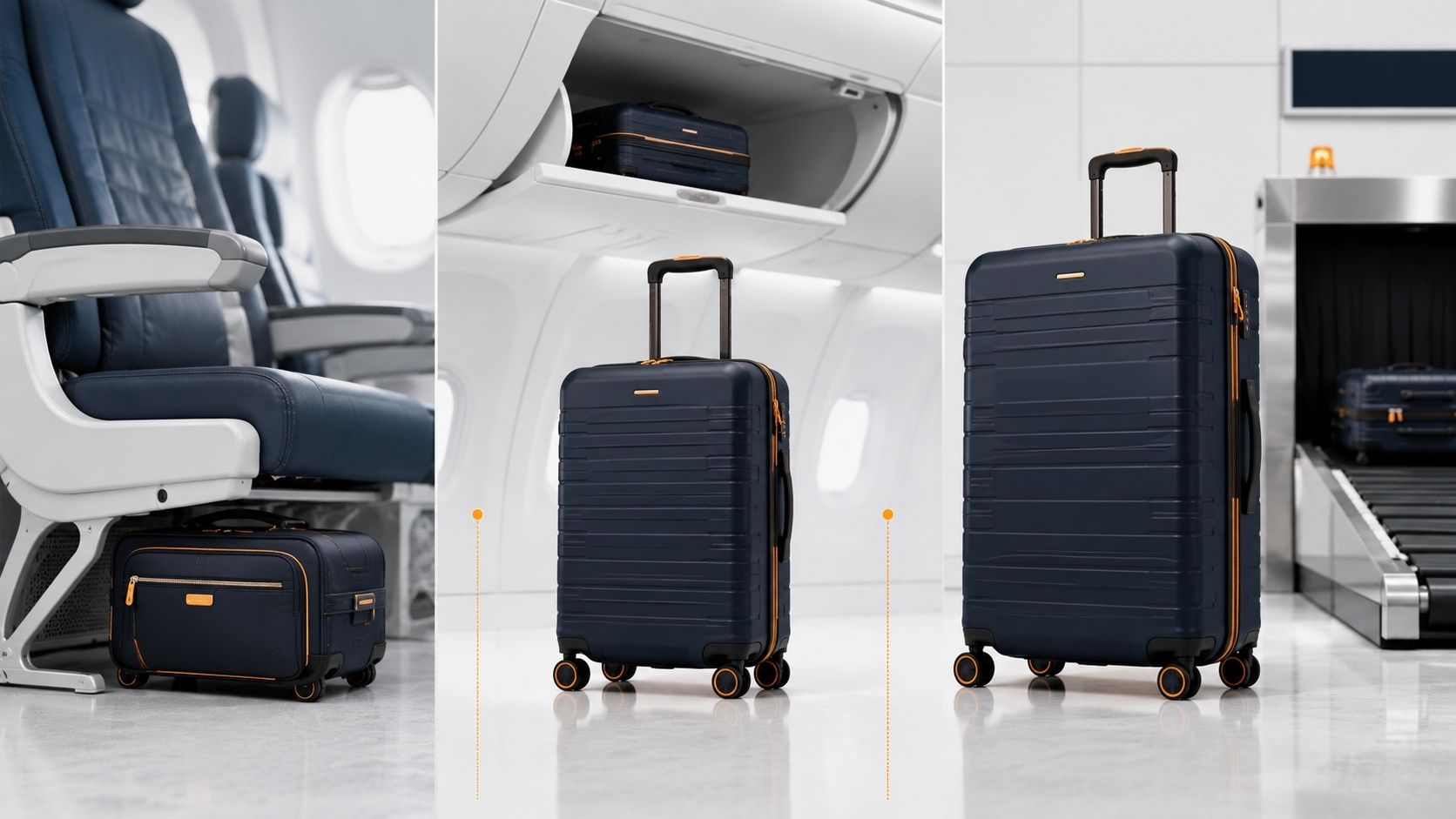
How Does Flight Placement Separate Suitcase Categories?
Flight placement separates suitcase categories by where the bag travels during air travel: under the seat, in the overhead bin, or in the checked cargo hold. Underseat suitcase categories prioritize compact access, overhead suitcase categories prioritize cabin-bin fit, and checked suitcase categories prioritize larger capacity with greater handling exposure.
This article explains suitcase categories by aircraft placement zone, ticket and trip matching, packing rules by placement, common sizing mistakes, and the final airport checklist before travel.
Why do suitcase categories matter for matching bags to flight placement?
Suitcase categories matter for matching bags to flight placement because the same bag can succeed or fail depending on whether it must fit under a seat, in an overhead bin, or in the checked cargo hold.
Many travelers choose by appearance or capacity first, but wheels, handles, expansion zippers, overfilled pockets, and soft bulging can change the packed exterior profile. suitcase classification becomes clearer when flight placement is treated as the first filter before shell, wheels, and style.
The solution is to choose the placement zone first. Underseat bags prioritize compact access, overhead bags prioritize cabin-bin fit, and checked bags prioritize larger capacity with more protection against handling exposure. Even the right category still needs checking against airline, fare, aircraft, and route rules.
How do suitcase categories change across underseat, overhead, and checked placement zones?
Suitcase categories change across underseat, overhead, and checked placement zones because each aircraft storage area creates different size, access, capacity, and handling priorities.
underseat luggage fits the category built around seat-level access and compact personal-item rules. carry-on luggage belongs to the overhead-focused category when the ticket and airline rules allow cabin-bin storage.
checked luggage fits the cargo-hold category when larger packing capacity matters more than in-flight access. Mixed-placement and special-use bags can be useful, but they also increase rule confusion because the same bag may not qualify the same way across fares, aircraft, or routes.
| Placement Zone | Main Suitcase Categories | Primary Strength | Main Risk |
|---|---|---|---|
| Underseat | Personal-item bags, small backpacks, underseat rollers | In-flight access | Airline/seat variation |
| Overhead bin | Carry-on suitcases, cabin rollers, spinners | Cabin control | Sizer or bin-space issues |
| Checked hold | Checked suitcases, trunks, large duffels | Larger capacity | Weight and handling exposure |
| Mixed placement | Convertible bags, softside carry-ons | Flexibility | Rule confusion |
| Special-use placement | Gear bags, garment bags, sports bags | Task-specific packing | Airline-specific restrictions |
Which suitcase categories fit different ticket types, trip lengths, and travel needs?
Suitcase categories fit different ticket types, trip lengths, and travel needs when the traveler matches the bag category to allowance, access needs, packing volume, and handling exposure.
Which suitcase categories work best for personal-item-only tickets?
Compact underseat bags, small backpacks, or soft personal-item totes usually work best for personal-item-only tickets because they keep essentials close and reduce dependence on overhead-bin space. underseat personal-item limits should be checked before assuming a compact bag qualifies with a basic fare.
Which suitcase categories work best for standard carry-on travel?
Carry-on suitcases, cabin rollers, softside carry-ons, or hardside spinners usually work best for standard carry-on travel when the ticket includes cabin-bin allowance. carry-on overhead bin fit depends on the packed exterior profile, not just the main shell.
Which suitcase categories work best for longer trips?
Checked suitcases, trunk luggage, large softside suitcases, or rolling duffels usually work best for longer trips because they carry more clothing, shoes, gear, and bulky items. The risk is that larger capacity makes overweight packing easier.
Which suitcase categories work best for fragile or high-value items?
Cabin-access suitcase categories work best for fragile or high-value items when the item is allowed in the cabin; otherwise, checked luggage needs strong internal padding. Some items cannot be carried in certain compartments, so airline and security rules matter.
| Travel Need | Better Suitcase Categories | Main Check Before Travel |
|---|---|---|
| Personal-item-only fare | Underseat bag, small backpack | Airline personal-item rule |
| Short cabin trip | Carry-on suitcase | Packed exterior size |
| Longer trip | Checked suitcase or trunk | Checked size and weight rule |
| Formalwear | Garment bag or structured carry-on | Folded packed dimensions |
| Bulky gear | Trunk or rolling duffel | Weight and handling exposure |
| Fast airport exit | Cabin carry-on | Carry-on allowance included |
How should suitcase categories be packed according to their flight placement zone?
Suitcase categories should be packed according to their flight placement zone because underseat bags need access, overhead bags need compact profiles, and checked bags need protection and weight control.
Underseat suitcase categories should keep essentials near the opening. Overhead suitcase categories should maintain a compact exterior profile, including wheels, handles, pockets, straps, and any expanded depth.
Checked suitcase categories should protect items in the center, manage packed weight, and avoid forced closures. checked cargo-hold placement changes the priority from cabin access to weight control, padding, and handling exposure.
Soft suitcase categories need bulge control, hardside suitcase categories need closure-stress control, and expanded bags should be remeasured after final packing.
| Placement Zone | Packing Priority | Practical Rule |
|---|---|---|
| Underseat | Access | Keep essentials near the opening |
| Overhead | Exterior profile | Measure including wheels and handles |
| Checked hold | Protection | Pad fragile items inside the center |
| Softside | Bulge control | Keep front pockets flat |
| Hardside | Closure stress | Avoid forced zipper/latch closure |
| Expanded bags | Depth control | Recheck packed dimensions |
What mistakes cause suitcase categories to create gate-check, sizing, or handling problems?
Suitcase categories create gate-check, sizing, or handling problems when travelers measure only the bag body, use expansion zippers carelessly, overpack soft bags, misunderstand ticket rules, or pack checked bags poorly.
How do suitcase categories fail because of incorrect measuring?
Suitcase categories fail because of incorrect measuring when travelers measure only the main body and ignore wheels, handles, pockets, straps, and expansion panels. Full packed exterior measurement gives a more realistic fit check before reaching the airport.
How do suitcase categories fail because of expansion zippers?
Suitcase categories fail because of expansion zippers when a traveler opens a carry-on expansion panel and assumes the bag still fits the same cabin category. Rechecking the bag after expansion lowers sizer and bin-fit risk.
How do suitcase categories fail because of soft-bag bulging?
Suitcase categories fail because of soft-bag bulging when an overpacked fabric bag rounds outward and becomes harder to measure or fit. Flattening the load, moving bulky items inward, or removing overflow makes the bag easier to place.
How do suitcase categories fail because of ticket-rule confusion?
Suitcase categories fail because of ticket-rule confusion when travelers assume every ticket includes both a personal item and a cabin carry-on. Checking the ticket allowance before packing reduces check-in and boarding surprises.
How do suitcase categories fail in checked handling?
Suitcase categories fail in checked handling when fragile or essential items are packed loosely inside checked luggage. Keeping essentials with you when allowed and padding fragile items inside the center improves protection against handling exposure and delay.
| Observed Problem | Likely Cause | Safer Fix |
|---|---|---|
| Bag too deep | Open expansion or full front pocket | Close expansion and flatten load |
| Wheels protrude | Exterior profile not measured | Measure total packed bag |
| Underseat bag rounds out | Softside overpacking | Reduce and reshape contents |
| Ticket allows less than expected | Fare rule misunderstood | Recheck booking allowance |
| Checked bag overweight risk | Dense items overpacked | Weigh and repack |
| Fragile item exposed | Poor internal padding | Center and cushion item |
Which suitcase categories checklist should you complete before airport travel?
A suitcase categories checklist should verify ticket allowance, airline rules, intended placement, packed exterior size, expansion depth, access items, checked weight, restricted items, and final bag shape before airport travel.
This checklist does not guarantee airline compliance or fee avoidance. It helps reduce avoidable sizer issues, gate-check surprises, ticket-rule confusion, overpacking, and checked-handling mistakes.
- Check whether your ticket includes a personal item, carry-on, checked bag, or combination.
- Confirm the airline’s current baggage rules for your route and fare type.
- Match each bag to its intended placement: underseat, overhead, or checked hold.
- Measure the bag after packing, including wheels, handles, pockets, straps, and expansion panels.
- Keep expansion zippers closed unless the expanded size is still allowed.
- Keep underseat essentials easy to access.
- Keep overhead bags compact enough for the airline’s current cabin rule.
- Weigh checked luggage if checked-bag weight limits apply.
- Keep medication, essential documents, valuables, and permitted critical electronics with you rather than in checked luggage.
- Follow airline and security rules for batteries, liquids, tools, and restricted items.
- Remove old airline routing tags before checking luggage.
- Pad fragile items in the center of checked suitcase categories.
- Avoid forcing zippers, latches, or shells closed.
- Recheck soft bags for bulging after final packing.
What should you remember about suitcase categories?
Suitcase categories work best when flight placement, ticket allowance, packed profile, access needs, handling exposure, and airline rules all match before the traveler reaches the airport. The category label is useful, but the final packed bag must still match the current airline and ticket requirements.
Choose underseat categories for compact in-flight access, overhead categories for cabin-bin control, and checked categories for larger capacity with more handling exposure. Then measure, weigh, and recheck the packed exterior profile before travel.
Frequently Asked Questions About Suitcase Categories
What are suitcase categories?
Suitcase categories are groups of travel bags separated by how they are used, including underseat personal-item bags, overhead carry-on suitcases, and checked suitcases for the cargo hold.
How does flight placement separate suitcase categories?
Flight placement separates suitcase categories by where the bag travels during air travel. Underseat categories stay below the seat, overhead categories go in cabin bins, and checked categories travel in the cargo hold.
Do suitcase categories guarantee airline compliance?
No. Suitcase categories help organize bag choice, but airline compliance depends on the airline’s current rules, fare type, route, aircraft, packed exterior size, and weight limits.
Which suitcase categories are best for short trips?
Underseat bags and carry-on suitcases are usually better for short trips because they stay with the traveler and support faster airport movement, but the ticket allowance and packed dimensions still need verification.
Which suitcase categories are best for long trips?
Checked suitcases, trunk luggage, large softside suitcases, and rolling duffels are usually better for longer trips because they provide more packing volume, but they require weight control and better protection against handling exposure.