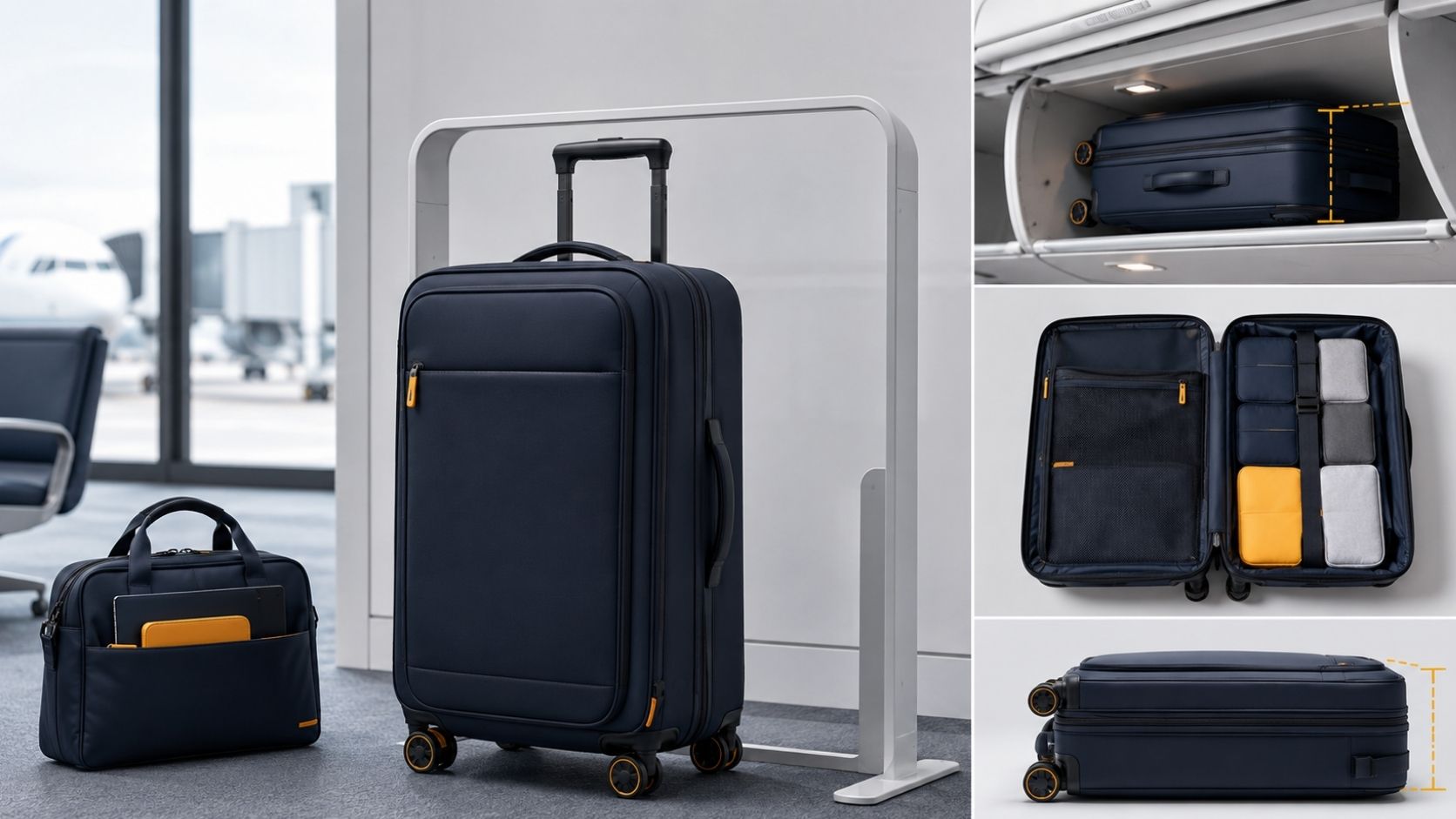
Which Cabin Suitcases Stay Inside the Cabin?
Cabin suitcases stay inside the cabin more reliably when their fully packed exterior profile matches the traveler’s ticket allowance, airline rule, aircraft limits, and boarding conditions. A carry-on label alone does not guarantee overhead-bin placement or protection from gate-check changes.
This article explains airline rule checks, shell and wheel design, packing profile control, gate-check triggers, and the final pre-flight checklist for cabin suitcases.
Why do cabin suitcases matter for reducing boarding gate stress?
Cabin suitcases matter for reducing boarding gate stress because a suitcase that looks cabin-sized can still be redirected if its packed profile, ticket allowance, or boarding conditions do not match the airline’s rule.
Travelers often check only the product label, but a suitcase can be gate-checked because of packed depth, fare rules, carry-on allowance, or limited overhead space. Cabin suitcases are designed for cabin travel, but final placement still depends on ticket allowance, packed profile, and boarding conditions.
The safer solution is to measure the fully packed exterior, check the ticket allowance, and keep important items in a smaller personal item. Underseat personal-item limits matter because essentials should stay accessible if the cabin suitcase changes placement.
How do airline rules determine whether cabin suitcases fit overhead bins?
Airline rules determine whether cabin suitcases fit overhead bins by setting the ticket allowance, packed-size limit, possible weight rule, aircraft constraint, and boarding-space reality for that trip.
Carry-on luggage rules determine whether the suitcase is treated as an overhead cabin bag or redirected at the gate. Carry-on size limits should be checked against the fully packed suitcase, not the empty shell alone.
Measure wheels, handles, front pockets, straps, expansion panels, and soft bulging as part of the exterior profile. Carry-on cabin placement can change when aircraft size, fare rules, or overhead-bin availability changes.
| Rule Area | What to Check | Why It Matters |
|---|---|---|
| Ticket allowance | Personal item, carry-on, or both | Prevents fare-rule surprises |
| Packed size | Full exterior profile | Sizer boxes measure more than the shell |
| Weight rule | Airline-specific limit if applied | Some routes enforce cabin weight |
| Aircraft type | Regional, narrow-body, wide-body | Bin space can vary |
| Boarding situation | Group, load, cabin fullness | Bin access is not guaranteed |
| Restricted items | Batteries, liquids, tools | Security and airline rules apply |
Which cabin suitcases designs are most likely to pass airport sizer checks?
Cabin suitcases designs are most likely to pass airport sizer checks when wheels, handles, pockets, shell shape, and expansion depth keep the packed exterior profile within the airline’s current rule.
When do recessed-wheel cabin suitcases help?
Recessed-wheel cabin suitcases help when the traveler wants a cleaner exterior profile with less wheel protrusion. The trade-off is that recessed designs may reduce interior space or add structure.
When do spinner cabin suitcases help?
Spinner cabin suitcases help on smooth airport floors and in queues because they are easier to guide beside the body. Exposed spinner wheels can add to the measured exterior profile and may struggle on rough surfaces.
When do two-wheel cabin suitcases help?
Two-wheel cabin suitcases help on rougher sidewalks, curbs, and outdoor paths because they often track better than exposed spinner wheels. They usually need to be tilted and pulled.
When do hardside cabin suitcases help?
Hardside cabin suitcases help when a fixed outer shape and resistance to soft bulging matter. They do not compress much if the bin or sizer is tight.
When do softside cabin suitcases help?
Softside cabin suitcases help when exterior pockets, slight flexibility, and quick-access storage matter. Overfilled pockets can make the bag too deep or uneven.
| Design Feature | Helps With | Watch Out For |
|---|---|---|
| Recessed wheels | Cleaner exterior profile | Less internal space |
| Spinner wheels | Smooth airport mobility | Wheel protrusion |
| Two-wheel layout | Rougher surfaces | Pulling effort |
| Hardside shell | Fixed shape | Low flexibility |
| Softside shell | Pocket access | Pocket bulge |
| Expansion zipper | Extra packing room | Recheck packed size |
How should cabin suitcases be packed to maximize space without bulging?
Cabin suitcases should be packed to maximize space without bulging by keeping dense items low, rigid items away from outer panels, cubes flat, exterior pockets slim, and expansion zippers conditional.
Dense items should sit near the wheel base for balance, while hard items should move away from outer bulge points. Packing cubes should control shape, not hide overpacking or force the shell closed.
Exterior pockets should stay slim, and expansion zippers should be treated as conditional. Carry-on overhead bin fit depends on packed profile, available cabin space, and boarding conditions.
| Packing Issue | Safer Packing Move | Benefit |
|---|---|---|
| Front bulge | Keep pockets flat | Cleaner sizer profile |
| Heavy top load | Move dense items low | Better balance |
| Hard edge pressure | Wrap or move rigid items | Less panel distortion |
| Expansion use | Recheck packed size | Lower gate-check risk |
| Loose straps | Tuck or secure | Less snag risk |
| Overfilled cubes | Flatten or reduce load | Easier closure |
What mistakes cause cabin suitcases to be flagged for gate-check risk?
Cabin suitcases are flagged for gate-check risk when expansion panels, outer pockets, wheels, handles, weight, uneven shape, or boarding conditions make the bag harder to place inside the cabin. Carry-on baggage handling risks increase when a cabin suitcase is redirected to gate-check or checked handling.
How do cabin suitcases fail because of open expansion zippers?
Cabin suitcases fail because of open expansion zippers when travelers pack with the expansion panel open and assume the suitcase still fits the cabin allowance. Closing the expansion zipper or remeasuring the expanded bag gives a more realistic fit check.
How do cabin suitcases fail because of overfilled front pockets?
Cabin suitcases fail because of overfilled front pockets when outer pockets are stuffed with laptops, tablets, books, toiletries, chargers, jackets, or other bulky items. Moving bulky items inward keeps the suitcase profile flatter.
How do cabin suitcases fail because of protruding wheels or handles?
Cabin suitcases fail because of protruding wheels or handles when travelers measure only the box body and ignore wheel points, grab handles, and telescoping-handle housing. Measuring the full exterior better matches what a sizer sees.
How do cabin suitcases fail because of weight issues?
Cabin suitcases fail because of weight issues when heavy electronics, books, shoes, or liquids make the bag difficult to lift or heavier than the airline’s cabin weight rule. Weighing the packed bag when weight limits apply reduces check-in or boarding problems.
How do cabin suitcases fail because of full overhead bins?
Cabin suitcases fail because of full overhead bins when travelers assume an allowed cabin suitcase will always stay overhead. Keeping essentials in a smaller personal item protects access if suitcase placement changes.
| Detected Issue | Likely Cause | Safer Fix |
|---|---|---|
| Bag too deep | Open expansion or full front pocket | Close expansion, flatten pocket |
| Bag too tall | Wheels or handles not measured | Measure full exterior |
| Bag hard to lift | Dense overpacking | Repack or reduce weight |
| Pocket protrusion | Bulky outer-pocket items | Move items inward |
| Sizer friction | Uneven packed shape | Rebalance contents |
| Placement change | Full cabin or fare rule | Keep essentials separate |
Which pre-flight checklist helps cabin suitcases meet airline rules?
A pre-flight checklist helps cabin suitcases meet airline rules by verifying ticket allowance, airline policy, fully packed dimensions, weight, expansion depth, pocket shape, closure stress, essentials access, and restricted-item rules before leaving for the airport.
This checklist does not guarantee cabin placement or fee avoidance. It helps reduce avoidable sizer problems, gate-check triggers, packed-profile mistakes, and essentials-access issues.
- Check whether your ticket includes a cabin suitcase, personal item, or both.
- Confirm the airline’s current cabin baggage rule for your route, fare type, and aircraft if available.
- Measure the fully packed bag, including wheels, handles, pockets, straps, and expansion panels.
- Weigh the packed bag if your airline applies cabin weight limits.
- Keep the expansion zipper closed unless the expanded size is still allowed.
- Keep front pockets flat and free from bulky hard items.
- Place dense items low near the wheel base.
- Keep soft clothing near outer panels to reduce hard protrusions.
- Make sure the suitcase closes without forcing the zipper, latch, or shell.
- Tuck loose straps, keychains, and dangling tags.
- Keep medication, essential documents, valuables, and permitted critical electronics accessible.
- Follow airline and security rules for batteries, liquids, tools, and restricted items.
- Keep a smaller personal item prepared in case overhead space is limited.
- Recheck the packed profile after adding souvenirs, jackets, or last-minute items.
What should you remember about cabin suitcases staying inside the cabin?
Cabin suitcases stay inside the cabin more reliably when rule compliance, packed exterior profile, liftability, boarding conditions, and essentials access are planned together. A product label can help identify the category, but it does not replace airline, ticket, aircraft, and packed-bag checks.
The strongest cabin suitcase choice is the one that remains compact after packing, includes all wheels and handles in measurement, stays liftable when weight rules apply, and leaves medication, essential documents, valuables, and permitted critical electronics accessible if cabin placement changes.
Frequently Asked Questions About Cabin Suitcases
Which cabin suitcases are most likely to stay inside the cabin?
Cabin suitcases are most likely to stay inside the cabin when they match the airline’s current allowance after packing, including wheels, handles, pockets, straps, expansion panels, and soft bulging. Ticket allowance and overhead-bin space still matter.
Do cabin suitcases always stay in the cabin if they are labeled carry-on?
No. Product labels do not guarantee cabin placement. The airline’s current rule, ticket allowance, aircraft limits, packed profile, weight rule, and boarding conditions determine whether the suitcase can stay in the cabin.
Should cabin suitcases have spinner wheels or two wheels?
Spinner cabin suitcases are useful on smooth airport floors, while two-wheel cabin suitcases can work better on rougher sidewalks and curbs. The better choice depends on route surface, wheel protrusion, and packed exterior profile.
Do expansion zippers make cabin suitcases risky?
Expansion zippers can make cabin suitcases risky when the expanded bag exceeds the airline’s current allowance. For cabin travel, expansion should stay closed unless the expanded packed size is still allowed.
What should I keep outside a cabin suitcase in case it is gate-checked?
Medication, essential documents, valuables, and permitted critical electronics should stay accessible in a smaller personal item when possible. Follow airline and security rules for batteries, liquids, tools, and restricted items.