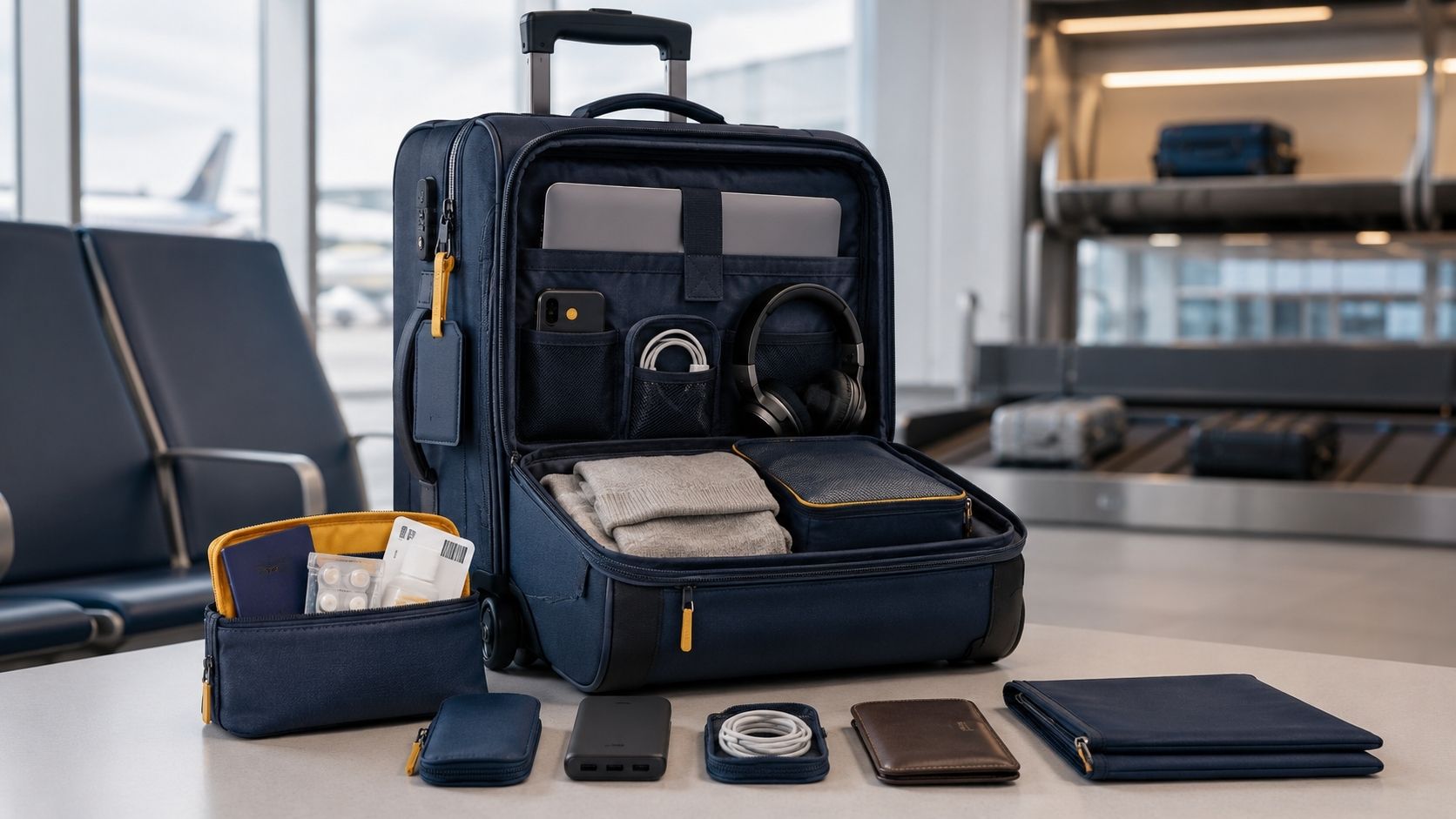
Which travel risks does carry-on luggage reduce?
Carry-on luggage reduces some travel risks by keeping essential items closer to the traveler and limiting exposure to checked-bag routing, baggage-claim waiting, and some handling conditions.
This guide explains how carry-on luggage compares with checked luggage, which risks still remain, which features can support safer travel, how to pack essentials and valuables, how to prepare for gate-check, and which final risk-reduction checklist to use before boarding.
Why can carry-on luggage reduce some checked-bag travel risks?
Carry-on luggage can reduce some checked-bag travel risks because the bag usually remains closer to the passenger instead of moving through the full checked-baggage system.
Checked bags can pass through airline baggage systems, airport handling areas, sorting belts, aircraft loading, transfer points, and baggage claim. Each transfer point can add exposure to delay, misrouting, rough handling, or loss of access to important items.
Carry-on luggage reduces some risks best when the traveler understands its cabin-use limits and airline-rule boundaries. Medication, documents, electronics, valuables, chargers, and one essential clothing layer can stay closer when they are packed accessibly.
The boundary is that carry-on luggage still faces theft, overhead-bin crowding, gate-check requirements, cabin movement, and traveler mistakes. It is a risk-reduction tool, not a guarantee of complete safety.
Which travel risks can carry-on luggage reduce compared with checked luggage?
Carry-on luggage can reduce some travel risks compared with checked luggage by keeping the bag closer, reducing checked-routing exposure, and preserving access to important items.
Checked luggage can be more practical for bulky items, but it also exposes the bag to different routing and handling conditions. Carry-on luggage can reduce reliance on baggage-claim timing and checked-bag transfers when the ticket and aircraft allow cabin placement.
Checked handling exposure helps explain why some travelers keep valuables and essentials out of checked bags. Carry-on luggage can also reduce the risk of losing access to medication, documents, chargers, and fragile electronics during delays.
The remaining risk is placement uncertainty. Airline rules, fare type, aircraft size, cabin fullness, and crew instructions can still change whether a bag remains in the cabin.
| Travel Risk | How Carry-On Luggage Can Help | Remaining Limitation |
|---|---|---|
| Delayed checked bag | Bag usually stays with traveler | Gate-check may still happen |
| Misrouting | Avoids checked-bag routing system | Aircraft or crew may require check |
| Lost access to essentials | Essentials remain close | Poor packing can trap items |
| Rough handling | Avoids some cargo handling | Overhead bins can still shift |
| Baggage claim wait | May allow faster airport exit | Depends on airline process |
| Extra bag cost | May reduce cost if included | Some fares charge for carry-on |
Which travel risks does carry-on luggage not eliminate?
Carry-on luggage does not eliminate theft, damage, gate-check, restricted-item, battery, medication-access, or identification risks.
A cabin bag can still be accessible to other travelers, moved by crew, shifted in overhead bins, damaged during boarding, or redirected when aircraft space is limited. Travelers can also create risk by burying medication, packing restricted items, ignoring battery rules, or relying on weak identification.
Carry-on cabin placement can change when cabin space, aircraft size, fare rules, or crew instructions change. Carry-on cabin storage depends on overhead-bin space, underseat access, aircraft layout, and boarding conditions.
The practical takeaway is that carry-on luggage reduces exposure to some checked-bag risks, but safe travel still depends on preparation, compliance, and keeping essentials removable.
| Risk Not Eliminated | Why It Still Exists | Safer Traveler Action |
|---|---|---|
| Theft | Bag may be unattended or accessible | Keep valuables close |
| Damage | Bags can shift in overhead bins | Pad fragile items |
| Gate-check | Cabin space may fill | Keep essentials removable |
| Rule violation | Items may be restricted | Check airline/security rules |
| Battery issue | Battery rules are specific | Pack batteries correctly |
| Lost identification | Bag may be misplaced | Use contact tag and tracker if useful |
Which carry-on luggage features can reduce access, theft, and damage risks?
Carry-on luggage features can reduce access, theft, and damage risks only when they support organization, closure control, visibility, and padding without creating false security.
How can locks help carry-on luggage security?
Locks can help carry-on luggage security by discouraging casual access and keeping zippers or latches closed.
Locks do not make carry-on luggage theft-proof. They should be treated as one small support feature, not a reason to leave valuables unattended or out of sight.
How can stronger zippers or latch systems help carry-on luggage?
Stronger zippers or latch systems can help carry-on luggage by improving closure reliability and reducing accidental opening.
Stronger closures cannot prevent all forced entry. Their best role is reducing zipper strain, accidental opening, and closure failure when the bag is packed within limits.
How can hard shells help carry-on luggage protection?
Hard shells can help carry-on luggage protection by adding structure against light compression and cabin contact.
Hardside shells can still crack, scratch, or transfer impact to fragile contents. Fragile items still need internal padding and should not be placed against hard shell edges.
How can organized compartments help carry-on luggage safety?
Organized compartments can help carry-on luggage safety by making medication, electronics, chargers, and documents easier to remove quickly.
Overstuffed compartments can create bulge and sizer risk. Organization helps most when pockets stay flat and urgent items remain easy to remove.
How can trackers help carry-on luggage visibility?
Trackers can help carry-on luggage visibility by making a misplaced bag easier to locate in some situations.
Many consumer trackers are not true always-on GPS devices, and trackers should be treated as visibility aids rather than recovery guarantees.
| Feature | Can Help With | Does Not Guarantee |
|---|---|---|
| Approved lock | Casual access deterrence | Theft-proof security |
| Strong zipper/latch | Closure reliability | Forced-entry prevention |
| Hardside shell | Light compression protection | Damage-proof handling |
| Organized pockets | Faster access | Automatic compliance |
| Tracker pocket | Bag visibility | Guaranteed recovery |
| Contact tag | Easier identification | Lost-bag prevention |
How should travelers pack carry-on luggage to protect essentials and valuables?
Travelers should pack carry-on luggage to protect essentials and valuables by keeping critical items accessible, padding fragile items, following battery rules, keeping valuables close, and labeling the bag clearly.
Medication, documents, valuables, and critical electronics should stay in an accessible pouch or personal item when possible. This protects access if the main carry-on luggage is moved, gate-checked, or stored away from the seat.
Fragile items should be padded with soft clothing and kept near the center of the bag. Batteries and electronics should be packed according to the airline and security rules for the route.
Do not leave high-value items unattended in overhead bins during sleep or long periods. Clear identification, an internal contact card, and a secure tag can help if the bag is moved or misplaced.
| Item Type | Best Placement | Why |
|---|---|---|
| Passport/documents | Personal item or removable pouch | Quick access |
| Medication | Personal item or top-access pouch | Needed if gate-check occurs |
| Power bank | Cabin-accessible location | Battery rules may apply |
| Laptop/tablet | Padded sleeve | Impact protection |
| Camera/lens | Center of bag with padding | Shock reduction |
| Wallet/keys | Personal item | Theft/access control |
What mistakes weaken carry-on luggage risk reduction during boarding?
Mistakes weaken carry-on luggage risk reduction during boarding when essentials are buried, gate-check risk is ignored, straps hang loose, the bag is overpacked, or security features are trusted too much.
Carry-on baggage handling risks increase when a cabin bag is redirected to gate-check or valet-check handling, so boarding preparation should happen before the bag leaves the traveler’s hands.
How does burying essentials weaken carry-on luggage risk reduction?
Burying essentials weakens carry-on luggage risk reduction when medication, documents, batteries, and valuables are packed deep inside the main suitcase.
A removable pouch or personal item keeps essentials accessible if the bag is moved, stored far away, gate-checked, or valet-checked.
How does ignoring gate-check risk weaken carry-on luggage planning?
Ignoring gate-check risk weakens carry-on luggage planning when travelers assume cabin placement is guaranteed.
Preparing a quick-remove essentials kit before boarding keeps the traveler ready if overhead space runs out or crew instructions require a different bag plan.
How do loose straps weaken carry-on luggage safety?
Loose straps weaken carry-on luggage safety when straps, tags, buckles, or cords dangle and catch on bins, seats, or aisle hardware.
Tucking or securing loose parts lowers snagging, tearing, and boarding-delay risk.
How does overpacking weaken carry-on luggage risk reduction?
Overpacking weakens carry-on luggage risk reduction when pockets bulge, zippers strain, or the packed bag exceeds the airline’s current rule.
Flattening pockets, closing expansion panels, and remeasuring the packed bag lowers sizer and gate-check risk.
How does overtrusting security features weaken carry-on luggage safety?
Overtrusting security features weakens carry-on luggage safety when travelers assume locks, trackers, or anti-theft fabrics make theft impossible.
Keeping high-value items close and staying aware in crowded spaces treats features as support, not a substitute for caution.
| Boarding Problem | Common Cause | Safer Fix |
|---|---|---|
| Bag must be gate-checked | Full cabin or smaller aircraft | Remove essentials first |
| Bag fails sizer | Bulging profile | Flatten pockets and recheck |
| Valuables trapped | Poor access planning | Use removable pouch |
| Bag snags | Loose straps or tags | Tuck loose parts |
| Battery issue | Rule-sensitive item | Follow airline/security rules |
| Wrong return expectation | Unclear gate-check process | Ask where bag will be returned |
Which final checklist helps carry-on luggage reduce travel risks?
A final checklist helps carry-on luggage reduce travel risks by confirming airline allowance, essentials access, battery compliance, fragile-item padding, loose-strap control, bag identification, and gate-check readiness.
This checklist does not remove all risk. It helps travelers catch preventable mistakes before boarding, especially when the bag may need to be moved, stored away from the seat, gate-checked, or handled by airline staff.
- Confirm whether your ticket includes carry-on luggage, a personal item, or both.
- Check the airline’s current carry-on rules for your route and fare type.
- Keep medication, documents, valuables, and permitted electronics easy to remove.
- Pack power banks and spare batteries according to airline and security rules.
- Place fragile items near the center of the bag with soft padding around them.
- Keep passports, wallets, phones, and urgent medication in a personal item when possible.
- Tuck loose straps, buckles, cords, and luggage tags.
- Keep exterior pockets flat to reduce sizer risk.
- Use a lock, stronger zipper, or tracker as a support feature, not a guarantee.
- Add current contact information to a secure luggage tag.
- Remove old barcode tags from previous flights when relevant.
- Keep an essentials pouch ready in case the bag must be gate-checked.
- Ask where a gate-checked or valet-checked bag will be returned.
- Follow crew instructions for overhead bins, underseat storage, and gate-check handling.
- Remember that carry-on luggage reduces some travel risks but does not remove all risk.
What should you remember about carry-on luggage risk reduction?
Carry-on luggage reduces travel risk best when the traveler keeps essentials accessible, checks airline rules, controls the packed profile, and prepares for possible gate-check.
It can reduce some checked-bag delay, routing, baggage-claim, and access risks, but it does not eliminate theft, damage, restricted-item problems, battery-rule issues, or traveler mistakes. The safest approach is to treat carry-on luggage as part of a realistic risk-reduction plan, not as a zero-risk solution.
Frequently Asked Questions About Carry-On Luggage Risk Reduction
Which travel risks does carry-on luggage reduce?
Carry-on luggage can reduce checked-bag delay, misrouting exposure, baggage-claim waiting, and loss of access to essentials because the bag usually stays closer to the traveler.
Does carry-on luggage eliminate baggage risk?
No. Carry-on luggage does not eliminate theft, damage, gate-check risk, restricted-item problems, battery-rule issues, or traveler mistakes.
Is carry-on luggage safer than checked luggage?
Carry-on luggage may be safer for essentials, valuables, medication, documents, and fragile electronics because those items can stay closer. Checked luggage may still be more practical for bulky items, restricted cabin items, or larger packing needs.
What should I keep in carry-on luggage?
Keep medication, documents, valuables, permitted electronics, chargers, batteries according to current rules, one essential clothing layer, and urgent travel items in carry-on luggage or a personal item.
What should I do if carry-on luggage must be gate-checked?
Remove medication, documents, valuables, permitted electronics, batteries when required, and urgent essentials before handing over the bag. Ask where the gate-checked or valet-checked bag will be returned.