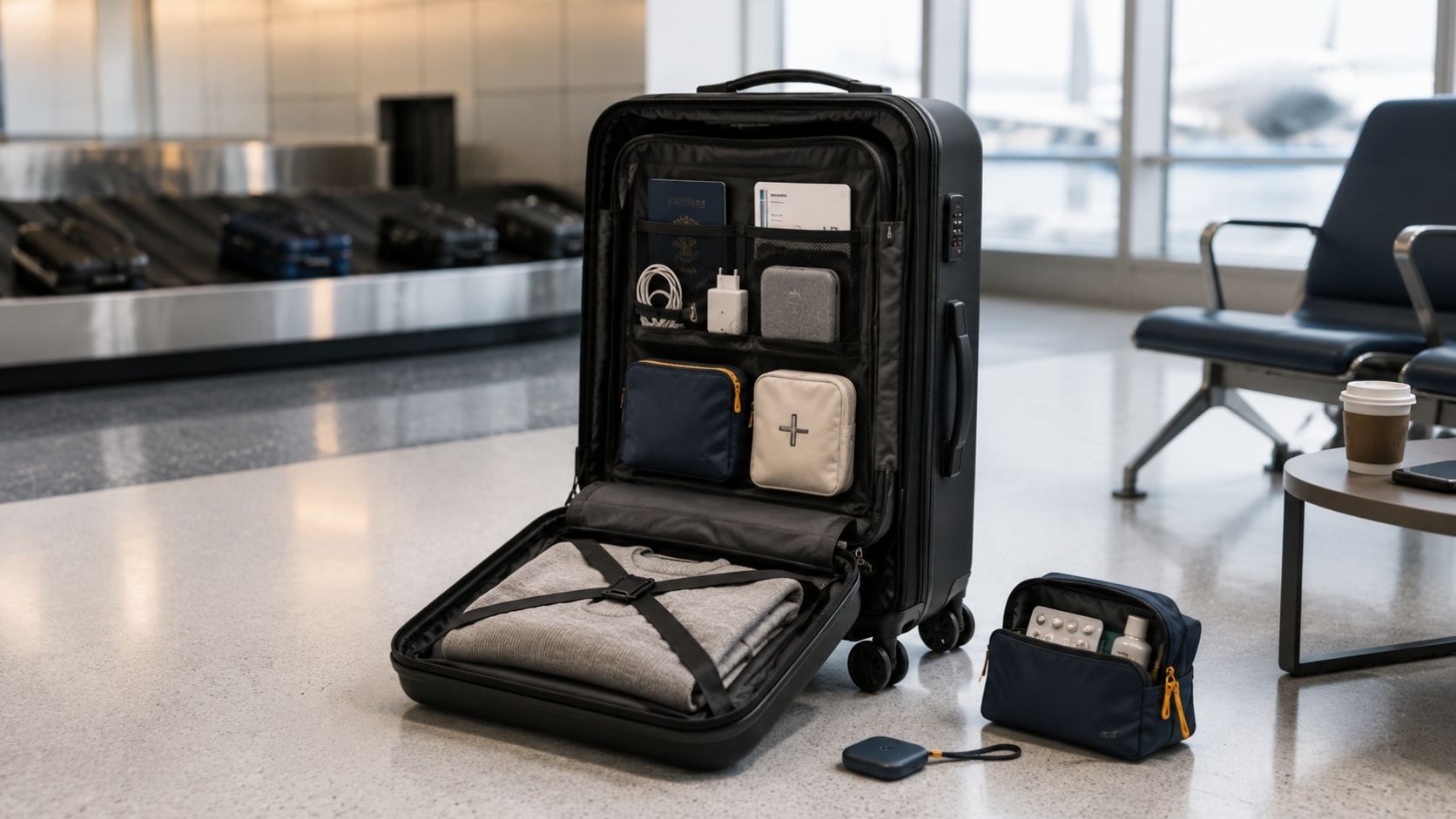
Which baggage-handling risks does carry-on luggage avoid?
Carry-on luggage can avoid some checked-bag handling risks when it stays with the traveler instead of moving through baggage sorting, transfer handling, ramp loading, carousel pickup, and baggage claim.
This guide explains which checked-bag handling risks carry-on luggage can reduce, which risks still remain, which protective features help, how to pack fragile and essential items, how to prepare for gate-check pressure, and which pre-boarding checklist to use.
Why can carry-on luggage reduce exposure to checked-bag handling risks?
Carry-on luggage can reduce exposure to checked-bag handling risks because it usually avoids the full checked-baggage system when it stays with the passenger.
Checked bags pass through airline baggage systems, sorting belts, transfer points, ramp handling, aircraft loading, unloading, and baggage claim. Each step can add movement, waiting, scanning, lifting, stacking, or public pickup exposure.
Carry-on luggage reduces baggage-handling exposure best when it matches airline rules and stays easy to manage. Medication, documents, valuables, chargers, permitted electronics, and urgent personal items can remain closer when they are packed accessibly.
The boundary is that carry-on luggage can still be gate-checked, moved by crew, squeezed in overhead bins, misplaced, or stolen if unattended. It lowers some handling exposure; it does not create a risk-free trip.
Which checked-bag handling risks can carry-on luggage reduce?
Carry-on luggage can reduce checked-bag handling risks by avoiding some routing delays, transfer errors, carousel pickup exposure, ramp handling, and checked-bag stacking when it remains onboard.
Checked luggage can be practical for larger loads, but it moves through a different handling and routing process. That process can involve sorting belts, transfers, cargo loading, unloading, and baggage-claim recovery.
Checked handling exposure helps explain why some travelers keep fragile items, documents, medication, and electronics out of checked bags. Carry-on luggage can avoid some conveyor, ramp, and checked-bag stacking exposure when it stays in the cabin.
The remaining limitation is operational control. Airline rules, smaller aircraft, full flights, fare conditions, and crew instructions can still require gate-checking or valet-checking.
| Baggage-Handling Risk | How Carry-On Luggage Can Help | Remaining Limitation |
|---|---|---|
| Routing delay | Avoids checked-bag sorting when kept onboard | Gate-check may still happen |
| Transfer error | Stays with traveler on many connections | Aircraft rules may change placement |
| Carousel wait | May allow direct airport exit | Depends on baggage needs |
| Public pickup exposure | Avoids carousel when kept in cabin | Theft risk still exists onboard |
| Ramp handling | Avoids some loading and unloading exposure | Gate-check may add handling |
| Stacking pressure | Avoids some checked-bag pile pressure | Overhead bins can still shift |
Which baggage-handling risks does carry-on luggage not fully avoid?
Carry-on luggage does not fully avoid gate-check, damage, theft, weather exposure, restricted-item, battery, or bag-confusion risks.
Gate-check can happen when cabin space is full or aircraft storage is limited. Damage can still happen if bags shift, passengers force bags into bins, or the bag is handled outside the cabin during gate-check.
Carry-on cabin placement can change when overhead space, aircraft size, crew instructions, or fare rules affect storage. Carry-on cabin storage depends on overhead-bin space, underseat access, seat position, and boarding conditions.
The practical takeaway is that carry-on luggage avoids some checked-bag handling loops, but it does not create a risk-free journey. Travelers still need accessible essentials, secure identification, compliant items, and a gate-check plan.
| Risk Not Fully Avoided | Why It Still Exists | Safer Traveler Action |
|---|---|---|
| Gate-check | Cabin space or aircraft limits | Keep essentials removable |
| Cabin damage | Bags can shift or be moved | Pad fragile items |
| Theft | Bags may be unattended | Keep valuables close |
| Weather exposure | Gate-check may add ramp handling | Use water-resistant protection |
| Rule problems | Restricted items vary | Check current rules |
| Bag confusion | Similar bags look alike | Use visible ID and contact tag |
Which carry-on luggage features help reduce handling, theft, and weather risks?
Carry-on luggage features can help reduce handling, theft, and weather risks when they improve closure control, light compression resistance, moisture protection, visibility, and identification without promising full protection.
How can stronger closures help carry-on luggage?
Stronger closures can help carry-on luggage by improving zipper, latch, and pull reliability during boarding, storage, and movement.
Stronger closures do not make carry-on luggage theft-proof. Their best role is reducing accidental opening, zipper strain, and closure failure when the bag is packed within its limits.
How can locks help carry-on luggage?
Locks can help carry-on luggage by discouraging casual access and keeping closures secured.
Locks do not stop all forced entry or theft. They should be treated as a support feature, not a reason to leave valuables unattended or visible.
How can hard shells help carry-on luggage?
Hard shells can help carry-on luggage by reducing light compression and surface contact during cabin handling.
Hard shells can still crack, scratch, dent, or transfer shock to contents. Fragile items still need internal padding and careful placement.
How can water-resistant materials help carry-on luggage?
Water-resistant materials can help carry-on luggage during light moisture exposure, brief outdoor handling, or accidental surface contact.
Water-resistant materials are not the same as waterproof protection. Weather exposure can still matter during gate-check, ramp handling, heavy rain, or prolonged moisture contact.
How can trackers help carry-on luggage?
Trackers can help carry-on luggage visibility by making a misplaced bag easier to locate in some situations.
Many consumer trackers are not true always-on GPS trackers and should be used as visibility aids, not recovery guarantees.
| Feature | Can Help With | Does Not Guarantee |
|---|---|---|
| Strong zipper/latch | Closure reliability | Theft-proof security |
| Approved lock | Casual access deterrence | Forced-entry prevention |
| Hardside shell | Light compression protection | Damage-proof performance |
| Water-resistant material | Light moisture resistance | Waterproof protection |
| Tracker pocket | Bag visibility | Guaranteed recovery |
| Contact tag | Identification | Lost-bag prevention |
How should travelers pack carry-on luggage to protect fragile and essential items?
Travelers should pack carry-on luggage to protect fragile and essential items by keeping critical items removable, padding delicate gear, separating rule-sensitive items, keeping valuables close, and labeling the bag clearly.
Medication, documents, valuables, and permitted electronics should remain easy to remove. This matters because overhead bags can be moved, stored away from the seat, or redirected to gate-check.
Fragile items should be padded with soft clothing and kept near the center of the bag. Power banks, spare batteries, and other rule-sensitive items should be packed according to the airline and security rules for the trip.
Travelers should avoid putting irreplaceable items deep in overhead carry-on luggage where they are hard to remove quickly. Clear external identification and an internal contact card can also help if the bag is moved or confused with a similar bag.
| Item Type | Better Placement | Why |
|---|---|---|
| Passport/documents | Personal item or removable pouch | Quick access |
| Medication | Personal item or top-access pouch | Needed if gate-check occurs |
| Power bank | Cabin-accessible location | Battery rules may apply |
| Laptop/tablet | Padded sleeve | Impact protection |
| Camera/lens | Center with soft padding | Shock reduction |
| Contact card | Inside bag and tag | Identification support |
What should travelers do if carry-on luggage faces gate-check pressure?
Travelers should respond to carry-on luggage gate-check pressure by removing essentials, flattening the packed profile, asking where the bag will return, moving fragile items when allowed, and securing loose straps.
Carry-on risk reduction works best when essentials stay removable and the traveler prepares for possible gate-check before the bag leaves their hands.
What if overhead bins are full?
When overhead bins are full, carry-on luggage may need to be moved, checked, or handled according to crew instructions.
Removing medication, documents, valuables, batteries, and electronics first keeps essential items with the traveler.
What if carry-on luggage fails a sizer check?
When carry-on luggage fails a sizer check, bulging pockets, open expansion panels, wheels, or handles may be creating a larger packed profile.
Carry-on size limits should be checked against the fully packed bag before relying on cabin placement. Flattening pockets, closing expansion zippers, removing bulky items, or accepting gate-check if required lowers conflict and damage risk.
What if the airline offers valet-check or gate-check?
When the airline offers valet-check or gate-check, travelers should ask where the bag will be returned and remove essentials before handing it over.
The result is a clearer process and better protection for critical items if the main bag leaves the cabin.
What if fragile items are inside the carry-on luggage?
When fragile items are inside carry-on luggage, travelers should move fragile, high-value, or rule-sensitive items into a personal item when allowed.
The most vulnerable contents stay closer if the larger bag leaves the cabin.
What if loose straps or tags create handling problems?
When loose straps or tags create handling problems, dangling straps, cords, buckles, or luggage tags can snag on sizers, bins, handles, or aisle hardware.
Tucking or securing loose parts before boarding lowers snagging and damage risk.
| Gate-Check Issue | Likely Cause | Safer Response |
|---|---|---|
| Full overhead bins | Flight load or boarding order | Remove essentials first |
| Sizer issue | Bulging or expanded profile | Flatten and recheck |
| Smaller aircraft | Limited bin space | Ask return location |
| Fragile contents | Poor separation | Move to personal item |
| Battery rule issue | Rule-sensitive items | Follow airline/security rules |
| Loose straps | Snagging risk | Tuck dangling parts |
Which pre-boarding checklist helps carry-on luggage reduce baggage-handling risks?
A pre-boarding checklist helps carry-on luggage reduce baggage-handling risks by verifying airline allowance, packed profile, essentials access, battery compliance, fragile-item padding, loose-strap control, identification, and gate-check readiness.
This checklist does not guarantee cabin placement, safe handling, theft prevention, or damage prevention. It helps reduce preventable problems before the boarding door and before a bag might leave the traveler’s control.
- Confirm whether your ticket includes carry-on luggage, a personal item, or both.
- Check your airline’s current baggage rules for your route and fare type.
- Measure the fully packed bag if overhead-bin or sizer fit matters.
- Keep medication, documents, valuables, keys, and permitted electronics easy to remove.
- Pack power banks and spare batteries according to airline and security rules.
- Place fragile items near the center of the bag with soft padding around them.
- Keep passports, wallets, phones, and urgent medication in a personal item when possible.
- Keep exterior pockets flat to reduce sizer risk.
- Tuck loose straps, cords, buckles, and luggage tags.
- Use approved locks, stronger closures, or trackers as support tools, not guarantees.
- Add current contact information to an external luggage tag and an internal card.
- Remove old airline barcode tags when relevant.
- Prepare a removable essentials pouch in case gate-check is required.
- Ask where a gate-checked or valet-checked bag will be returned.
- Remember that carry-on luggage reduces some baggage-handling risks but does not remove all risk.
What should you remember about carry-on luggage and baggage-handling risks?
Carry-on luggage reduces baggage-handling risks best when the bag stays cabin-ready, essentials remain removable, and the traveler prepares for possible gate-check.
It can reduce exposure to some checked-bag sorting, transfer, ramp, carousel, and stacking conditions, but it does not remove all risk. The safer approach is to keep fragile and essential items accessible, check current airline rules, control the packed profile, secure loose parts, label the bag clearly, and treat protective features as support tools rather than guarantees.
Frequently Asked Questions About Carry-On Luggage and Baggage-Handling Risks
Which baggage-handling risks does carry-on luggage avoid?
Carry-on luggage can avoid some checked-bag handling risks when it stays in the cabin, including checked-bag sorting, transfer handling, ramp loading, carousel pickup, baggage-claim waiting, and some stacking exposure.
Does carry-on luggage avoid all baggage-handling risk?
No. Carry-on luggage does not avoid all baggage-handling risk. It can still be gate-checked, dropped, squeezed in overhead bins, misplaced, stolen if unattended, or affected by traveler packing mistakes.
Can carry-on luggage still be gate-checked?
Yes. Carry-on luggage can still be gate-checked or valet-checked if overhead bins are full, aircraft storage is limited, the bag fails a sizer check, or crew instructions require it.
What should I remove before gate-checking carry-on luggage?
Remove medication, documents, valuables, keys, permitted electronics, power banks, spare batteries when required, and urgent personal items before handing over carry-on luggage for gate-check or valet-check.
Do locks, trackers, or hard shells make carry-on luggage safe?
Locks, trackers, and hard shells can help with deterrence, visibility, or light compression protection, but they do not guarantee theft-proof, damage-proof, waterproof, or recovery-proof performance.