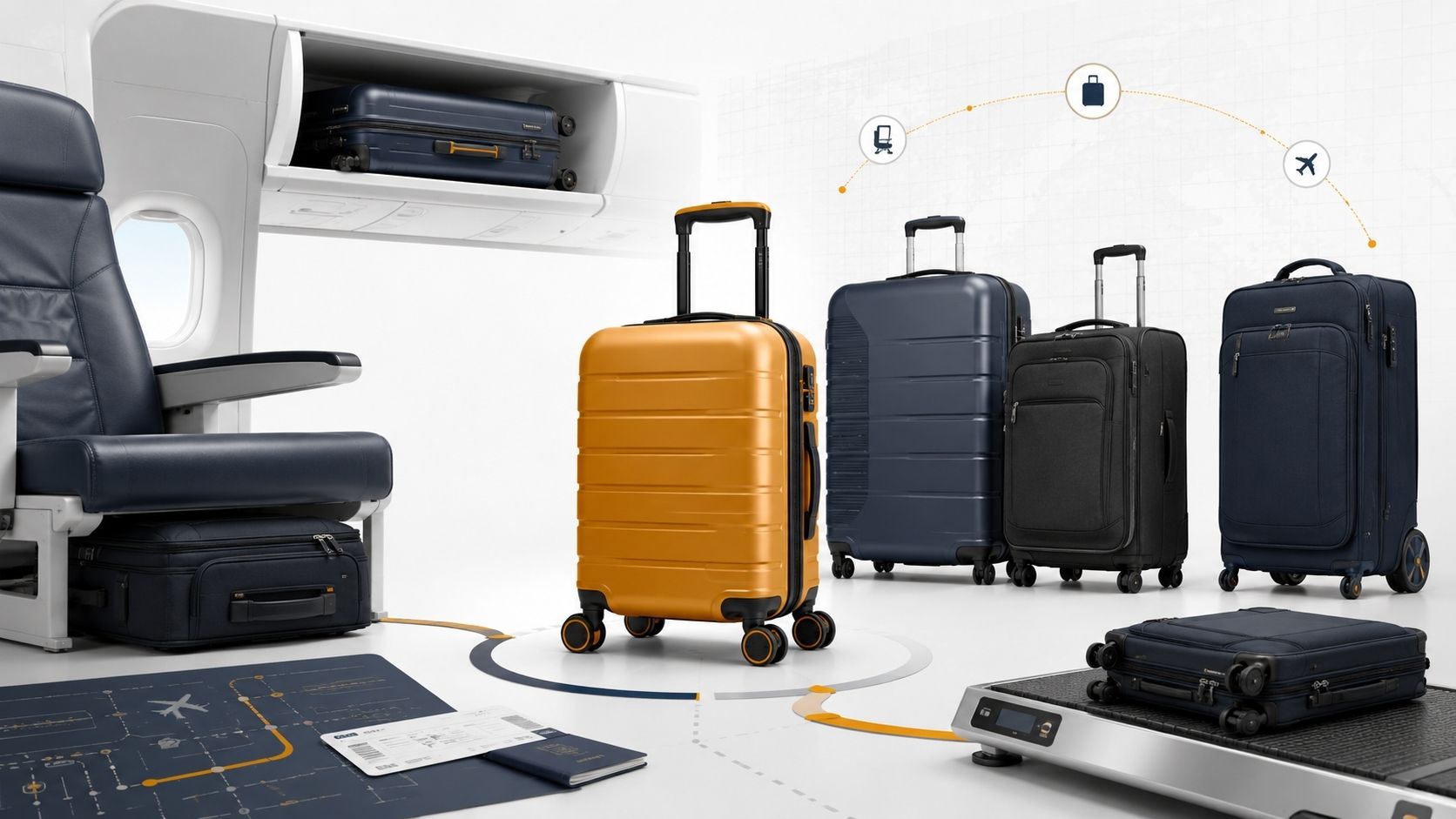
What Classifies Suitcases Through Transit Placement, Shell Format, and Wheel Mobility?
Suitcases are classified by how they travel, how their shell is built, and how their wheel system moves across real surfaces. The same bag can belong to several categories at once, such as a hardside carry-on spinner or a softside checked roller.
This guide explains how to classify suitcases by transit placement, shell format, wheel mobility, packing behavior, common mistakes, and final trip fit so the suitcase matches the itinerary instead of only matching a product label.
Why does classifying suitcases before a trip prevent costly travel disruptions?
Classifying suitcases before a trip prevents costly travel disruptions because each suitcase category solves a different airport, packing, and movement problem.
A suitcase that looks suitable in a store can become the wrong choice when the airline rule, cabin storage location, sidewalk surface, packing volume, or checked-bag handling exposure changes. The classification step turns a broad product name into a practical travel decision.
The first lens is transit placement: whether the suitcase is intended for underseat, overhead-bin, or checked cargo-hold travel. The second lens is shell format: whether the suitcase uses a rigid hardside shell or a flexible softside body. The third lens is wheel mobility: whether it rolls as a four-wheel spinner or a two-wheel roller.
The safest decision starts with the trip. A suitcase should match where it will travel, how much it must hold, how it will be handled, and where it must roll.
How should suitcases be classified before comparing size, shell, and wheels?
Suitcases should be classified before comparing size, shell, and wheels because those traits only matter after the travel role is clear.
A traveler choosing a suitcase should first ask where the bag will travel. Suitcase flight placement separates underseat, carry-on, and checked roles before smaller design details become useful.
After placement, shell format explains protection, flexibility, access, and packing behavior. Wheel mobility then explains how easily the suitcase moves through airports, hotels, city streets, curbs, train platforms, and uneven ground.
This layered classification avoids comparing unrelated bags. A softside underseat suitcase, a hardside carry-on spinner, and a large checked roller may all be suitcases, but they solve different travel problems.
| Classification Lens | Suitcase Types | Main Decision |
|---|---|---|
| Transit placement | Underseat, carry-on, checked | Where the suitcase travels |
| Shell format | Hardside, softside | Protection vs flexibility |
| Wheel mobility | Spinner, roller | Smooth floors vs rough terrain |
| Trip use case | Business, family, city, long trip | Practical travel fit |
How do underseat, carry-on, and checked suitcases differ by transit placement?
Underseat, carry-on, and checked suitcases differ by transit placement because each one occupies a different travel zone and faces different airline limits.
Transit placement is the strongest classification lens because it decides whether the suitcase stays near the seat, goes in the overhead bin, or travels through checked-bag handling. That placement changes access, size pressure, packing volume, and handling exposure.
When should underseat suitcases replace a larger cabin bag?
Underseat suitcases should replace a larger cabin bag when the trip is minimal, the fare allows only a personal item, or the traveler needs essentials close during the flight.
Underseat personal-item limits matter because the usable space below the seat is smaller and more airline-specific than a generic suitcase label suggests. Underseat suitcases work best for light packing, documents, medication, electronics, and one compact change of clothing.
When should carry-on suitcases be your main travel bag?
Carry-on suitcases should be the main travel bag when the trip is short, the traveler can pack within the airline’s current cabin rule, and faster airport movement matters.
Carry-on luggage works best when the fully packed suitcase fits the overhead-bin allowance, keeps essentials accessible, and does not rely on overfilled pockets or expanded depth to hold the trip.
When should checked suitcases be used instead of cabin suitcases?
Checked suitcases should be used instead of cabin suitcases when the trip requires more capacity, bulkier clothing, multiple shoes, family supplies, formalwear, equipment, or items that do not fit cabin limits.
Checked luggage gives more packing room, but it also changes the risk profile because the suitcase may face weight limits, handling exposure, baggage-claim waiting, and less immediate access to contents.
| Suitcase Type | Travel Position | Best Use | Main Risk |
|---|---|---|---|
| Underseat suitcase | Below seat | Minimal trips and essentials | Airline-specific limits |
| Carry-on suitcase | Overhead bin | Short trips and fast exits | Oversize checks |
| Checked suitcase | Cargo hold | Long trips and bulky packing | Weight fees and rough handling |
Which shell formats make suitcases more protective or more flexible?
Shell formats make suitcases more protective or more flexible by changing how the bag resists pressure, opens, expands, and gives access to contents.
Suitcase shell format should be treated as a behavior choice, not only a style choice. Hardside suitcases usually favor structure and cleaner exterior protection, while softside suitcases usually favor flexibility, pockets, and easier last-minute access.
When do hardside suitcases provide better protection?
Hardside suitcases provide better protection when structure, crush resistance, wipe-clean surfaces, and predictable exterior shape matter more than outer-pocket access.
They are often useful for checked travel, fragile packing, wet airport floors, and travelers who prefer a firmer shell. The trade-off is that hardside suitcases can scratch, dent, crack, or transfer shock to contents if fragile items are not padded correctly.
When do softside suitcases provide better flexibility?
Softside suitcases provide better flexibility when outer pockets, expansion panels, lighter access, and squeeze tolerance matter more than rigid-shell protection.
They are often useful for carry-on travel, business documents, jackets, toiletries, and travelers who need quick access. The trade-off is that overstuffed pockets and expansion panels can create bulge, zipper strain, and airline sizer problems.
| Shell Format | Best Strength | Main Trade-Off | Best For |
|---|---|---|---|
| Hardside suitcase | Structure and impact protection | Scratches, dents, fewer pockets | Checked and fragile packing |
| Softside suitcase | Flexibility and access | Less crush protection | Carry-on and quick-access travel |
How do spinner and roller suitcases differ by wheel mobility and terrain?
Spinner and roller suitcases differ by wheel mobility and terrain because they move through the world in different positions.
Suitcase wheel mobility should be matched to the surface, not only to the showroom test. Smooth airport floors reward upright four-wheel movement, while curbs, cobblestones, rough sidewalks, and train stations often reward stronger two-wheel tracking.
When do spinner suitcases move best?
Spinner suitcases move best on smooth indoor surfaces where four wheels can glide upright beside the traveler.
They are convenient in airports, hotels, cruise terminals, and flat corridors because they reduce pulling effort and turn easily in tight spaces. Their weakness is exposed wheel assemblies, which can be vulnerable on rough ground, curbs, and uneven pavement.
When do roller suitcases move better than spinner suitcases?
Roller suitcases move better than spinner suitcases when the route includes uneven sidewalks, curbs, rough ground, train platforms, or city streets.
Two-wheel rollers usually track behind the traveler and often protect the wheels better because the wheels are more recessed. Their trade-off is that the traveler carries more of the pulling load through the handle and wrist.
| Wheel Type | Best Terrain | Main Weakness | Best Traveler |
|---|---|---|---|
| Spinner suitcase | Smooth airports and hotels | Exposed wheels, weak on rough ground | Airport-focused traveler |
| Roller suitcase | Streets, curbs, uneven surfaces | Requires pulling weight | City and train traveler |
How should rolling suitcases be packed and maneuvered for balance and lifespan?
Rolling suitcases should be packed and maneuvered for balance and lifespan because weight placement and surface handling affect wheel stress, tipping, zipper strain, and shell pressure.
Heavy items should sit near the wheel base so the suitcase remains easier to roll and less likely to tip. Dense items placed high in the case can make a spinner unstable and can increase handle strain on a two-wheel roller.
Travelers should lift rolling suitcases over curbs, stairs, train gaps, and deep pavement cracks instead of dragging exposed wheels through impact points. This is especially important for spinners because the caster assemblies usually sit outside the shell footprint.
Packing also affects structure. A suitcase that closes without force, keeps its profile clean, and avoids pocket bulge is easier to measure, easier to store, and less likely to strain zippers or seams.
| Check | Pass Signal |
|---|---|
| Heavy items | Placed near wheel base |
| Zipper pressure | Closes without force |
| Shell shape | Not bulging outward |
| Wheel handling | Lifted over curbs |
| Expanded depth | Still within airline limit |
Which mistakes cause suitcases to trigger fees, damage, or handling problems?
Suitcase mistakes trigger fees, damage, or handling problems when travelers classify the bag by appearance instead of by airline fit, packed shape, wheel exposure, and construction quality.
The most common failures come from measuring the wrong part of the suitcase, overfilling flexible sections, using the wrong wheel system for the route, or trusting a large checked suitcase without checking its weak points.
Why is measuring only the suitcase compartment a mistake?
Measuring only the suitcase compartment is a mistake because wheels, handles, bumpers, side pockets, and expansion panels can add size beyond the packing box.
Airline checks may consider the full exterior suitcase, so the safer method is to measure the packed height, width, and depth after closing all pockets and expansion areas.
Why can overstuffing softside suitcases cause problems?
Overstuffing softside suitcases can cause problems because fabric flexibility can hide extra depth until the bag reaches a sizer, overhead bin, or tight trunk space.
The fix is to keep outer pockets flat, close expansion panels before measuring, and remove dense items that force the zipper line outward.
Why can dragging spinner suitcases over rough ground damage wheels?
Dragging spinner suitcases over rough ground can damage wheels because spinner casters are designed for smooth multi-directional movement, not repeated curb impact or uneven pavement shocks.
The safer habit is to lift spinner suitcases over obstacles and use a two-wheel roller when rough city routes are the main travel surface.
Why can checked suitcases fail when construction quality is ignored?
Checked suitcases can fail when construction quality is ignored because cargo-hold travel may expose the bag to lifting, stacking, conveyor movement, and repeated handling.
Checked structural integrity matters most at wheels, corners, handles, zippers, seams, frames, and shell edges because those points often carry the stress before the main panels do.
Which final checklist helps you choose the right suitcases for your itinerary?
A final checklist helps you choose the right suitcases for your itinerary by forcing the decision through placement, shell format, wheel mobility, packing volume, and construction quality.
Use the checklist before purchase and again before travel. A suitcase that passes the checklist is more likely to match the route, airline rule, packed profile, and handling environment.
- Confirm the airline’s carry-on, personal-item, and checked-bag rules before buying.
- Measure the full exterior suitcase, including wheels, handles, and expansion depth.
- Choose underseat suitcases for minimalist packing and personal-item travel.
- Choose carry-on suitcases for short trips and fast airport exits.
- Choose checked suitcases for long trips, bulky clothing, or larger packing needs.
- Choose hardside suitcases when structure and protection matter more than outer pockets.
- Choose softside suitcases when flexibility, expansion, and quick access matter more.
- Choose spinner suitcases for smooth airports, hotels, and flat indoor surfaces.
- Choose roller suitcases for uneven streets, curbs, train stations, and rougher routes.
- Pack heavy items near the wheel base to improve balance.
- Avoid forcing zippers, bulging shells, or overusing expansion panels.
- Inspect wheels, handles, corners, zippers, and frame quality before purchase.
- Choose the suitcase that matches the itinerary, not the one that only looks best.
What should you remember about classifying suitcases?
Suitcases are best classified through transit placement first, shell format second, and wheel mobility third. That sequence separates where the bag travels, how it protects or flexes, and how it moves across the actual route.
The right suitcase is not simply the largest, strongest, lightest, or most stylish option. It is the suitcase whose placement, shell, wheels, packing behavior, and construction match the itinerary without creating avoidable size, handling, or mobility problems.
Frequently Asked Questions About Suitcases
What are the main suitcase categories?
The main suitcase categories are underseat suitcases, carry-on suitcases, checked suitcases, hardside suitcases, softside suitcases, spinner suitcases, and roller suitcases. These categories can overlap, so one suitcase can be a hardside carry-on spinner.
What is the difference between a carry-on suitcase and a checked suitcase?
A carry-on suitcase is built for cabin travel when overhead-bin rules allow it, while a checked suitcase is built for cargo-hold travel. Carry-on suitcases usually support shorter trips and faster airport exits, while checked suitcases support larger packing loads, bulky clothing, or items that do not fit cabin limits.
Are hardside suitcases better than softside suitcases?
Hardside suitcases are better when structure, impact resistance, and wipe-clean surfaces matter more. Softside suitcases are better when flexibility, expansion, outer pockets, and quick access matter more. The better choice depends on the trip, packing style, and handling exposure.
Are spinner suitcases better than roller suitcases?
Spinner suitcases are better on smooth airport floors, hotels, cruise terminals, and flat indoor surfaces. Roller suitcases are often better for uneven sidewalks, curbs, rough streets, and train stations because two fixed wheels usually track better on imperfect surfaces.
Why should I measure the full exterior of a suitcase?
You should measure the full exterior of a suitcase because wheels, handles, bumpers, side pockets, and expansion depth can make the suitcase larger than the packing compartment alone. Airline size checks may include those external parts.