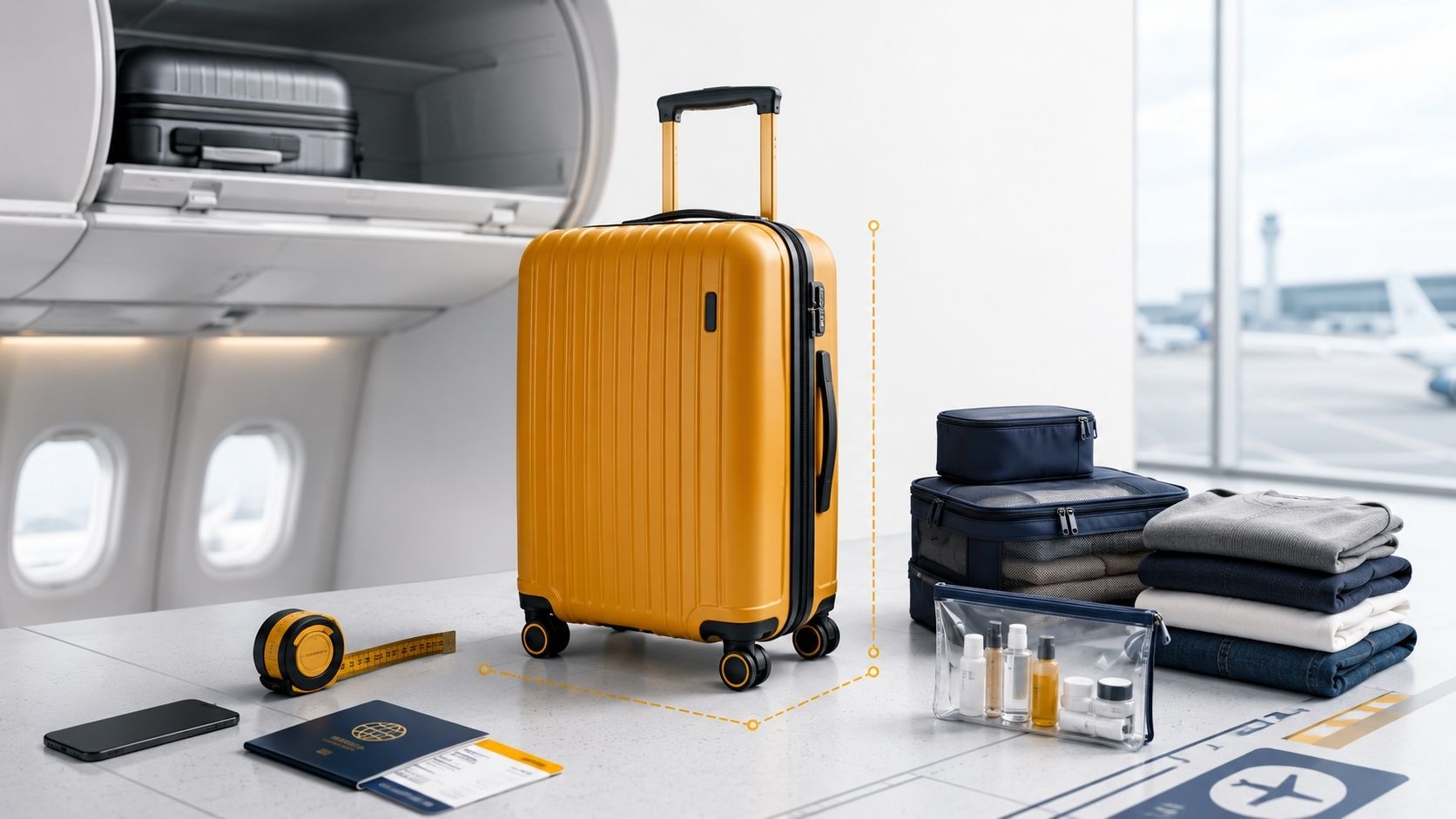
What Defines Carry-On Luggage Through Cabin Placement, Size Limits, and Short-Trip Capacity?
Carry-on luggage is defined by cabin placement, airline size limits, full exterior measurement, and realistic short-trip capacity. It usually travels in the cabin, often in the overhead bin, but the product label alone does not prove airline compliance, packed exterior fit, short-trip usefulness, or protection from gate-check risk.
This article explains why sizing matters, how overhead-bin placement shapes size limits, how hardside, softside, 2-wheel, and 4-wheel formats affect use, how to plan short-trip capacity, how to pack for space and screening access, how to fix gate sizer failures, and which final airport-readiness checklist to use.
Why does carry-on luggage sizing matter before you arrive at the airport?
Carry-on luggage sizing matters before you arrive at the airport because a fully packed bag can fail the gate sizer even when the product label says “carry-on.” A label can describe the product category, but it does not confirm the airline’s current size rule, fare allowance, aircraft storage, or packed exterior dimensions.
The impact can be expensive and inconvenient. Wheels, handles, bulging pockets, and expansion zippers can push the bag beyond an airline limit, and oversized carry-on luggage may need to be gate-checked, delayed, or charged depending on the airline, fare type, route, and aircraft.
The safer solution is to measure the full bag before travel and verify the exact airline rule instead of relying on generic carry-on sizing. Carry-on luggage can support faster airport movement, but only when the packed bag still fits the cabin rule.
How does carry-on luggage placement in overhead bins shape size limits?
Carry-on luggage placement in overhead bins shapes size limits because cabin storage space is finite, aircraft-dependent, and controlled by each airline’s current rules. cabin placement explains why the bag must match the cabin, aircraft, and fare conditions before packing.
Many U.S. airlines commonly use limits around 22 x 14 x 9 inches, often including wheels and handles, but this is not universal. International airlines, low-cost carriers, small aircraft, and different fare classes may use stricter size or weight rules.
The measurement rule is to measure from the bottom of the wheels to the highest point of the top handle, then measure full width and packed depth. overhead-bin fit depends on packed depth, wheels, handles, and available cabin space. carry-on size limits should be checked against the full exterior bag, not just the packing compartment.
| Check | What to Verify |
|---|---|
| Airline rule | Exact carry-on size limit |
| Fare type | Whether carry-on is included |
| Wheels/handles | Whether they count in size |
| Weight limit | Whether weight is enforced |
| Aircraft/route | Whether smaller bins apply |
Which carry-on luggage structure protects short-trip capacity best?
Carry-on luggage structure protects short-trip capacity best when the shell format and wheel system match the traveler’s packing style, route surface, and access needs. Structure affects protection, access, weight, squeeze flexibility, pocket use, wheel exposure, terrain handling, and packing discipline.
When does hardside carry-on luggage work best?
Hardside carry-on luggage works best when structure, impact resistance, cleaner exterior, and dimension control matter more than outer-pocket access. It can be helpful for electronics, neatly compressed clothing, travelers who want a protective shell, and travelers who do not need quick outer-pocket access.
The trade-off is that hardside carry-on luggage usually has fewer exterior pockets, less squeeze flexibility in tight overhead spaces, possible scratches or scuffs, and a need for internal padding around fragile items. A hard shell should not be treated as full protection for everything inside.
When does softside carry-on luggage work best?
Softside carry-on luggage works best when flexibility, outer pockets, expansion panels, and quick access matter more than rigid shell protection. It can be helpful for laptops, documents, jackets, toiletries, last-minute packing changes, and quick-access travel.
The trade-off is that expansion can make the bag too deep for airline sizers, outer pockets can bulge, and fabric can be more exposed to staining, tearing, or moisture. Softside flexibility does not guarantee airline fit.
When does 2-wheel carry-on luggage beat 4-wheel carry-on luggage?
2-wheel carry-on luggage beats 4-wheel carry-on luggage when rougher city routes, recessed wheel protection, and stronger tracking matter more than smooth upright airport glide. Two-wheel rollers usually have more recessed wheels and can control rougher surfaces better.
Four-wheel spinners glide more easily on smooth airport floors and hotel corridors, but they often have more exposed wheels. Rollers are often better for rougher city routes, while spinners are often better for smooth airport-focused travel.
| Format | Best Strength | Main Trade-Off | Best For |
|---|---|---|---|
| Hardside carry-on | Structure and protection | Fewer outer pockets | Fragile or neat packing |
| Softside carry-on | Flexibility and access | Can bulge when packed | Quick-access travel |
| 2-wheel roller | Rough-surface control | Must be pulled | City routes |
| 4-wheel spinner | Smooth upright movement | Exposed wheels | Airports and hotels |
How much short-trip capacity can carry-on luggage realistically hold?
Carry-on luggage can realistically hold short-trip clothing and essentials when the traveler plans outfits, limits shoes, controls toiletries, and avoids using the expansion zipper as the main packing solution. carry-on packing capacity depends on trip length, shoe count, toiletries, clothing bulk, and expansion discipline.
For 1–2 day trips, carry-on luggage can usually handle essentials easily if the traveler avoids unnecessary backup outfits. For 3–5 day trips, it works best with outfit planning, packing cubes, limited shoes, and compact toiletries.
For 5–7 day trips, carry-on luggage can work only with strict packing discipline, laundry planning, and minimal bulky clothing. carry-on short trips work best when the packing list is planned before the bag is filled.
| Trip Length | Carry-On Luggage Strategy | Main Risk |
|---|---|---|
| 1–2 days | Essentials-only packing | Wasted space if poorly organized |
| 3–5 days | Packing cubes + outfit planning | Bulging or overweight bag |
| 5–7 days | Minimal shoes + laundry plan | Overusing expansion zipper |
How should carry-on luggage be packed to maximize space and keep screening items accessible?
Carry-on luggage should be packed by putting dense items near the wheel base, keeping screening items accessible, compressing internally before expanding, and separating quick-access items from packed clothing. These rules protect balance, usable volume, and airport access without treating packing as a guarantee of airline acceptance.
Dense items such as shoes, toiletry kits, chargers, and compact accessories should sit near the bottom wheel side because lower weight placement improves balance and reduces tipping. Packing cubes or compression cubes can save space before the expansion zipper adds external depth.
Liquids should remain accessible where security rules require removal. In U.S. TSA screening, liquids, gels, aerosols, creams, and pastes generally follow the 3-1-1 rule, but that rule should not be treated as a global airport rule without local verification.
Quick-access items such as passport, boarding documents, headphones, laptop, liquids, medication, and chargers should stay in an accessible pocket or personal item when possible. Opening the main compartment at security or the gate can disrupt a tightly packed carry-on.
| Packing Goal | Best Method |
|---|---|
| Save space | Use packing cubes |
| Improve balance | Heavy items near wheels |
| Keep screening items accessible | Liquids and electronics near the top |
| Avoid bulging | Compress internally first |
| Protect fragile items | Cushion inside clothing |
Which carry-on luggage mistakes cause gate sizer failures?
Carry-on luggage mistakes cause gate sizer failures when travelers measure the wrong part of the bag, use expansion depth, allow softside bulging, forget spinner-wheel height, or trust the product label alone. carry-on risk reduction starts with measuring the packed exterior and avoiding zipper or pocket bulge.
Why does measuring only the carry-on luggage compartment cause problems?
Measuring only the carry-on luggage compartment causes problems because wheels, handles, bumpers, pockets, and packed depth may push the full exterior bag beyond the airline’s limit. The packing box can look compliant while the full exterior is too large.
The fix is to measure the full exterior height, width, and depth after packing. Do not use one universal airline dimension as the final standard.
Why does expanding carry-on luggage create sizer risk?
Expanding carry-on luggage creates sizer risk because the expansion zipper can make the bag too deep for the gate sizer or overhead bin. Extra capacity is not useful if the packed exterior fails the airline rule.
The fix is to use internal compression first and close the expansion zipper before measuring. Expansion should be treated as controlled backup space, not free accepted capacity.
Why can overpacking softside carry-on luggage fail the size test?
Overpacking softside carry-on luggage can fail the size test because fabric bulge can push the packed bag beyond the listed depth. Softside flexibility helps packing access, but it does not make a bag automatically compliant.
The fix is to tighten compression straps, remove dense extras, and test the packed shape before leaving for the airport.
Why can spinner carry-on luggage fail height limits?
Spinner carry-on luggage can fail height limits because spinner wheels add height that may count toward the full exterior measurement. The issue is measurement, not that spinner carry-ons are poor choices.
The fix is to measure from the floor to the highest point of the bag, including wheels and handle, after the bag is packed.
| Mistake | Risk | Fix |
|---|---|---|
| Ignoring wheels | Too tall | Measure full height |
| Using expansion zipper | Too deep | Compress internally |
| Bulging softside bag | Fails sizer | Reduce volume |
| Overfilled outer pockets | Too wide/deep | Move items inside |
| Assuming label is enough | Wrong airline fit | Verify airline rule |
Which carry-on luggage checklist should you use before leaving for the airport?
A carry-on luggage checklist should verify airline rules, fare allowance, weight limits, full exterior measurements, packed depth, screening access, balance, and possible gate-check risk before leaving for the airport. carry-on baggage handling risks still matter when a compliant bag is gate-checked because bins are full or aircraft space is limited.
A completed checklist does not replace current airline rules, security rules, product specifications, or gate-agent decisions. It helps prevent avoidable packing, sizing, and access mistakes before travel.
- Confirm your airline’s current carry-on luggage size rule.
- Confirm whether your fare includes a carry-on bag.
- Check whether your airline enforces a carry-on weight limit.
- Measure the full exterior height, including wheels and handles.
- Measure packed width and depth, including pockets and expansion panels.
- Keep expansion zippers closed if they push the bag beyond the limit.
- Match the bag’s realistic capacity to your trip length.
- Pack dense items near the wheel base for better balance.
- Keep liquids accessible where security rules require removal.
- Keep documents, medication, chargers, and valuables easy to reach.
- Confirm the packed bag can stand, roll, and lift comfortably.
- Prepare for possible gate-checking if overhead bins fill or aircraft space is limited.
- Treat “carry-on” product labels as marketing until verified against your airline’s rule.
What should you remember about carry-on luggage?
Carry-on luggage is useful only when the fully packed bag matches the airline’s cabin rules, fare allowance, overhead-bin conditions, short-trip capacity needs, and traveler access requirements. Cabin placement, size limits, full exterior measurement, structure choice, wheel choice, and packing discipline all matter before the bag reaches the airport.
22 x 14 x 9 inches is not universal, carry-on labels are not proof of compliance, and wheels, handles, pockets, and expansion depth can change the real size. TSA 3-1-1 is U.S.-specific, compliant carry-on luggage can still be gate-checked, and the safest choice is the carry-on that matches the airline, fare, aircraft, trip length, and packed exterior size.
Frequently Asked Questions About Carry-On Luggage
What is carry-on luggage?
Carry-on luggage is a cabin bag designed to travel with the passenger, usually in the overhead bin, when the airline’s current size, weight, fare, aircraft, and packed-dimension rules allow it.
Is 22 x 14 x 9 inches the standard carry-on luggage size?
22 x 14 x 9 inches is commonly used by many U.S. airlines, often including wheels and handles, but it is not universal. International airlines, low-cost carriers, small aircraft, and fare rules may use different limits.
Do wheels and handles count in carry-on luggage size?
Wheels and handles may count in carry-on luggage size because many airlines measure the full exterior bag, not only the packing compartment. Travelers should measure from the bottom of the wheels to the highest point of the handle, then check width and packed depth.
Can carry-on luggage still be gate-checked?
Carry-on luggage can still be gate-checked even if it appears compliant when overhead bins are full, the aircraft is small, airline policy requires it, or fare rules restrict cabin bags.
How much can carry-on luggage hold for a short trip?
Carry-on luggage can usually handle 1–2 day trips easily, 3–5 day trips with packing cubes and outfit planning, and sometimes 5–7 day trips with strict packing discipline, laundry planning, and minimal bulky clothing.