What Defines Duffel Luggage Through Frameless Structure, Compression Capacity, and Carry Flexibility?
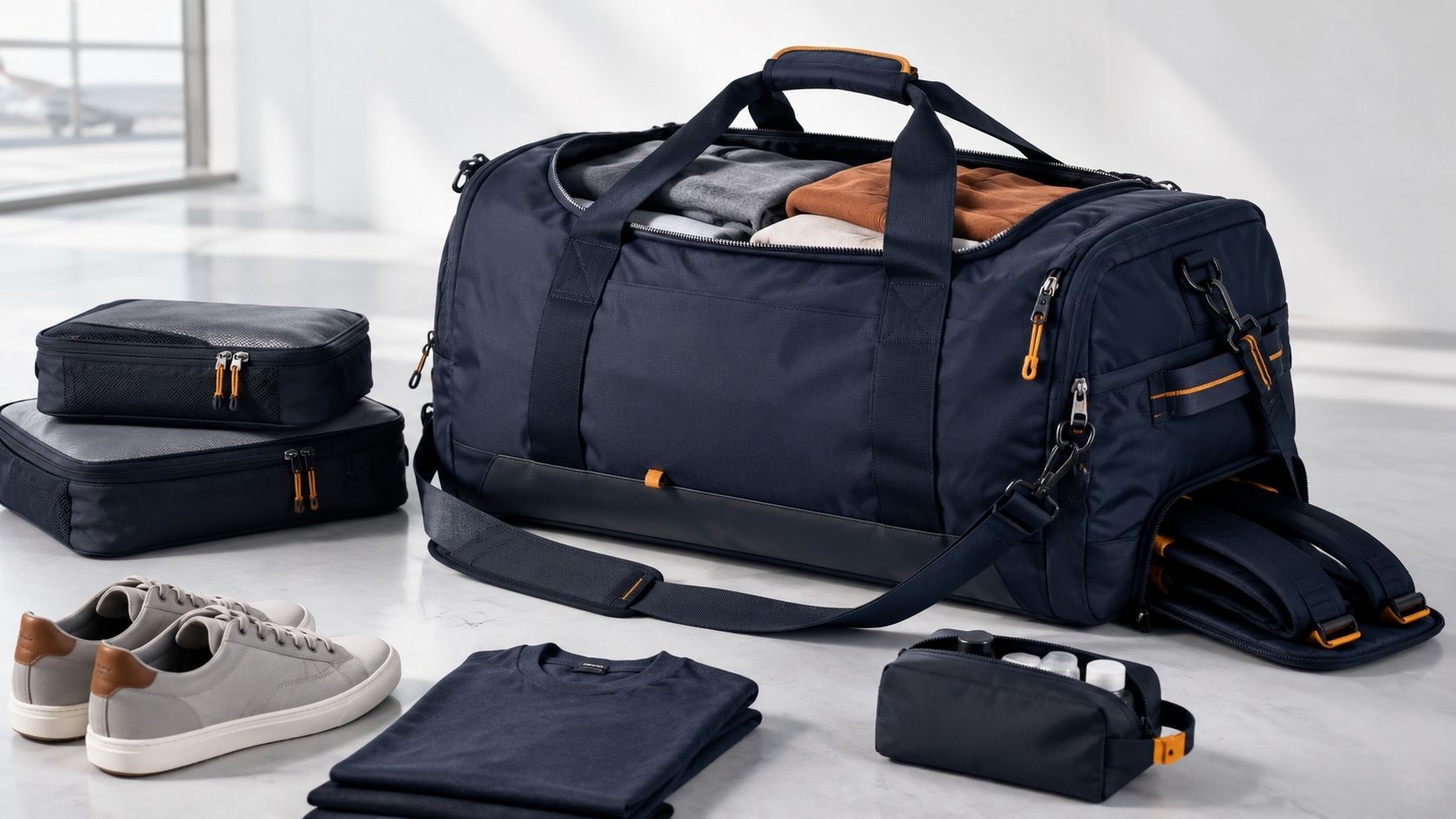
Duffel luggage is defined by a frameless soft body, flexible compression behavior, and multiple carry options that make it useful across irregular travel spaces. Its open main cavity can handle bulky clothing, shoes, soft gear, packing cubes, and mixed travel items more flexibly than many rigid suitcase layouts.
This article explains duffel luggage structure, material and reinforcement checks, compression measurement, carry-style selection, packing zones, mistake prevention, and the final travel checklist for airline and airport use.
Why does duffel luggage matter for flexible packing and irregular storage spaces?
Duffel luggage matters for flexible packing and irregular storage spaces because its soft body can adapt to trunks, lockers, overhead spaces, shared transport, and gear piles better than many rigid bags. Rigid suitcases keep a fixed shape, while duffel luggage can compress slightly when underpacked.
The advantage is flexible storage and movement. storage flexibility helps the bag adapt to trunks, lockers, shared transport spaces, and gear piles, while handles, shoulder straps, backpack straps, or wheels support different mobility needs.
The boundary is that duffel luggage can sag, bulge, become uncomfortable, or fail airline sizing if overloaded. frameless and rigid trade-offs show why flexible storage still needs careful packing control.
| Structure Factor | Duffel Luggage | Rigid Suitcase |
|---|---|---|
| Body shape | Soft and flexible | Fixed and structured |
| Main cavity | Open and adaptable | Compartment-based |
| Compression | Shape can change when packed | Shape mostly fixed |
| Access | Wide top or U-shaped opening | Split or lid opening |
| Main risk | Sagging, bulging, strap strain | Shell cracks, wheel/handle damage |
What structural features make duffel luggage durable for travel use?
Duffel luggage durability depends on the full build: fabric, coating, seams, zippers, handle mounts, strap anchors, base panels, compression buckles, and warranty support. traditional structure explains why the bag relies on fabric, seams, straps, and base support rather than a rigid suitcase frame.
Fabric quality matters, but denier is only one signal and does not prove strength, lifespan, or durability by itself. Buyer checks should include weave, backing, stitching, zipper tracks, D-rings, buckles, compression straps, handle mounts, and reinforced base areas.
Water wording should stay cautious. Use water-resistant, weather-resistant, or water-repellent unless a specific product has verified waterproof construction, because coated fabric does not automatically make zippers, seams, or backing waterproof.
| Feature | Helps With | Watch Out For |
|---|---|---|
| Coated fabric | Moisture resistance | Not always waterproof |
| Reinforced base | Less sagging and abrasion | Added weight |
| Strong haul handles | Better lifting control | Stitching stress |
| Compression straps | Shape control | Buckle strain |
| Protected zippers | Better weather resistance | Still a failure point |
How should duffel luggage compression capacity be measured before airline travel?
Duffel luggage compression capacity should be measured after packing because soft bags change shape with contents, bulging ends, side pockets, handles, wheels, and compression straps. Empty measurements can be misleading when a soft travel bag becomes rounded or overstuffed.
Measure the full packed length, width, and depth, including handles, wheels, side pockets, and bulging ends. traditional compression should control shape after packing, not hide an oversized load.
Keep the ends soft and flexible when airline fit matters, avoid round bulging, and check the airline’s current carry-on, checked-bag, personal-item, or gate-check rule. Compression can improve shape control, but it does not guarantee airline compliance.
Which duffel luggage carrying styles work best across different travel surfaces?
Duffel luggage carrying styles work best when the carry method matches the distance, surface, packed weight, body comfort, and transport mode. carry methods change how the load feels across short transfers, stairs, stations, and vehicle loading.
When does hand-carry duffel luggage work best?
Hand-carry duffel luggage works best for short transfers, car loading, gym use, and quick movement. Heavy loads can strain one hand, wrist, shoulder, or one side of the body, so hand carry should not be treated as a comfort guarantee.
When does shoulder-strap duffel luggage work best?
Shoulder-strap duffel luggage works best for short walks, taxis, train boarding, and quick transfers when one free hand matters. Long carries can create one-sided shoulder strain if the bag is heavy or poorly balanced.
When does backpack-style duffel luggage work best?
Backpack-style duffel luggage works best for stairs, rough paths, station transfers, and hands-free movement. Comfort depends on padding, strap shape, torso fit, and total packed weight.
When does wheeled duffel luggage work best?
Wheeled duffel luggage works best for airports, hotels, smooth sidewalks, and heavy gear loads where rolling reduces hand-carry demand. mobility components make wheels, handles, and base structure part of the travel-surface decision.
The warning is that wheels and handles add weight and can struggle on stairs, gravel, sand, and rough ground.
| Carry Style | Best For | Main Risk |
|---|---|---|
| Hand carry | Short transfers | Arm strain |
| Shoulder strap | Quick movement | One-sided load |
| Backpack straps | Stairs and stations | Back comfort varies |
| Wheeled duffel | Heavy airport travel | Wheel/handle failure |
| Grab handles | Loading vehicles | Poor for long distance |
How should duffel luggage be packed to protect gear and control sagging?
Duffel luggage should be packed with dense items along the base, fragile items in the padded center, soft items at the ends, access items near the top, and loose straps secured.
The base or center spine should hold shoes, dense gear, and compact pouches to reduce sagging. Fragile items should sit inside the center core wrapped in clothing or padded organizers, while soft clothing at the ends helps control compression.
Travel documents, chargers, snacks, and small essentials can stay near the top or exterior pocket if the bag has one. Loose straps, buckle tails, and backpack straps should be tucked or clipped because they can snag on conveyors, doors, handles, or vehicle cargo areas.
| Zone | Best Items | Purpose |
|---|---|---|
| Base/spine | Shoes, dense gear | Reduce sagging |
| Center core | Fragile items wrapped in clothes | Impact buffering |
| Ends | Soft clothing | Compression control |
| Top/exterior pocket | Documents, chargers, snacks | Quick access |
| Strap area | Tucked straps, clipped buckles | Snag prevention |
How can duffel luggage mistakes be avoided when weight, straps, and airline rules create risk?
Duffel luggage mistakes can be avoided by controlling packed shape, switching carry methods, securing straps, protecting fabric walls, and measuring the full bag against airline rules. adaptability limits appear when wheels, handles, and soft bodies meet stairs, gravel, sand, or rough ground.
How can overloaded duffel luggage be corrected?
Overloaded duffel luggage can be corrected by removing non-essential items, flattening clothing layers, and using packing cubes to control shape. The result is a bag that becomes easier to carry, measure, and fit.
How can duffel luggage strap strain be reduced?
Duffel luggage strap strain can be reduced by switching carry sides, using backpack straps when available, or choosing wheeled duffel luggage for heavier loads. The result is load stress distributed more evenly.
How can rolling duffel luggage handling problems be reduced?
Rolling duffel luggage handling problems can be reduced by slowing down, lifting over sharp edges, and avoiding surfaces the wheels are not designed for. The result is less stress on wheels, handles, and fabric corners.
How can airline-size problems with duffel luggage be reduced?
Airline-size problems with duffel luggage can be reduced by measuring the packed bag instead of assuming a soft bag automatically fits. The result is a bag less likely to create check-in, gate, or boarding problems.
How can fabric damage in duffel luggage be reduced?
Fabric damage in duffel luggage can be reduced by wrapping hard edges, using internal organizers, and keeping sharp or rigid gear away from fabric walls. The result is less rubbing and puncture stress on fabric panels, seams, and coatings.
| Mistake | Safer Fix | Main Benefit |
|---|---|---|
| Overstuffing | Remove excess and flatten load | Better shape |
| One-shoulder overload | Switch carry method | Less strain |
| Loose straps | Tuck or secure straps | Less snag risk |
| Sharp gear at edge | Wrap or reposition | Less fabric stress |
| Assuming airline fit | Measure packed bag | Fewer travel surprises |
Which duffel luggage checklist should you complete before airport travel?
A duffel luggage checklist should verify packed size, airline rule, weight, shape control, fabric safety, strap security, handle condition, essential access, and manufacturer care guidance before airport travel.
This checklist does not guarantee airline compliance, waterproofing, comfort, or durability. It helps reduce avoidable bulging, strap strain, snag risk, sizing surprises, and fabric stress before travel.
- Measure the duffel luggage when fully packed.
- Check the airline’s current carry-on, personal-item, or checked-bag rule.
- Weigh the bag if airline weight limits apply.
- Keep the packed shape flat enough to measure clearly.
- Avoid round bulging at the sides or ends.
- Keep hard or sharp items away from outer fabric walls.
- Wrap fragile items in soft clothing or padded organizers.
- Place dense items near the base or center spine.
- Use compression straps to stabilize shape, not hide overpacking.
- Tuck loose shoulder straps, backpack straps, and compression strap tails.
- Check handle stitching, D-rings, buckles, and zipper tracks.
- Keep travel documents, medication, valuables, and essential electronics outside any bag that may be checked.
- Dry the bag fully before storage if it has been exposed to rain or moisture.
- Review manufacturer guidance before washing, treating, or repairing the fabric.
What should you remember about duffel luggage?
Duffel luggage works best when its frameless structure, compression behavior, carry method, packed shape, strap control, and fabric durability match the trip. Its strength is flexible packing and movement across irregular spaces, not guaranteed airline fit or waterproof protection.
The safest approach is to measure the bag fully packed, control bulging with realistic compression, secure straps, protect fabric walls from hard edges, and follow manufacturer guidance before washing, treating, repairing, or replacing hardware.
Frequently Asked Questions About Duffel Luggage
What is duffel luggage?
Duffel luggage is soft-sided travel luggage with a frameless or semi-soft body, open main cavity, flexible packing behavior, and carry options such as handles, shoulder straps, backpack straps, or wheels.
Is duffel luggage better than a suitcase?
Duffel luggage is better when flexible packing, irregular storage, bulky gear, and multiple carry methods matter most. A suitcase is better when rigid structure, wheeled stability, and compartment organization matter more.
Can duffel luggage be used as carry-on luggage?
Duffel luggage can be used as carry-on luggage only when its fully packed size matches the airline’s current rule. Soft compression does not guarantee carry-on compliance, so the packed bag should be measured before travel.
Is duffel luggage waterproof?
Duffel luggage is not waterproof unless the product has verified waterproof construction. Many duffel bags may be water-resistant, weather-resistant, or water-repellent, but zippers, seams, fabric backing, and coatings still need product-specific verification.
Is wheeled duffel luggage better than non-wheeled duffel luggage?
Wheeled duffel luggage is better for heavy airport or hotel movement on smooth surfaces, while non-wheeled duffel luggage is better for flexible storage, vehicle loading, stairs, and rougher routes where wheels may struggle.